
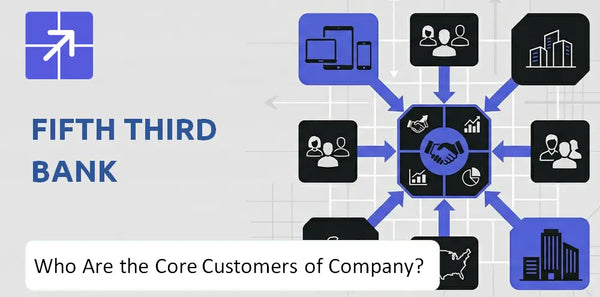
Who are Fifth Third Bank's core customers in its Midwest and Southeast target markets?
Fifth Third Bank focuses on middle-market commercial clients, high-growth SMEs, and affluent retail customers in Midwest and expanding Southeast corridors. This matters because the bank targets a 16 to 18 percent return on tangible common equity in 2025, driven by regional expansion and commercial lending signals.
Prioritize commercial banking products, treasury services, and wealth management to capture migrating businesses and affluent households; see Fifth Third Bank BCG Matrix Analysis for portfolio implications.
Who Is Fifth Third Bank Trying to Win?
Fifth Third Bank tries to win middle-market commercial firms with revenues of 20 million to 500 million dollars, plus mass-affluent retail households and sector-focused institutional clients in healthcare, renewable energy, and technology.
 Core commercial clients
Fifth Third Bank targets middle-market commercial enterprises because they drive lending volume and fee income; commercial banking made up approximately 60 percent of the total loan portfolio as of early 2026.
Secondary retail and institutional segments
Secondary targets are mass-affluent retail banking customers with investable assets of 100,000 to 1 million dollars, plus healthcare, renewable energy, and technology institutional clients for specialized lending and treasury services.
Customer type and market role
Fifth Third Bank serves a mixed base: commercial banking clients (businesses) plus retail banking customers and wealth management clients; commercial loans and deposit account holders together shape revenue and balance-sheet risk.
Most important segment by impact
The middle-market commercial segment is most important by scale and usage, driving lending concentration and fee income; capture in Sunbelt metros among young professionals and families supports cross-sell of mortgages, deposits, and wealth services. See Mission, Vision, and Values of Fifth Third Bank Company
Fifth Third Bank SWOT Analysis
- Complete SWOT Breakdown
- Fully Customizable
- Editable in Excel & Word
- Professional Formatting
- Investor-Ready Format

What Do Fifth Third Bank's Customers Care About Most?
Fifth Third Bank customers prioritize seamless digital tools plus high-touch advice; commercial clients want certainty on execution and treasury access, while retail and wealth management clients seek personalized financial wellness and omnichannel convenience.

Execution certainty for commercial clients
Commercial banking clients need predictable execution on deals, hedges, and lending as interest-rate volatility persists in 2025; they expect industry-specific expertise for sectors like CRE, healthcare, and manufacturing.
Practical buying drivers: capital access and treasury
Small business banking clients and larger commercial customers choose Fifth Third for capital markets access, treasury management, and scalable credit lines that replicate money-center bank capabilities at regional price points.
Emotional appeal: financial confidence and partnership
Wealth management clients and retail banking customers value the 5/3 Better-Off proposition for sense of security and long-term partnership – feeling guided in planning, not sold to.
What customers value most: omnichannel seamlessness
Retail banking customers demand a top-tier mobile app for daily transactions and remote servicing while expecting local, expert advisors for mortgages, wealth planning, and complex credit needs.
Loyalty drivers: advisory relationships and product breadth
Repeat demand is supported by integrated advice, competitive deposit and lending rates, and digital engagement – keeping deposit account holders and wealth clients within the ecosystem.
Why customers choose Fifth Third Bank
Fifth Third Bank customers pick the bank for combined digital capability and local relationship management, plus access to capital markets and treasury solutions historically offered by larger banks; see Ownership and Control of Fifth Third Bank Company for context.
Fifth Third Bank Business Model Canvas
- One-time Payment
- No Research Needed – Save Hours of Work
- Built by Experts, Trusted by Consultants
- Instant Download, Ready to Use
- 100% Editable, Fully Customizable

Where Is Demand Strongest for Fifth Third Bank?
Demand for Fifth Third Bank customers is strongest in the Southeast – notably Charlotte, Nashville, and the Florida peninsula – where loan and deposit growth outpaces the Midwest and digital engagement is highest.
Main Southeast Urban Hubs
Fifth Third target market concentrates in Southeast metros where population and business formation rose fastest; Q1 2026 loan and deposit growth in these markets ran at nearly 2x the Midwest pace, driven by urban retail banking customers and small business banking clients.
Secondary Markets and Vertical Hotspots
Secondary demand is material across the Florida peninsula and expanding healthcare and renewable energy verticals; Fifth Third Bank customer segments include middle – market healthcare providers and renewable project developers using the Dividend Finance platform.
Where Fifth Third Bank Is Strongest
Fifth Third Bank is strongest in retail deposits and digital engagement: mobile active users represent over 78% of the retail base as of Q1 2026, and the bank holds leading share in specialized physician-practice financing among Fifth Third Bank customer segments.
Where Demand Is Growing Fastest
Demand is accelerating in digital channels and in Southeast urban markets in 2025/2026, plus commercial demand from renewable energy and healthcare finance; see Growth Outlook of Fifth Third Bank Company for related performance and regional metrics: Growth Outlook of Fifth Third Bank Company
Fifth Third Bank Marketing Mix
- Complete Marketing Mix Analysis
- Effortlessly Communicate Your Business Strategy
- Investor-Ready Format
- 100% Editable and Customizable
- Clear and Structured Layout

How Does Fifth Third Bank Keep Its Audience Growing?
Fifth Third Bank keeps its audience growing through targeted branch expansion in high-density, migration-heavy markets and fintech integrations that lower customer acquisition costs while boosting cross-sell into wealth and treasury products.
Branch and Digital Expansion to Reach Adjacent Segments
Fifth Third Bank customers expand via organic branch openings in urban/suburban corridors and partnerships with fintechs to reach digital-first millennials and student and young adult customers; branch density targets migration-heavy metros to capture mortgage borrowers and small business banking clients.
Customer Retention Drivers
Retention hinges on treasury management stickiness for commercial banking clients, high-switching-cost business services, and relationship banking; core commercial relationship retention exceeds 92 percent, limiting churn among small business owners and high net worth clients.
Loyalty, Repeat Demand, and Customer Depth
Advanced data analytics identify cross-sell paths from retail banking customers to wealth management clients; assets under management rose 12 percent year-over-year in 2025 as retail deposit account holders moved into fee-based wealth products, increasing customer lifetime value.
Strongest Growth Lever in 2025/2026
The key lever is pivoting to fee-based income (wealth and treasury) combined with concentration in migration-heavy markets, which provides a durable buffer against net interest margin pressure and positions Fifth Third to outperform peers; see Sales and Marketing Strategy of Fifth Third Bank Company for channel tactics: Sales and Marketing Strategy of Fifth Third Bank Company
Fifth Third Bank Boston Consulting Group Matrix
- Built by Experts, Trusted by Consultants
- Structured for Consultants, Students, and Founders
- 100% Editable in Microsoft Word & Excel
- Instant Digital Download – Use Immediately
- Compatible with Mac & PC – Fully Unlocked

Related Blogs
- What Is the History of Fifth Third Bank Company and How Did It Evolve?
- What Is the Competitive Landscape of Fifth Third Bank Company and How Does It Compete?
- What Is the Growth Outlook of Fifth Third Bank Company and Where Is It Heading?
- How Does Fifth Third Bank Company Work and What Drives Its Business Model?
- How Does Fifth Third Bank Company Reach Customers and Turn Demand into Sales?
- What Do the Mission, Vision, and Core Values of Fifth Third Bank Company Reveal?
- Who Owns Fifth Third Bank Company Today and Who Holds Control?
Frequently Asked Questions
Fifth Third Bank's core customers are middle-market commercial firms, especially businesses with revenues of 20 million to 500 million dollars. The bank also serves mass-affluent retail households and sector-focused institutional clients in healthcare, renewable energy, and technology.
Disclaimer
All information, articles, and product details provided on this website are for general informational and educational purposes only. We do not claim any ownership over, nor do we intend to infringe upon, any trademarks, copyrights, logos, brand names, or other intellectual property mentioned or depicted on this site. Such intellectual property remains the property of its respective owners, and any references here are made solely for identification or informational purposes, without implying any affiliation, endorsement, or partnership.
We make no representations or warranties, express or implied, regarding the accuracy, completeness, or suitability of any content or products presented. Nothing on this website should be construed as legal, tax, investment, financial, medical, or other professional advice. In addition, no part of this site - including articles or product references - constitutes a solicitation, recommendation, endorsement, advertisement, or offer to buy or sell any securities, franchises, or other financial instruments, particularly in jurisdictions where such activity would be unlawful.
All content is of a general nature and may not address the specific circumstances of any individual or entity. It is not a substitute for professional advice or services. Any actions you take based on the information provided here are strictly at your own risk. You accept full responsibility for any decisions or outcomes arising from your use of this website and agree to release us from any liability in connection with your use of, or reliance upon, the content or products found herein.