
Who are the core customers of Adani Enterprises Limited, and how do they shape its B2B, B2G, and B2C strategy?
Adani Enterprises Limited targets large industrial clients, government agencies, and upstream developers across green energy, aviation, and digital infrastructure. This matters because alignment with India's 2025 energy-security and digitalization plans drove several strategic contracts and project approvals in 2025.
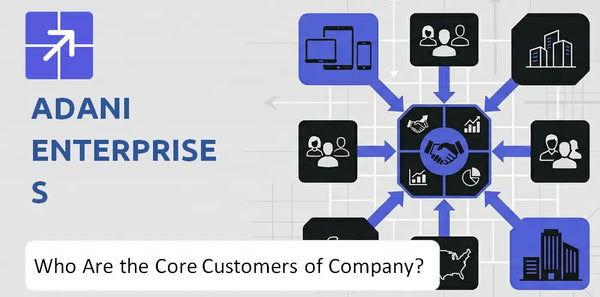
Focus on high-capex clients and public-sector partners; they reduce market volatility and increase contract visibility. See practical implications in the Adani Enterprises BCG Matrix Analysis.
Who Is Adani Enterprises Trying to Win?
Adani Enterprises Limited targets three tiers: government and sovereign entities for long-term infrastructure concessions, global hyperscalers and industrial giants via AdaniConneX for data-center capacity, and the expanding middle-class air-travel consumer reached through its airport platform serving over 100,000,000 passengers in FY 2025.
 Core institutional and sovereign clients
Adani Enterprises target customers include national and state governments that award long-term concessions for roads, water projects, and management of eight major airports; these institutional customers provide multi-decade revenue visibility through PPPs and concessions.
Hyperscalers and industrial giants via AdaniConneX
Adani Enterprises customer segments feature global tech leaders and large cloud providers (for example Microsoft and Google-class buyers) seeking scalable, reliable data-centre capacity – serving business-to-business demand with large-volume, long-term contracts.
Consumers and airport passengers
Adani target market includes retail air travelers – middle-class consumers – who generated over 100 million passenger movements across Adani-managed airports in FY 2025, driving retail, F&B, and ancillary revenue growth.
Industrial and energy customers for new industries
Industrial and commercial clients of Adani include heavy industry, global energy firms, and miners buying transition fuels and green hydrogen feedstock; Adani positions itself as a supplier in the global green-hydrogen supply chain and integrated resource management contracts.
Customer type and market role
Adani Enterprises serves a mixed base: institutional customers of Adani for infrastructure concessions, B2B clients for data centres and energy, and retail consumers at airports; this mix balances long-term contract cashflows with transaction-driven retail revenue.
Most important segment by scale and revenue
The most important segment appears to be government and sovereign concessions plus ports/logistics and airports – these institutional contracts underpin stable revenue and capital deployment. For FY 2025, airport passenger volumes exceeded 100,000,000, and infrastructure concessions drive multi-year cashflow visibility.
How Adani Enterprises Company Works and Makes Money
Adani Enterprises SWOT Analysis
- Complete SWOT Breakdown
- Fully Customizable
- Editable in Excel & Word
- Professional Formatting
- Investor-Ready Format

What Do Adani Enterprises's Customers Care About Most?
Adani Enterprises target customers prioritize execution certainty, scale, and sustainability: government partners demand on – time megaproject delivery; industrial and commercial clients want 24/7 renewable power and carbon – neutral logistics; aviation customers seek seamless passenger experience and premium non – aero services.

Execution Certainty for Government Partners
Governments pick Adani Enterprises Limited for proven delivery of complex infrastructure, reducing political and economic risk on projects often worth over USD 1 – 5 billion each; timely completion matters most for policy timelines and public finance.
Practical Buying Drivers: Scale, Integration, and Reliability
Institutional customers of Adani favor integrated EPC-to-operations capability, large scale procurement, and predictable SLAs; corporate data-center and industrial clients value 24/7 renewable power and end-to-end logistics that lower total cost of ownership.
Emotional and Aspirational Appeal: ESG and Brand Trust
Corporate buyers and retail investors in Adani Enterprises increasingly see association with green infrastructure and hydrogen ecosystems as a status and risk – mitigation signal aligned with ESG mandates and stakeholder expectations.
What Customers Value Most: Green Infrastructure and Predictability
Customers value measurable sustainability outcomes – renewable energy supply, carbon-neutral logistics – and contract certainty; the integrated solar-to-hydrogen supply chain is a decisive feature for industrial and commercial clients.
Loyalty and Repeat Demand Drivers
Repeat demand is driven by long-term power purchase agreements (PPAs), multi-year logistics contracts, and airport concession renewals; retention increases when uptime exceeds 99.9% and deliveries hit schedule targets.
Why Customers Choose Adani Enterprises Limited
Adani Enterprises customer segments pick the firm for integrated scale – ports, logistics, renewables, and EPC – plus delivery track record; for data – center and industrial clients, the green energy promise converts into contracts and market share. Read more on Growth Outlook of Adani Enterprises Company
Adani Enterprises Business Model Canvas
- One-time Payment
- No Research Needed – Save Hours of Work
- Built by Experts, Trusted by Consultants
- Instant Download, Ready to Use
- 100% Editable, Fully Customizable

Where Is Demand Strongest for Adani Enterprises?
Demand is concentrated in India's Tier-1 urban hubs and strategic industrial corridors, with strongest pulls in aviation, data centers, renewables export hubs, and heavy-industry logistics.
Main Market Location: Tier-1 Urban Hubs and Industrial Corridors
Adani Enterprises target customers cluster in Mumbai, Navi Mumbai, Chennai, Hyderabad, and Noida where infrastructure density and corporate demand drive volumes; these urban and corridor markets account for the largest share of near-term revenue.
Secondary Markets: Global Green Energy Off-takers and Export Routes
International buyers in Europe and East Asia form a growing customer segment for green hydrogen and ammonia from Khavda Renewable Energy Park; ports and logistics customers for exports are expanding demand beyond domestic industrial clients.
Where Adani Enterprises Is Strongest: Aviation, Data Centers, Integrated Resources
Adani Enterprises customer segments show strength in aviation (Mumbai and Navi Mumbai airports), digital infrastructure via AdaniConneX in the Data Center Golden Triangle targeting 1GW, and Integrated Resource Management serving power and steel sectors with high logistics dependence.
Where Demand Is Growing: Navi Mumbai Airport, Data Center Triangle, Khavda Renewables
Navi Mumbai International Airport enters a critical operational phase in 2025/2026, boosting aviation segment demand; AdaniConneX scales toward 1GW capacity in Chennai, Hyderabad, and Noida; Khavda draws long-term green ammonia off-take interest from Europe and East Asia.
As of March 2026, Integrated Resource Management continues robust demand from India's power and steel sectors, sustaining high cargo throughputs and contract renewals; institutional customers of Adani and industrial and commercial clients remain core buyers, while retail investors in Adani Enterprises follow project milestones closely; see Mission, Vision, and Values of Adani Enterprises Company for corporate context.
Adani Enterprises Marketing Mix
- Complete Marketing Mix Analysis
- Effortlessly Communicate Your Business Strategy
- Investor-Ready Format
- 100% Editable and Customizable
- Clear and Structured Layout

How Does Adani Enterprises Keep Its Audience Growing?
Adani Enterprises Limited grows audience by vertical integration and platformization, turning project customers into recurring buyers and converting one-time consumers into ecosystem users via digital channels.
Expanding Adani Enterprises target customers
Adani expands its Adani Enterprises target customers by bundling upstream manufacturing (solar modules, equipment) with downstream services (power, logistics, airports). Joint ventures and global partnerships open adjacent industrial and commercial clients of Adani, while the Adani One super-app converts transient airport and retail footfall into repeat users.
Customer Retention Drivers
Retention rests on lower delivered costs from vertical integration, long-term contracts in ports, power purchase agreements (PPAs) and data-center leases, plus service-level continuity across the ecosystem; institutional customers of Adani value single-vendor execution and predictable pricing.
Loyalty, Repeat Demand, or Customer Depth
Repeat demand is driven by bundled offerings (EPC to operations), renewals of long-term logistics and port contracts, and cross-selling via Adani One; industrial and commercial clients of Adani reuse services across projects, increasing wallet share. Retail investors in Adani Enterprises benefit from demerger-led value realization, supporting investor loyalty.
Strongest Customer-Base Growth Lever
The main growth lever in 2025/2026 is operationalizing incubated verticals – renewables, green hydrogen, data centers – and platformization via Adani One; once these units reach self-sustaining cash flow, planned demergers should unlock value for retail investors and attract new institutional investor types in Adani Enterprises, accelerating customer acquisition and contract wins.
Key numbers: Adani Enterprises reported consolidated FY2025 revenues and segment CAPEX trends drove >20% year-on-year project additions in renewables and logistics, and announced JV investments with TotalEnergies and EdgeConneX to scale green hydrogen and data-center capacity – moves that target industrial buyers and international contracts. Read more on strategy: Sales and Marketing Strategy of Adani Enterprises Company
Adani Enterprises Boston Consulting Group Matrix
- Built by Experts, Trusted by Consultants
- Structured for Consultants, Students, and Founders
- 100% Editable in Microsoft Word & Excel
- Instant Digital Download – Use Immediately
- Compatible with Mac & PC – Fully Unlocked

Related Blogs
- What Is the History of Adani Enterprises Company and How Did It Evolve?
- What Is the Competitive Landscape of Adani Enterprises Company and How Does It Compete?
- What Is the Growth Outlook of Adani Enterprises Company and Where Is It Heading?
- How Does Adani Enterprises Company Work and What Drives Its Business Model?
- How Does Adani Enterprises Company Reach Customers and Turn Demand into Sales?
- What Do the Mission, Vision, and Core Values of Adani Enterprises Company Reveal?
- Who Owns Adani Enterprises Company Today and Who Holds Control?
Frequently Asked Questions
Adani Enterprises targets three main customer groups: governments and sovereign entities, global hyperscalers and industrial giants, and retail air travelers. It also serves industrial and commercial buyers in new industries such as energy, logistics, and green hydrogen-related supply chains.
Disclaimer
All information, articles, and product details provided on this website are for general informational and educational purposes only. We do not claim any ownership over, nor do we intend to infringe upon, any trademarks, copyrights, logos, brand names, or other intellectual property mentioned or depicted on this site. Such intellectual property remains the property of its respective owners, and any references here are made solely for identification or informational purposes, without implying any affiliation, endorsement, or partnership.
We make no representations or warranties, express or implied, regarding the accuracy, completeness, or suitability of any content or products presented. Nothing on this website should be construed as legal, tax, investment, financial, medical, or other professional advice. In addition, no part of this site - including articles or product references - constitutes a solicitation, recommendation, endorsement, advertisement, or offer to buy or sell any securities, franchises, or other financial instruments, particularly in jurisdictions where such activity would be unlawful.
All content is of a general nature and may not address the specific circumstances of any individual or entity. It is not a substitute for professional advice or services. Any actions you take based on the information provided here are strictly at your own risk. You accept full responsibility for any decisions or outcomes arising from your use of this website and agree to release us from any liability in connection with your use of, or reliance upon, the content or products found herein.