
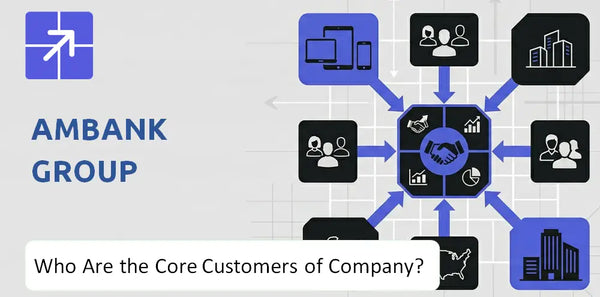
Who are AmBank Group's core customers in Malaysia's retail, SME, and wholesale markets?
AmBank Group targets salaried urban consumers, growth-stage SMEs, and corporate clients seeking transaction banking and risk solutions. This matters because the group aims for a 10 – 12% return on equity in the 2025/2026 fiscal period, driven by digital transformation and fee-income growth.
Prioritize digital SME lending, premium retail segments, and corporate treasury services to boost margins and reduce cost-to-income ratios; see AmBank Group BCG Matrix Analysis.
Who Is AmBank Group Trying to Win?
AmBank Group tries to win Mass Affluent and Emerging Affluent retail customers, SMEs in manufacturing and services, and Mid-to-Large Corporates/GLCs; it also recruits Gen Z and Millennials via digital channels.
 Main customer group: Mass Affluent and Emerging Affluent
AmBank target customers focus on the Mass Affluent and Emerging Affluent who demand wealth management, mortgages, and advisory services; this segment drove an estimated 30% of retail revenue in 2025 and underpins fee income growth.
Secondary customer groups: SMEs and digital youth
SME banking customers – especially manufacturing and services firms – are targeted for trade finance and payroll solutions, contributing roughly 25% of lending volumes in 2025; Gen Z and Millennial digital banking users are cultivated via wealth and insurance platforms to expand future retail deposits.
Customer type and market role: mixed consumer and institutional focus
AmBank Group clientele spans retail banking customers, SME banking customers, and corporate banking clients; wholesale banking and debt capital market activity served institutional deals totaling about RM12 billion in 2025 syndications and underwriting fees.
Most important segment: SME and corporate lending
By balance-sheet impact, SME and corporate banking remain most important – business lending accounted for roughly 45% of net loans outstanding at end – FY2025 – while affluent retail is strategically vital for higher-margin fee income.
Sales and Marketing Strategy of AmBank Group Company
AmBank Group SWOT Analysis
- Complete SWOT Breakdown
- Fully Customizable
- Editable in Excel & Word
- Professional Formatting
- Investor-Ready Format

What Do AmBank Group's Customers Care About Most?
AmBank Group customers prioritize digital reliability, capital efficiency, and sustainable finance; retail users want frictionless mobile banking, while SME and corporate clients focus on cost of capital and fast trade disbursements in a projected 3.00 percent OPR environment, plus growing demand for ESG-linked lending tied to AmBank Group's RM20 billion sustainable finance portfolio.

Frictionless digital access and uptime
Retail banking customers seek 24/7 mobile reliability; over 50 percent of transactions now occur via mobile interfaces, so instant credit decisions and near-zero downtime are table stakes.
Cost of capital and speed of funding
SME banking customers and corporate banking clients prioritize lower financing costs and same-day trade facility disbursement, especially with a projected OPR of 3.00 percent affecting borrowing economics.
ESG alignment and sustainable finance
Corporate clients increasingly demand ESG-linked financing to meet Malaysia's decarbonization goals; many prefer lenders with sizeable sustainability books, such as AmBank Group's History and Background of AmBank Group Company noting a RM20 billion sustainable finance commitment.
Convenience, price, and integrated services
Practical buying drivers include competitive pricing, seamless digital payments, and bundled services (treasury, cash management, and trade) that reduce working capital needs for SMEs and corporates.
Reputation, trust, and stability
Emotional appeal centers on trust and reputation; affluent and high net worth customer segments value a stable banking partner with clear sustainability credentials and reliable digital channels.
Retention drivers and repeat usage
High retention comes from fast service delivery, predictable pricing tied to OPR moves, and ESG-linked products that help corporate clients meet regulatory and investor expectations.
Why AmBank Group wins target customers
AmBank Group's mix of robust digital adoption (mobile-first retail banking), competitive trade and lending execution for SMEs/corporates, and a RM20 billion sustainable finance portfolio aligns with the priorities of AmBank target customers and AmBank customer segments across Malaysia.
AmBank Group Business Model Canvas
- One-time Payment
- No Research Needed – Save Hours of Work
- Built by Experts, Trusted by Consultants
- Instant Download, Ready to Use
- 100% Editable, Fully Customizable

Where Is Demand Strongest for AmBank Group?
Demand for AmBank Group Company concentrates in Malaysia's Klang Valley, Penang, and the Johor-Singapore Special Economic Zone, driven by industrial expansion and infrastructure projects; digital channels AmAccess Biz and AmOnline show the strongest user activity.
Main Market Location: Klang Valley, Penang, Johor-Singapore SEZ
These high-growth industrial hubs account for the bulk of AmBank target customers, reflecting concentrated corporate lending and infrastructure financing tied to the New Industrial Master Plan 2030 and National Energy Transition Roadmap.
Secondary Markets: Regional Manufacturing Clusters and Renewables
Penang's electronics cluster and Johor's export-oriented manufacturers are growing borrowers; renewable energy projects across Malaysia are expanding the AmBank Group clientele in project finance and asset-backed lending.
Where AmBank Is Strongest: Digital Channels and Corporate Lending
AmAccess Biz and AmOnline saw a 20 percent year-on-year rise in active engagement, and corporate banking clients in manufacturing and energy make up the fastest-growing loan books by volume in 2025.
Where Demand Is Growing Fastest: Manufacturing & Renewable Energy
Loan growth in manufacturing and renewable energy accelerated in 2025 as firms upgrade plants and adopt green tech under the National Energy Transition Roadmap; SME banking customers in supply chains also show rising credit demand.
For market context and competitive positioning, see Competitive Landscape of AmBank Group Company
AmBank Group Marketing Mix
- Complete Marketing Mix Analysis
- Effortlessly Communicate Your Business Strategy
- Investor-Ready Format
- 100% Editable and Customizable
- Clear and Structured Layout

How Does AmBank Group Keep Its Audience Growing?
AmBank Group grows its audience by cross-selling banking, AmMetLife insurance, and asset management to raise products-per-customer to 3.2 in 2025, using data-driven personalization and a Focus 8 capital strategy to reach adjacent segments and improve retention.
Expanding customer base via integrated offerings
AmBank target customers expand through bundled offers across retail banking, SME banking customers, and wealth management, driving new acquisitions from millennial and Gen Z digital banking users and small business banking customer personas.
Customer retention drivers
Retention hinges on predictive analytics and hyper-personalization that lower churn by an estimated 12 percent, timely refinancing and investment prompts, and targeted SME and corporate banking client programs.
Loyalty, repeat demand, and customer depth
Cross-selling and loyalty mechanics increase repeat demand and ecosystem stickiness: average products-per-customer rose to 3.2, boosting fee income from digital channels and wealth management for affluent and high net worth customer segments.
Strongest growth lever in 2025/2026
The key lever is integrated cross-selling supported by data analytics and Focus 8 capital allocation, preserving a CET1 ratio above 13 percent while capturing Malaysia's projected GDP growth of 4.7 percent to lift high-margin digital fee income.
For deeper operational and revenue context see How AmBank Group Company Works and Makes Money
AmBank Group Boston Consulting Group Matrix
- Built by Experts, Trusted by Consultants
- Structured for Consultants, Students, and Founders
- 100% Editable in Microsoft Word & Excel
- Instant Digital Download – Use Immediately
- Compatible with Mac & PC – Fully Unlocked

Related Blogs
- What Is the History of AmBank Group Company and How Did It Evolve?
- What Is the Competitive Landscape of AmBank Group Company and How Does It Compete?
- What Is the Growth Outlook of AmBank Group Company and Where Is It Heading?
- How Does AmBank Group Company Work and What Drives Its Business Model?
- How Does AmBank Group Company Reach Customers and Turn Demand into Sales?
- What Do the Mission, Vision, and Core Values of AmBank Group Company Reveal?
- Who Owns AmBank Group Company Today and Who Holds Control?
Frequently Asked Questions
AmBank Group's core customers are Mass Affluent and Emerging Affluent retail customers, SMEs in manufacturing and services, and Mid-to-Large Corporates and GLCs. The article also notes that Gen Z and Millennials are being recruited through digital channels to build future retail deposits and engagement.
Disclaimer
All information, articles, and product details provided on this website are for general informational and educational purposes only. We do not claim any ownership over, nor do we intend to infringe upon, any trademarks, copyrights, logos, brand names, or other intellectual property mentioned or depicted on this site. Such intellectual property remains the property of its respective owners, and any references here are made solely for identification or informational purposes, without implying any affiliation, endorsement, or partnership.
We make no representations or warranties, express or implied, regarding the accuracy, completeness, or suitability of any content or products presented. Nothing on this website should be construed as legal, tax, investment, financial, medical, or other professional advice. In addition, no part of this site - including articles or product references - constitutes a solicitation, recommendation, endorsement, advertisement, or offer to buy or sell any securities, franchises, or other financial instruments, particularly in jurisdictions where such activity would be unlawful.
All content is of a general nature and may not address the specific circumstances of any individual or entity. It is not a substitute for professional advice or services. Any actions you take based on the information provided here are strictly at your own risk. You accept full responsibility for any decisions or outcomes arising from your use of this website and agree to release us from any liability in connection with your use of, or reliance upon, the content or products found herein.