
Who are Ambu's core hospital and clinic customers driving demand for single-use endoscopes?
Ambu serves infection-conscious hospitals and high-throughput clinics shifting from reusable to single-use endoscopes; this matters because consumable-led revenue offers steadier margins. In 2025 Ambu reported continued growth in endoscopy sales as hospitals prioritized infection control.
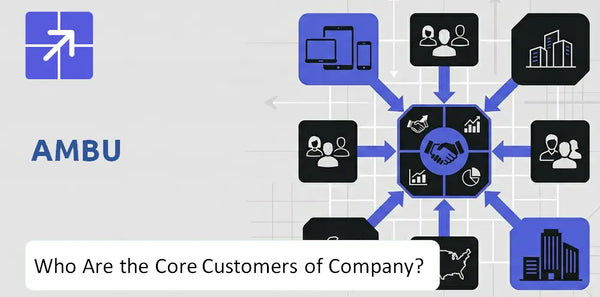
Focus on perioperative and diagnostic units where throughput and infection risk make single-use scopes compelling. See product positioning in Ambu BCG Matrix Analysis.
Who Is Ambu Trying to Win?
Ambu tries to win high-acuity healthcare providers: hospital systems, integrated delivery networks (IDNs), and ambulatory surgery centers (ASCs), plus clinical department heads and hospital procurement managers who control device standards and total cost of ownership.
 Main customer group: Hospital systems and IDNs
Ambu target customers are chiefly large US and European hospital systems and IDNs where centralized purchasing enables rapid roll-out of single-use airway and endoscopy platforms; these networks drove an estimated 45% of Ambu's 2025 device revenue in developed markets.
Secondary groups: ASCs, EMS, and rescue services
Ambu core customers include ambulatory surgery centers and emergency medical services that value portable, ruggedized resuscitation and monitoring kits; EMS and ambulance procurement accounts contributed roughly 12 – 15% of 2025 revenues in targeted regions.
Customer type and market role
Ambu primarily serves institutions and businesses (hospitals, clinics, EMS) rather than direct consumers; key buyers are clinical department heads in pulmonology, urology, gastroenterology, anesthesiology, and hospital procurement managers responsible for purchasing and total cost of ownership decisions.
Most important segment: ICUs and ORs
ICUs and operating rooms are the highest-value use cases for Ambu target market hospitals and clinics because single-use sterile devices are non-negotiable; usage intensity in ICUs/ORs accounted for an estimated 50 – 55% of product utilization and a majority of unit ASPs in 2025.
For procurement context and competitive positioning see Competitive Landscape of Ambu Company
Ambu SWOT Analysis
- Complete SWOT Breakdown
- Fully Customizable
- Editable in Excel & Word
- Professional Formatting
- Investor-Ready Format

What Do Ambu's Customers Care About Most?
Ambu target customers care most about infection prevention and workflow efficiency: they need guaranteed sterility to avoid HAIs and steady device availability to maximize throughput and reduce hidden per-procedure costs.

Infection prevention drives purchase
Hospitals and clinics in Ambu target market prioritize reducing healthcare-associated infections (HAIs); single-use Ambu aScope removes the 2% to 3% contamination risk tied to reusable endoscopes and cuts HAI exposure that can cost US hospitals billions annually.
Practical buying drivers: total cost and workflow
Hospital procurement managers and healthcare providers using Ambu devices favor single-use scopes because they eliminate hidden costs of reusable reprocessing – about $200 to $450 per procedure in labor, chemicals, and maintenance – while enabling same-day procedural throughput.
Emotional and professional reassurance
Clinicians and anesthesiologists value the confidence of always-sterile tools; choosing Ambu devices reduces stress around cross-contamination, supports professional standards, and signals commitment to patient safety.
What customers value most: availability and predictability
Ambu core customers prize the 'always-ready' nature of single-use devices that remove sterilization bottlenecks, increasing procedural throughput and patient turnover in high-demand departments like endoscopy and emergency care.
Loyalty and repeat demand drivers
Repeat demand comes from consistent supply reliability, measurable cost-savings per procedure, and infection control data; procurement teams and distributors stick with suppliers showing year-over-year reductions in reprocessing spend and HAI incidents.
Why customers choose Ambu
Ambu target customers choose the company because single-use products directly address top priorities – infection prevention and workflow optimization – translating into lower hidden costs and higher throughput for hospitals and clinics; see more on Ownership and Control of Ambu Company Ownership and Control of Ambu Company.
Ambu Business Model Canvas
- One-time Payment
- No Research Needed – Save Hours of Work
- Built by Experts, Trusted by Consultants
- Instant Download, Ready to Use
- 100% Editable, Fully Customizable

Where Is Demand Strongest for Ambu?
Ambu finds the most demand in North America, especially the US, where about 50% of total revenue comes from and GI and Urology drive the strongest uptake; demand is also high in Europe where staffing shortages push hospitals toward single-use devices.
North America: Primary Revenue Engine
North America accounts for roughly 50% of Ambu's revenue as of early 2026, led by US hospital procurement managers buying single-use endoscopes for Gastroenterology and Urology; OpEx purchasing preferences favor Ambu's consumable, subscription-like model.
Europe: Labor-Driven Adoption
European demand is rising where healthcare labor shortages make reprocessing reusable scopes costly and slow, prompting clinicians purchasing Ambu devices to switch to single-use scopes and streamlined workflows in hospitals and clinics.
Strongest by Vertical and Model
Ambu appears strongest in Gastroenterology and Urology by revenue mix and procedure coverage, and with hospital procurement teams preferring OpEx models, Ambu core customers include hospital procurement managers, healthcare providers using Ambu devices, and medical device distributors.
Fastest-Growing Demand Areas (2025 – 2026)
Double-digit growth in GI and Urology continued into 2025 as Ambu expanded offerings for complex procedures; demand also grew in emergency medical services and ambulances and cost-sensitive public health systems shifting to single-use solutions. Read related strategic context in Mission, Vision, and Values of Ambu Company.
Ambu Marketing Mix
- Complete Marketing Mix Analysis
- Effortlessly Communicate Your Business Strategy
- Investor-Ready Format
- 100% Editable and Customizable
- Clear and Structured Layout

How Does Ambu Keep Its Audience Growing?
Ambu keeps its audience growing by shipping new single-use endoscope iterations every 12 – 18 months and embedding visualization processors that create recurring demand for disposables; it expands into adjacent segments like colonoscopy while targeting hospital procurement managers and distributors to broaden reach and retention.
Rapid innovation and ecosystem integration
Ambu targets hospitals and clinics in the Ambu target market by releasing upgraded single-use scopes on a 12 – 18 month cadence, keeping image quality competitive with reusable systems and attracting new clinicians purchasing Ambu single-use endoscopes.
Razor-and-blade retention strategy
Installing Ambu visualization processors locks hospitals into a consumable stream, so healthcare providers using Ambu devices and hospital procurement managers repeatedly buy proprietary scopes, supporting predictable recurring revenue.
Loyalty via repeat demand and ecosystem stickiness
High repeat demand comes from procedure volumes; Ambu's single-use economics appeal to cost-sensitive hospitals choosing Ambu single-use solutions and anesthesiologists who buy Ambu airway products, increasing customer depth across departments.
Key growth lever for 2025/2026
The strongest lever is penetration into high-volume colonoscopy markets: management projects organic revenue growth of 10% – 14% for 2025/2026 with EBIT margins moving toward 12% as manufacturing scales, driving market share gains among Ambu core customers.
For procurement teams and medical device distributors researching Ambu target customers and decision makers for Ambu purchases in hospital departments, see the detailed market outlook: Growth Outlook of Ambu Company
Ambu Boston Consulting Group Matrix
- Built by Experts, Trusted by Consultants
- Structured for Consultants, Students, and Founders
- 100% Editable in Microsoft Word & Excel
- Instant Digital Download – Use Immediately
- Compatible with Mac & PC – Fully Unlocked

Related Blogs
- What Is the History of Ambu Company and How Did It Evolve?
- What Is the Competitive Landscape of Ambu Company and How Does It Compete?
- What Is the Growth Outlook of Ambu Company and Where Is It Heading?
- How Does Ambu Company Work and What Drives Its Business Model?
- How Does Ambu Company Reach Customers and Turn Demand into Sales?
- What Do the Mission, Vision, and Core Values of Ambu Company Reveal?
- Who Owns Ambu Company Today and Who Holds Control?
Frequently Asked Questions
Ambu's core customers are high-acuity healthcare providers, especially hospital systems, integrated delivery networks, and ambulatory surgery centers. The company also serves EMS and rescue services, while key buyers often include clinical department heads and hospital procurement managers who make device and total cost of ownership decisions.
Disclaimer
All information, articles, and product details provided on this website are for general informational and educational purposes only. We do not claim any ownership over, nor do we intend to infringe upon, any trademarks, copyrights, logos, brand names, or other intellectual property mentioned or depicted on this site. Such intellectual property remains the property of its respective owners, and any references here are made solely for identification or informational purposes, without implying any affiliation, endorsement, or partnership.
We make no representations or warranties, express or implied, regarding the accuracy, completeness, or suitability of any content or products presented. Nothing on this website should be construed as legal, tax, investment, financial, medical, or other professional advice. In addition, no part of this site - including articles or product references - constitutes a solicitation, recommendation, endorsement, advertisement, or offer to buy or sell any securities, franchises, or other financial instruments, particularly in jurisdictions where such activity would be unlawful.
All content is of a general nature and may not address the specific circumstances of any individual or entity. It is not a substitute for professional advice or services. Any actions you take based on the information provided here are strictly at your own risk. You accept full responsibility for any decisions or outcomes arising from your use of this website and agree to release us from any liability in connection with your use of, or reliance upon, the content or products found herein.