
Who are Becton Dickinson's core customers in hospitals and clinical labs?
Becton Dickinson sells high-volume consumables and devices to hospitals, clinical laboratories, and outpatient clinics; these customers drive recurring revenue and margin stability. In 2025 BD shifted toward higher-margin diagnostics, boosting sales to reference labs and health systems.
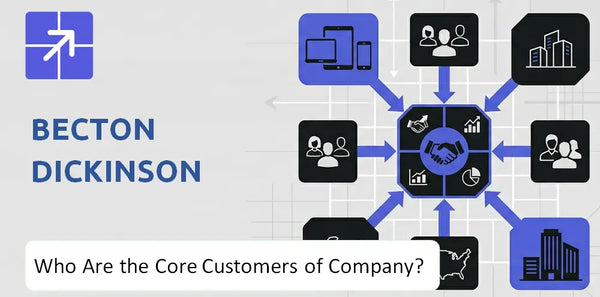
Focus sales on large health systems and reference labs where procurement cycles and switching costs favor BD; see product positioning in Becton Dickinson BCG Matrix Analysis.
Who Is Becton Dickinson Trying to Win?
Becton Dickinson tries to win large institutional buyers across hospitals, clinical labs, and pharmaceutical manufacturers who need standardized, enterprise-wide medical and life – science solutions.
 Main customer group: Acute care hospitals and IDNs
Acute care hospitals and integrated delivery networks (IDNs) are the primary target because they drive high-volume purchases of vascular access devices and medication management systems from the Becton Dickinson Medical segment; large IDNs can represent single contracts worth millions annually and account for a large share of hospital purchasing BD supplies.
Secondary customer groups: Clinical labs and research institutions
Clinical laboratories and academic research centers buy Life Sciences products – diagnostic assays, flow cytometry instruments, and consumables – driving recurring reagent and service revenue; laboratory directors and medical laboratories are key influencers in procurement decisions.
Customer type and market role: Institutional and B2B focus
Becton Dickinson customers are primarily institutional buyers – hospitals purchasing Becton Dickinson products, pharmaceutical companies partnering with BD for drug delivery, and healthcare providers – supported by a network of medical device distributors and procurement tenders.
Most important segment by revenue and scale: Medical segment (hospital supplies)
The Medical segment – vascular access, medication safety, and sharps disposal – generates the largest share of sales and margin; in fiscal 2025 hospital supply contracts and enterprise-wide device standardization continued to drive volume, with hospitals and hospital procurement managers remaining decisive buyers.
Key facts: three core customer tiers (hospitals/IDNs, clinical labs/academia, pharma/biotech), heavy reliance on enterprise contracts, and steady recurring revenue from consumables and service contracts; see further context in this article on Ownership and Control of Becton Dickinson Company.
Becton Dickinson SWOT Analysis
- Complete SWOT Breakdown
- Fully Customizable
- Editable in Excel & Word
- Professional Formatting
- Investor-Ready Format

What Do Becton Dickinson's Customers Care About Most?
Becton Dickinson customers prioritize clinical efficiency, medication safety, and resilient supply chains; staffing shortages and inflation make total cost of ownership and automation decisive purchase drivers.

Efficiency and Labor-Saving Automation
Hospitals purchasing Becton Dickinson products and outpatient clinics favor BD target market solutions that reduce bedside time and automate workflows; with global healthcare vacancy rates still high in 2025, devices that cut procedure time by 20 – 40% get priority.
Practical Buying Drivers: Safety, Throughput, Cost
Hospital procurement managers and medical laboratories choose BD core customers products for needle-stick prevention, closed-system transfer devices, and high-throughput diagnostics – features linked to reduced adverse events and faster turnaround; procurement tenders increasingly evaluate total cost of ownership over sticker price.
Emotional and Professional Assurance
Nurses preferences for BD syringes and needles and infection control specialists choosing BD safety devices reflect trust in proven safety; clinicians value products that lower personal risk and institutional liability, strengthening professional confidence.
What Customers Value Most
Clinical laboratories buying BD diagnostic equipment and laboratory directors evaluating BD diagnostic assays prioritize diagnostic accuracy, integrated data workflows, and compatibility with LIS systems; customers report valuing reduced error rates and 30 – 60% faster sample throughput in modernized labs.
Loyalty and Repeat Demand Drivers
Hospital supply chain managers procuring BD medical supplies and long term care facilities sourcing BD catheter supplies stick with familiar suppliers to minimize onboarding and validation time; service, spare-part availability, and contract pricing visibility drive repeat orders.
Why Customers Choose Becton Dickinson
Medical device distributors selling Becton Dickinson products and pharmaceutical companies partnering with BD for drug delivery pick BD core customers offerings for combination of safety, regulatory track record, and global supply coverage; resilient supply chains and transparent price-to-value metrics win procurement decisions – see Growth Outlook of Becton Dickinson Company for recent market context.
Becton Dickinson Business Model Canvas
- One-time Payment
- No Research Needed – Save Hours of Work
- Built by Experts, Trusted by Consultants
- Instant Download, Ready to Use
- 100% Editable, Fully Customizable

Where Is Demand Strongest for Becton Dickinson?
Demand for Becton Dickinson customers is strongest in the United States, which drives roughly 55% of revenue, while the fastest volume growth is in Greater Asia and EMEA; hospitals, ICUs and outpatient care settings show the most concentrated demand.
Primary market: United States hospitals and acute care
U.S. hospitals purchasing Becton Dickinson products account for the largest share of BD target market revenue at about 55%, driven by hospital procurement managers and infection control specialists prioritizing syringes, needles, and critical care devices.
Secondary markets: Greater Asia and EMEA expansion
Greater Asia and EMEA show the fastest growth in 2025 as emerging markets demand for Becton Dickinson products rises, with outpatient clinics purchasing BD injection systems and clinical laboratories buying BD diagnostic equipment.
Where Becton Dickinson is strongest: Interventional and acute care reach
BD core customers include hospital supply chain managers and nurses; strength sits in interventional segments – peripheral vascular and oncology – plus intensive care units where operating rooms and hemodynamic monitoring drive recurring consumables and device sales.
Fastest-growing demand channels: Care at Home and AI-enabled critical care
The shift toward Care at Home boosts self-injection and chronic disease management tools for long term care facilities and telemedicine providers, while the $4.2 billion Critical Care acquisition increased uptake of AI-driven hemodynamic monitoring in ICUs and ORs.
See company context and history at History and Background of Becton Dickinson Company
Becton Dickinson Marketing Mix
- Complete Marketing Mix Analysis
- Effortlessly Communicate Your Business Strategy
- Investor-Ready Format
- 100% Editable and Customizable
- Clear and Structured Layout

How Does Becton Dickinson Keep Its Audience Growing?
Becton Dickinson keeps its audience growing by advancing clinical innovation and executing strategic portfolio moves, expanding into smart connected care, biologics, and diagnostics while embedding high-switching-cost systems in care workflows.
Expanding Reach into Adjacent Care Segments
Becton Dickinson customers expand as the company targets Healthcare providers and Medical laboratories through product launches in smart connected care and biologics. By 2025 BD's revenue mix shifted toward higher-growth diagnostics and biologics reagents, helping hospitals purchasing Becton Dickinson products and outpatient clinics purchasing BD injection systems adopt new offerings. See the Competitive Landscape of Becton Dickinson Company for market context: Competitive Landscape of Becton Dickinson Company
Customer Retention Drivers
Retention relies on embedded systems such as Alaris infusion and Pyxis dispensing, which create high switching costs for Hospital procurement managers and nurses. Integration across supply chains and service contracts raised renewal rates; BD reported stabilized installed-base revenue contributing to predictable consumables demand in 2025.
Loyalty, Repeat Demand, and Ecosystem Stickiness
Repeat demand comes from consumables and diagnostics consumptions – syringes, needles, catheters – driving recurring revenue from Long term care facilities sourcing BD catheter supplies and Clinical laboratories buying BD diagnostic equipment. Service, training, and software updates for telemedicine providers using BD remote diagnostic tools deepen customer relationships.
Strongest Growth Lever in 2025 – 2026
The key lever is portfolio-driven clinical innovation plus targeted acquisitions; the Advanced Patient Monitoring acquisition broadened touchpoints across the patient journey and improved cross-sell into hospitals and pharmaceutical companies partnering with BD for drug delivery. Management guided mid-single-digit organic revenue growth and high-single-digit adjusted EPS growth for 2026, supported by demographic tailwinds from an aging population and healthcare digitization.
Becton Dickinson Boston Consulting Group Matrix
- Built by Experts, Trusted by Consultants
- Structured for Consultants, Students, and Founders
- 100% Editable in Microsoft Word & Excel
- Instant Digital Download – Use Immediately
- Compatible with Mac & PC – Fully Unlocked

Related Blogs
- What Is the History of Becton Dickinson Company and How Did It Evolve?
- What Is the Competitive Landscape of Becton Dickinson Company and How Does It Compete?
- What Is the Growth Outlook of Becton Dickinson Company and Where Is It Heading?
- How Does Becton Dickinson Company Work and What Drives Its Business Model?
- How Does Becton Dickinson Company Reach Customers and Turn Demand into Sales?
- What Do the Mission, Vision, and Core Values of Becton Dickinson Company Reveal?
- Who Owns Becton Dickinson Company Today and Who Holds Control?
Frequently Asked Questions
Becton Dickinson targets three main customer tiers. Its primary buyers are acute care hospitals and integrated delivery networks, followed by clinical labs and research institutions, and then pharmaceutical and biotech partners. The company mainly serves institutional, B2B buyers who purchase standardized medical and life-science solutions through enterprise contracts.
Disclaimer
All information, articles, and product details provided on this website are for general informational and educational purposes only. We do not claim any ownership over, nor do we intend to infringe upon, any trademarks, copyrights, logos, brand names, or other intellectual property mentioned or depicted on this site. Such intellectual property remains the property of its respective owners, and any references here are made solely for identification or informational purposes, without implying any affiliation, endorsement, or partnership.
We make no representations or warranties, express or implied, regarding the accuracy, completeness, or suitability of any content or products presented. Nothing on this website should be construed as legal, tax, investment, financial, medical, or other professional advice. In addition, no part of this site - including articles or product references - constitutes a solicitation, recommendation, endorsement, advertisement, or offer to buy or sell any securities, franchises, or other financial instruments, particularly in jurisdictions where such activity would be unlawful.
All content is of a general nature and may not address the specific circumstances of any individual or entity. It is not a substitute for professional advice or services. Any actions you take based on the information provided here are strictly at your own risk. You accept full responsibility for any decisions or outcomes arising from your use of this website and agree to release us from any liability in connection with your use of, or reliance upon, the content or products found herein.