
Who are Cellnex Telecom's core customers in Europe's operator and enterprise market?
Cellnex Telecom serves mobile network operators, private wireless users, and neutral-host customers as demand shifts to shared infrastructure. This matters because Cellnex reported 138,000 sites in 2025 while pivoting from acquisitions to organic monetization, supporting 5G rollout and recurring revenue.
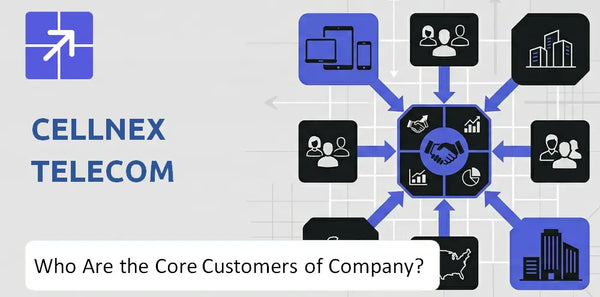
Operators buy passive infrastructure; enterprises demand private 5G and edge services – so prioritize site co-location and edge compute partnerships. See Cellnex Telecom BCG Matrix Analysis.
Who Is Cellnex Telecom Trying to Win?
Cellnex Telecom targets large Tier-1 Mobile Network Operators (MNOs) as primary customers, plus broadcasters, public administrations, and growing Neutral Host buyers like stadiums and malls for DAS and small cells.
 Main customer group: Tier-1 Mobile Network Operators
Cellnex target customers are dominated by Tier-1 mobile network operators such as Vodafone, CK Hutchison, Iliad, Orange, and Telefónica, which account for the bulk of revenue under long-term Master Service Agreements (MSAs); these mobile network operators drive tower leasing customers and long-term recurring cash flows.
Secondary customer groups: broadcasters and public sector
Cellnex core customers include broadcasters needing audiovisual signal transmission and public administration clients for emergency TETRA networks; these telecom infrastructure clients add diversification beyond MNOs.
Customer type and market role: mixed B2B wholesale provider
Cellnex mainly serves businesses and institutions as a wholesale connectivity and tower leasing provider, selling passive infrastructure, small cell deployments, and edge computing capacity to mobile operators and enterprise IoT service customers.
Most important segment: anchor tenants (Tier-1 MNOs)
The most important segment by revenue and scale is anchor tenants – Tier-1 MNOs – typically secured via MSAs; Cellnex reported that as of fiscal 2025 a majority of its site rental revenue remains concentrated with top operators in Europe, underpinning investment for 5G rollout and small cell deployments. Read more in Mission, Vision, and Values of Cellnex Telecom Company
Cellnex Telecom SWOT Analysis
- Complete SWOT Breakdown
- Fully Customizable
- Editable in Excel & Word
- Professional Formatting
- Investor-Ready Format

What Do Cellnex Telecom's Customers Care About Most?
Cellnex target customers care most about densifying networks fast, turning Capex into predictable Opex, and maximizing ROCE while meeting 5G coverage, reliability, and ESG targets; they choose partners who cut Total Cost of Ownership and speed time-to-market.

Network densification and capital efficiency
Mobile network operators and telecom infrastructure clients need rapid PoP rollouts and small cell deployments to handle rising data traffic; shifting tower Capex to Opex improves cash flow and ROCE.
Practical buying drivers: speed, predictability, cost
Customers buy tower leasing and rooftop services to avoid multi-million euro capital outlays, prefer predictable, inflation-linked lease contracts, and value rapid deployment to meet regulatory 5G rollout deadlines.
Emotional or aspirational appeal
Operators and enterprise IoT service customers want market leadership in 5G and smart-city projects; partnering with a neutral host supports brand credibility and faster service launches.
What customers value most
Reliability, low latency, and predictable Total Cost of Ownership drive decisions; shared infrastructure that reduces duplication also improves ESG scores and operational simplicity.
Loyalty and repeat demand
Long-term leasing, multi-site agreements, and integrated edge computing or wholesale connectivity services create sticky revenue and retention among Cellnex core customers.
Why customers choose this partner
Customers select the provider for its scale in tower leasing, ability to convert Capex to Opex, and demonstrated speed-to-market for 5G; see industry context in Competitive Landscape of Cellnex Telecom Company.
Cellnex Telecom Business Model Canvas
- One-time Payment
- No Research Needed – Save Hours of Work
- Built by Experts, Trusted by Consultants
- Instant Download, Ready to Use
- 100% Editable, Fully Customizable

Where Is Demand Strongest for Cellnex Telecom?
Demand concentrates in France, Italy, and Poland, where Build-to-Suit (BTS) programs and 5G densification drive the largest share of tower leasing and small cell contracts; urban centers and major transport corridors show the highest activity.
Main Market: France, Italy, Poland
France, Italy, and Poland account for the largest BTS pipeline and operator contracts in 2025; regulatory 5G mandates and operator capex in these markets make them Cellnex target market mobile operators' primary focus.
Secondary Markets and Vertical Demand
Urban centers across Spain and the UK show rising small cell and DAS orders; utilities, transport, and smart city projects create demand for edge sites and rooftop/mast leasing from telecom infrastructure clients and tower leasing customers.
Where Cellnex Is Strongest
Cellnex Telecom dominates by reach and revenue mix in Southern and Central Europe with a 2025 tenancy ratio and BTS backlog concentrated in France and Italy; mobile network operators and broadcasters provide the largest recurring wholesale connectivity buyers and tower leasing customers.
Fastest-Growing Demand in 2025
In 2025 the fastest-growing segment shifts from macro-cells to urban capacity solutions – small cells and DAS – and edge computing at tower bases to serve industrial IoT and autonomous applications; markets with mandatory 5G densification show the strongest immediate demand. Read more on network economics in How Cellnex Telecom Company Works and Makes Money
Cellnex Telecom Marketing Mix
- Complete Marketing Mix Analysis
- Effortlessly Communicate Your Business Strategy
- Investor-Ready Format
- 100% Editable and Customizable
- Clear and Structured Layout

How Does Cellnex Telecom Keep Its Audience Growing?
Cellnex Telecom grows audiences by increasing tenancy via co-location, targeting adjacent segments like small cells and edge computing, and keeping renewal rates above 95% through mission-critical contracts and high switching costs.
How Cellnex Expands Its Customer Base
Cellnex adds customers by raising tenancy on existing towers (projected tenancy ratio toward 1.65x by end-2026) and selling adjacent services – small cell deployments, edge computing, and neutral-host offerings – to mobile network operators and enterprise IoT clients, thus broadening Cellnex target customers and Cellnex customer segments.
Customer Retention Drivers
Retention stays high because contracts are mission-critical, switching costs are large, and renewal rates exceed 95%; stable long-term deals from a €110 billion backlog through 2025 support predictable cash flow and reassure telecom infrastructure clients and tower leasing customers.
Loyalty, Repeat Demand, and Customer Depth
Repeat demand comes from co-location economics and multi-year leases with mobile network operators and broadcasters; Cellnex customers for 5G rollout and companies that lease towers from Cellnex often expand services to small cell deployments and edge sites, deepening relationships and ecosystem stickiness.
Strongest Customer-Base Growth Lever
The primary lever is tenancy expansion via co-location – minimal incremental cost per added operator – supported by the Next Chapter shift to deleveraging and an investment-grade aim that lowers cost of capital, enabling more competitive pricing for Cellnex target market mobile operators and wholesale connectivity buyers through 2025/2026. Read more on the company's evolution in this History and Background of Cellnex Telecom Company.
Cellnex Telecom Boston Consulting Group Matrix
- Built by Experts, Trusted by Consultants
- Structured for Consultants, Students, and Founders
- 100% Editable in Microsoft Word & Excel
- Instant Digital Download – Use Immediately
- Compatible with Mac & PC – Fully Unlocked

Related Blogs
- What Is the History of Cellnex Telecom Company and How Did It Evolve?
- What Is the Competitive Landscape of Cellnex Telecom Company and How Does It Compete?
- What Is the Growth Outlook of Cellnex Telecom Company and Where Is It Heading?
- How Does Cellnex Telecom Company Work and What Drives Its Business Model?
- How Does Cellnex Telecom Company Reach Customers and Turn Demand into Sales?
- What Do the Mission, Vision, and Core Values of Cellnex Telecom Company Reveal?
- Who Owns Cellnex Telecom Company Today and Who Holds Control?
Frequently Asked Questions
Cellnex Telecom's core customers are mainly Tier-1 Mobile Network Operators, such as Vodafone, CK Hutchison, Iliad, Orange, and Telefónica. It also serves broadcasters, public administrations, and growing Neutral Host buyers like stadiums and malls for DAS and small cell deployments.
Disclaimer
All information, articles, and product details provided on this website are for general informational and educational purposes only. We do not claim any ownership over, nor do we intend to infringe upon, any trademarks, copyrights, logos, brand names, or other intellectual property mentioned or depicted on this site. Such intellectual property remains the property of its respective owners, and any references here are made solely for identification or informational purposes, without implying any affiliation, endorsement, or partnership.
We make no representations or warranties, express or implied, regarding the accuracy, completeness, or suitability of any content or products presented. Nothing on this website should be construed as legal, tax, investment, financial, medical, or other professional advice. In addition, no part of this site - including articles or product references - constitutes a solicitation, recommendation, endorsement, advertisement, or offer to buy or sell any securities, franchises, or other financial instruments, particularly in jurisdictions where such activity would be unlawful.
All content is of a general nature and may not address the specific circumstances of any individual or entity. It is not a substitute for professional advice or services. Any actions you take based on the information provided here are strictly at your own risk. You accept full responsibility for any decisions or outcomes arising from your use of this website and agree to release us from any liability in connection with your use of, or reliance upon, the content or products found herein.