
Who are Cemex's core customers in infrastructure and urban development?
Cemex serves public infrastructure projects, private developers, and eco-conscious construction firms; this matters because higher-margin urban solutions now drive EBITDA mix. In 2025 Cemex reported rising sales in ready-mix and solutions tied to urban projects, showing pricing leverage.
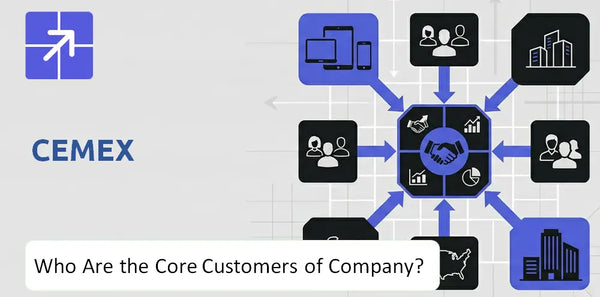
Cemex gains more margin from integrated services and logistics for developers and governments; segmenting customers by carbon sensitivity strengthens pricing. See product analysis: Cemex BCG Matrix Analysis
Who Is Cemex Trying to Win?
Cemex tries to win large institutional and industrial buyers that need engineered building solutions, plus commercial developers for warehouses and high – rise housing; in 2025 it added city planners and developers for integrated Urbanization Solutions, a segment now contributing 10% of consolidated EBITDA.
 Main customer group: Institutional and Tier-1 contractors
High-volume government agencies and Tier-1 contractors managing multi – year infrastructure projects (highways, bridges, mass transit) are Cemex target market priorities because they drive sustained bulk volumes and long procurement contracts and align with Cemex customers for ready-mix concrete and specialized solutions.
Secondary groups: Commercial developers and contractors
Commercial real estate developers focused on industrial warehouses and high – rise residential projects, plus large building contractors and construction companies, form secondary Cemex customer segments that provide repeat B2B demand and higher – margin engineered products.
Customer type and market role: Primarily B2B institutional
Cemex core customers are institutional and corporate buyers – government, contractors, and developers – rather than retail consumers; the mix includes distributors and wholesale customers that serve builder merchants and project procurement teams.
Most important segment by strategic value: Infrastructure projects
Infrastructure projects (roads, transit, bridges) appear most important by revenue and scale: long – cycle contracts secure steady volumes and higher lifetime value, while Urbanization Solutions added 10% of consolidated EBITDA in 2025, signaling strategic shift toward integrated city – scale services; see History and Background of Cemex Company History and Background of Cemex Company.
Cemex SWOT Analysis
- Complete SWOT Breakdown
- Fully Customizable
- Editable in Excel & Word
- Professional Formatting
- Investor-Ready Format

What Do Cemex's Customers Care About Most?
Cemex core customers prioritize on-time supply, verified low-carbon materials, and predictable technical performance; delays cost large projects far more than material price, while tighter codes and green financing push demand for products like Vertua and verified Environmental Product Declarations.

Supply chain reliability for large projects
Construction companies and real estate developers buying in bulk need just-in-time logistics and contingency capacity; a single week delay can add $100k – $1m in indirect costs on major infrastructure jobs, so Cemex target market decisions center on delivery certainty.
Performance and technical specs
Building contractors and engineers demand consistent compressive strength, workability, and site support; verified mix designs and on-site technical assistance reduce rework and schedule risk for commercial and residential projects.
Carbon compliance and ESG credibility
Municipal and corporate clients increasingly require low-CO2 options; Cemex customers for sustainable building materials look for products like Vertua and verified EPDs to meet procurement rules and access green financing.
Verified environmental documentation
In the US and European markets, verified Environmental Product Declarations are now a baseline requirement to win major contracts; lack of EPDs excludes bids for many institutional projects.
Value drivers for loyalty
Repeat demand from contractors and distributors hinges on on-time delivery, consistent quality, and documented CO2 intensity; multi-year supply agreements and technical partnerships boost retention.
Why customers pick Cemex
Cemex core customers choose the firm for integrated logistics, a broad product range including low-carbon options, and verified compliance – factors that matter most for infrastructure and commercial builders. Read more on operational and revenue drivers in How Cemex Company Works and Makes Money.
Cemex Business Model Canvas
- One-time Payment
- No Research Needed – Save Hours of Work
- Built by Experts, Trusted by Consultants
- Instant Download, Ready to Use
- 100% Editable, Fully Customizable

Where Is Demand Strongest for Cemex?
Demand for Cemex is concentrated in Mexico and the United States, which together drive the largest volumes and cashflow; Europe shows pockets of strong demand in renovation and green building where sustainable solutions earn premiums.
Main market: North America dominates
Mexico and the United States account for over 70% of Cemex's EBITDA in 2025, driven by nearshoring-led industrial warehouse builds and U.S. Infrastructure Investment and Jobs Act projects that sustain cement and aggregates volumes.
Secondary markets: Europe and targeted segments
Europe's overall growth is slower, but demand is strongest in renovation and green building segments where Cemex's sustainable materials command price premiums; other secondary demand comes from select Latin American and Middle Eastern markets.
Where Cemex is strongest by mix and reach
Cemex's core customers – construction companies, real estate developers, and building contractors – generate most revenue via ready-mix and aggregates in Mexico and the U.S.; in 2025 the company's U.S. and Mexico operations show the highest margins and volume stability.
Where demand is growing fastest (2025 – 2026)
Nearshoring in Mexico fuels industrial and residential volume growth into 2026, while U.S. infrastructure spending supports long-term cement and aggregates demand; sustainable building and renovation in Europe also show accelerating uptake for Cemex's low-carbon products.
For deeper context on channel strategy and customer segmentation, see Sales and Marketing Strategy of Cemex Company
Cemex Marketing Mix
- Complete Marketing Mix Analysis
- Effortlessly Communicate Your Business Strategy
- Investor-Ready Format
- 100% Editable and Customizable
- Clear and Structured Layout

How Does Cemex Keep Its Audience Growing?
Cemex grows its audience by pushing digital adoption, targeted acquisitions, and premium product conversion, expanding reach into adjacent construction and urban-solutions segments while improving retention via automated ordering and real-time service. These moves deepen relationships with construction companies, real estate developers, and building contractors across commercial and residential projects.
How Cemex Expands Its Customer Base
Cemex acquires aggregates and urban-solutions firms to add higher-margin, recurring-revenue clients and expand into infrastructure and urban corridors. The digital-first Cemex Go platform enables rapid onboarding of distributors and wholesale customers, converting transactional buyers into active B2B procurement clients.
Customer Retention Drivers
Cemex Go now processes over 95 percent of global transactions, cutting order errors and delivery lead times with automated ordering and real-time tracking – key to retaining construction companies, ready-mix users, and municipal clients. Service-level analytics and credit solutions further reduce churn.
Loyalty, Repeat Demand, and Customer Depth
Repeat demand comes from long-term contracts with real estate developers and infrastructure clients plus repeat purchases by retail builders merchants and building contractors. The Vertua premium cement lineup targets sustainable building materials buyers and architects – boosting wallet share and ecosystem stickiness.
Strongest Customer-Base Growth Lever
The largest lever is digital-native commerce via Cemex Go, combined with bolt-on acquisitions in aggregates and urban solutions; together they convert one-time buyers into recurring, higher-margin clients. By late 2026, Vertua is expected to represent nearly 75 percent of cement sales, fortifying Cemex target market positioning in urban corridors and sustainable projects – read more in the Growth Outlook of Cemex Company.
Cemex Boston Consulting Group Matrix
- Built by Experts, Trusted by Consultants
- Structured for Consultants, Students, and Founders
- 100% Editable in Microsoft Word & Excel
- Instant Digital Download – Use Immediately
- Compatible with Mac & PC – Fully Unlocked

Related Blogs
- What Is the History of Cemex Company and How Did It Evolve?
- What Is the Competitive Landscape of Cemex Company and How Does It Compete?
- What Is the Growth Outlook of Cemex Company and Where Is It Heading?
- How Does Cemex Company Work and What Drives Its Business Model?
- How Does Cemex Company Reach Customers and Turn Demand into Sales?
- What Do the Mission, Vision, and Core Values of Cemex Company Reveal?
- Who Owns Cemex Company Today and Who Holds Control?
Frequently Asked Questions
Cemex's core customers are mainly institutional and corporate buyers. That includes government agencies, Tier-1 contractors, commercial developers, construction companies, distributors, and wholesale customers. The article says Cemex focuses on B2B demand rather than retail consumers, especially for large infrastructure and building projects.
Disclaimer
All information, articles, and product details provided on this website are for general informational and educational purposes only. We do not claim any ownership over, nor do we intend to infringe upon, any trademarks, copyrights, logos, brand names, or other intellectual property mentioned or depicted on this site. Such intellectual property remains the property of its respective owners, and any references here are made solely for identification or informational purposes, without implying any affiliation, endorsement, or partnership.
We make no representations or warranties, express or implied, regarding the accuracy, completeness, or suitability of any content or products presented. Nothing on this website should be construed as legal, tax, investment, financial, medical, or other professional advice. In addition, no part of this site - including articles or product references - constitutes a solicitation, recommendation, endorsement, advertisement, or offer to buy or sell any securities, franchises, or other financial instruments, particularly in jurisdictions where such activity would be unlawful.
All content is of a general nature and may not address the specific circumstances of any individual or entity. It is not a substitute for professional advice or services. Any actions you take based on the information provided here are strictly at your own risk. You accept full responsibility for any decisions or outcomes arising from your use of this website and agree to release us from any liability in connection with your use of, or reliance upon, the content or products found herein.