
Who are Cleanaway Waste Management Limited's core customers in the Australian commercial and municipal waste market?
Cleanaway's core customers are councils, industrial manufacturers, and large retailers that need compliant waste and resource recovery solutions. This matters because Cleanaway held a 25 – 30% market share in Australia in 2025 and relies on inflation-linked contracts for steady cash flows. See Cleanaway BCG Matrix Analysis
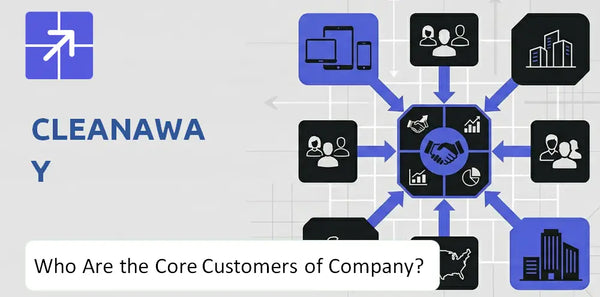
Councils and manufacturing customers value long-term compliance and scale; contracts reduce churn and support margin expansion via resource recovery technologies adopted in 2025 – 2026.
Who Is Cleanaway Trying to Win?
Cleanaway Waste Management Limited targets three tiers: municipalities (long-term council contracts), a broad commercial and industrial base, and specialized liquid and health services; municipalities give a defensive revenue floor while commercial clients drive margin growth.
 Main customer: Municipalities and Councils
Municipal governments supply roughly 25% of revenue via long-term curbside collection and processing contracts, offering stable, recurring cash flow and scale for fleet deployment across regions.
Secondary customers: Commercial & Industrial firms
Commercial waste customers and industrial waste clients form the largest, most diverse segment – retail, construction, manufacturing, and blue-chip chains needing nationwide logistics and integrated services that expand margins through scalability.
Customer type and market role
Cleanaway serves a mixed base: institutional municipalities, businesses (SMEs to enterprise), and regulated healthcare and industrial sites; the sales motion is B2B/B2I with contract-driven accounts and recurring billing.
Most important segment by revenue and strategy
The commercial and industrial segment is most important for revenue upside and margin gains, while municipalities secure a defensive revenue floor (≈25%); targeted growth in liquid waste and health services focuses on higher-barrier, higher-margin contracts.
See market positioning and competitive dynamics in Competitive Landscape of Cleanaway Company
Cleanaway SWOT Analysis
- Complete SWOT Breakdown
- Fully Customizable
- Editable in Excel & Word
- Professional Formatting
- Investor-Ready Format

What Do Cleanaway's Customers Care About Most?
Cleanaway customers prioritize reliable, compliant waste services that reduce environmental liability and support carbon-traceable reporting; industrial clients demand certified hazardous destruction while municipal customers value stable pricing and uninterrupted collection amid rising costs.

Regulatory compliance and reliability
Cleanaway target market customers need services that meet strict environmental and safety rules. Clients choose providers that guarantee chain-of-custody, certified disposal, and audit-ready records for property and corporate liability reduction.
Practical buying drivers: data, cost, continuity
Commercial waste customers and industrial waste clients select on price predictability, service continuity, and granular data reporting for mandatory climate disclosures; municipal contracts emphasize multi-year pricing and contingency coverage.
Emotional and reputational appeal
ESG-conscious procurement teams and corporate boards want partners that protect reputation and demonstrate measurable landfill diversion and emissions reductions – this supports investor and community trust.
What customers value most
Customers value verified carbon traceability, landfill diversion rates, and rapid hazardous-waste handling. In 2025 Cleanaway customers increasingly demand electronic reporting dashboards and ISO – aligned processes.
Loyalty and repeat demand drivers
Long-term municipal contracts, service reliability during fuel and labour inflation, and integrated reporting feed retention. Repeat demand rises when clients see stable multi-year pricing and verifiable diversion performance.
Why customers choose Cleanaway
Cleanaway customers pick the firm for certified hazardous waste capabilities, scale across commercial and industrial segments, and data services that meet 2025 ESG disclosure needs; see operational and revenue context in How Cleanaway Company Works and Makes Money.
Cleanaway Business Model Canvas
- One-time Payment
- No Research Needed – Save Hours of Work
- Built by Experts, Trusted by Consultants
- Instant Download, Ready to Use
- 100% Editable, Fully Customizable

Where Is Demand Strongest for Cleanaway?
Demand for Cleanaway Waste Management Limited concentrates in high-density urban corridors – primarily New South Wales, Victoria, and Queensland – where route density and asset utilization are highest; these East Coast metro areas drive the strongest, most consistent demand.
Primary Market: East Coast Metropolitan Corridors
New South Wales, Victoria, and Queensland produce over 70 percent of Australia's waste, concentrating Cleanaway target market activity in Sydney, Melbourne, and Brisbane corridors where commercial and municipal route density yields the most efficient asset utilization and highest revenue per kilometre.
Secondary Markets: Regional Infrastructure and Industrial Zones
Secondary demand sits in regional construction hubs and industrial precincts supporting infrastructure projects and mining supply chains; these areas drive industrial waste clients needing heavy-duty services and soil remediation across large-scale sites.
Where Cleanaway Is Strongest: Route Density and Resource Recovery
Cleanaway customers skew commercial and municipal contracts that benefit from dense service routes; the firm's fleet and transfer station network optimize usage, and the resource recovery division captures premium pricing in high-quality recycled commodities amid constrained domestic reprocessing capacity.
Fastest-Growing Demand: Renewable Energy and Recycled Commodities
Demand is surging in infrastructure and renewable energy projects requiring specialized remediation; the fastest-growing segment is high-quality recycled commodities as federal export bans on unprocessed waste and a structural shortage of domestic plastic and paper reprocessing lift prices and margins for Cleanaway target market segments.
For context on corporate priorities and how these markets fit strategic goals, see Mission, Vision, and Values of Cleanaway Company
Cleanaway Marketing Mix
- Complete Marketing Mix Analysis
- Effortlessly Communicate Your Business Strategy
- Investor-Ready Format
- 100% Editable and Customizable
- Clear and Structured Layout

How Does Cleanaway Keep Its Audience Growing?
Cleanaway Waste Management Limited grows its audience by vertically integrating collection, sorting and energy-from-waste operations, pushing into adjacent commercial and residential segments via digitized route planning and policy-driven service expansion, and locking customers into multi-year CPI-linked contracts that raise switching costs and deepen account penetration.
Expanding Cleanaway target market
Cleanaway expands into adjacent segments – SMEs, councils and residential homeowners – by offering integrated commercial and residential waste services, route-optimization software and organics collection pilots; Blueprint 2030 investments aim to add volume and win commercial waste customers through service bundling and landfill-avoidance solutions.
Customer retention drivers for Cleanaway customers
Retention relies on multi-year contracts with annual CPI-linked price escalators, high switching costs from embedded logistics and recycling infrastructure, and improved service predictability via digitized route planning and fleet optimization under Blueprint 2030.
Loyalty and ecosystem stickiness among Cleanaway core customers
Cleanaway deepens customer depth by integrating customers into its circular ecosystem – collection, sorting and energy-from-waste – and by converting single-service clients into bundled-contract customers; mandatory organic waste separation increases repeat demand from municipal and commercial waste customers.
Strongest growth lever in 2025/2026
The dominant growth lever is Blueprint 2030: fleet and route digitization plus vertical integration that target a move toward 20 percent EBITDA margins, capture market share as competitor landfill capacity shrinks, and monetize mandatory organic-waste regulation across industrial waste clients and councils. Read more on Ownership and Control of Cleanaway Company Ownership and Control of Cleanaway Company.
Cleanaway Boston Consulting Group Matrix
- Built by Experts, Trusted by Consultants
- Structured for Consultants, Students, and Founders
- 100% Editable in Microsoft Word & Excel
- Instant Digital Download – Use Immediately
- Compatible with Mac & PC – Fully Unlocked

Related Blogs
- What Is the History of Cleanaway Company and How Did It Evolve?
- What Is the Competitive Landscape of Cleanaway Company and How Does It Compete?
- What Is the Growth Outlook of Cleanaway Company and Where Is It Heading?
- How Does Cleanaway Company Work and What Drives Its Business Model?
- How Does Cleanaway Company Reach Customers and Turn Demand into Sales?
- What Do the Mission, Vision, and Core Values of Cleanaway Company Reveal?
- Who Owns Cleanaway Company Today and Who Holds Control?
Frequently Asked Questions
Cleanaway's core customers are municipalities and councils, commercial and industrial firms, and specialized liquid and health service clients. Municipal governments provide a stable revenue base through long-term contracts, while commercial and industrial customers make up the largest and most diverse segment and drive more of the growth and margin upside.
Disclaimer
All information, articles, and product details provided on this website are for general informational and educational purposes only. We do not claim any ownership over, nor do we intend to infringe upon, any trademarks, copyrights, logos, brand names, or other intellectual property mentioned or depicted on this site. Such intellectual property remains the property of its respective owners, and any references here are made solely for identification or informational purposes, without implying any affiliation, endorsement, or partnership.
We make no representations or warranties, express or implied, regarding the accuracy, completeness, or suitability of any content or products presented. Nothing on this website should be construed as legal, tax, investment, financial, medical, or other professional advice. In addition, no part of this site - including articles or product references - constitutes a solicitation, recommendation, endorsement, advertisement, or offer to buy or sell any securities, franchises, or other financial instruments, particularly in jurisdictions where such activity would be unlawful.
All content is of a general nature and may not address the specific circumstances of any individual or entity. It is not a substitute for professional advice or services. Any actions you take based on the information provided here are strictly at your own risk. You accept full responsibility for any decisions or outcomes arising from your use of this website and agree to release us from any liability in connection with your use of, or reliance upon, the content or products found herein.