
Who are Comcast Corporation's core residential and enterprise broadband customers?
Comcast Corporation targets urban and suburban households and small-to-medium enterprises that value high-speed broadband, streaming access, and bundled wireless services. This matters as Comcast reported 52 million customer relationships in 2025 while shifting revenue mix toward broadband and streaming in 2025 – 2026.
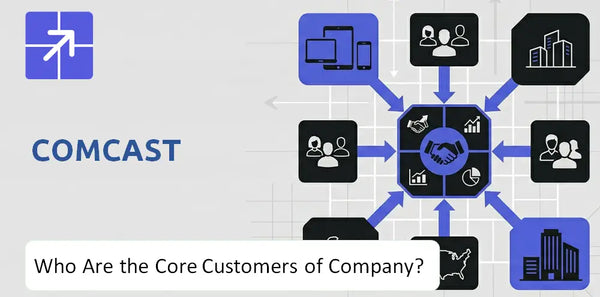
Focus on high ARPU households and SMEs: prioritize fiber upgrades and bundled offers to reduce churn and raise lifetime value. See Comcast BCG Matrix Analysis
Who Is Comcast Trying to Win?
Comcast Corporation primarily pursues high-bandwidth residential households and convergence buyers who bundle Xfinity internet with Xfinity Mobile, while also courting small and mid-sized enterprises and streaming-first audiences for Peacock.
 Main Customer Group: High-Bandwidth Residential Households
Comcast core customers are residential broadband subscribers – over 32 million U.S. broadband accounts as of fiscal 2025 – who demand high-speed internet for streaming, gaming, and remote work. Convergence buyers (bundle purchasers) matter most: Xfinity Mobile reached 9.2 million lines by early 2026, raising ARPU and reducing churn.
Secondary Customer Groups: SMBs, Streaming Audiences, and International Consumers
Comcast business customers include small and mid-sized enterprises served by Comcast Business, which generated over $11 billion in annual revenue in 2025 for managed networks and cybersecurity. Peacock targets cord cutters and streaming-first viewers – especially sports fans and NBCUniversal film audiences – while Sky serves consumers in the U.K., Germany, and Italy; Universal targets tourists globally.
Customer Type and Market Role: Mixed Consumer and Business Base
Comcast target market spans consumers and businesses: primary focus on households (residential customers and Xfinity customers) plus Comcast Business for SMBs and enterprise and corporate Comcast clients. Revenue mix is weighted to consumer broadband, video, and advertising, with growing B2B services.
Most Important Segment: Convergence Residential Bundles
Families and household subscribers to Comcast Xfinity who buy bundles drive the highest customer lifetime value (CLV). Residential broadband scale – 32 million subscribers – and bundle penetration (including 9.2 million Xfinity Mobile lines) deliver the largest share of revenue and strategic advantage versus cord cutters and isolated streaming customers.
For additional corporate context see History and Background of Comcast Company
Comcast SWOT Analysis
- Complete SWOT Breakdown
- Fully Customizable
- Editable in Excel & Word
- Professional Formatting
- Investor-Ready Format

What Do Comcast's Customers Care About Most?
Comcast core customers value fast, reliable multi-gigabit connectivity, bundled price-value, exclusive streamed and live content, and seamless business-grade uptime; purchase drivers vary by segment from Xfinity customers seeking consolidated mobile+home billing to enterprise clients needing scalable cloud integration.

Need: Consistent, high-speed connectivity
Connectivity customers demand network reliability and symmetrical speed to support streaming, cloud work, and gaming; the wide-scale 10G rollout targets multi-gigabit performance for urban and suburban Comcast customers.
Buying drivers: Price-value and bundles
Comcast residential customers often choose bundles that consolidate Xfinity Mobile and home internet bills; price-value perception drives adoption among families and household subscribers looking for bundle deals and lower effective monthly cost.
Emotional appeal: Exclusive content and live events
Peacock and Xfinity video customers are motivated by exclusive live sports (NFL, Premier League) and day-and-date Universal Pictures releases, attracting cord cutters and streaming customers who value must-see live programming.
What they value most: Uptime and scalability
Comcast business customers prioritize network uptime and scalable cloud integration to support remote workforces; enterprises value SLAs, managed services, and secure connectivity for mission-critical apps.
Loyalty drivers: Frictionless experiences and bundles
Repeat demand is supported by reliable service, attractive bundle economics, and exclusive content; Xfinity customers show higher retention when mobile, broadband, and video are bundled under one bill.
Why customers choose Comcast
Comcast wins through network scale, bundled pricing, exclusive Peacock content, and business-grade uptime; theme park guests in 2026, including visitors to Universal Epic Universe, choose for technological immersion and IP-driven experiences that reduce friction and boost spend.
Key numbers: as of fiscal 2025 Comcast reported ~32 million residential broadband customers, Xfinity Mobile contributed ~5 million subscribers, Peacock reached ~30 million active accounts, and enterprise/wholesale revenue emphasized network services with uptime SLAs; Universal Epic Universe opened in 2025 driving significant guest demand and higher per-capita spend in Orlando. For strategy context see Sales and Marketing Strategy of Comcast Company
Comcast Business Model Canvas
- One-time Payment
- No Research Needed – Save Hours of Work
- Built by Experts, Trusted by Consultants
- Instant Download, Ready to Use
- 100% Editable, Fully Customizable

Where Is Demand Strongest for Comcast?
Comcast Corporation finds the most demand in the United States, especially suburban Xfinity customers who use bundled broadband, video, and wireless services; domestic wireless and streaming show the sharpest growth in 2025 – 2026.
Main market: U.S. suburban broadband and wireless
Demand concentrates in U.S. suburbs where Xfinity infrastructure is most mature and 10G upgrades limit fiber churn; Xfinity customers in these areas drive steady ARPU and low churn among Comcast residential customers.
Secondary markets: streaming, theme parks, Europe
Peacock reached 40,000,000 paid subscribers by Q1 2026, boosting cord cutters and streaming customers; Orlando's Universal Epic Universe pivoted theme-park demand toward Florida, while Sky's Sky Glass and Sky Stream support Comcast customer segments in Europe.
Where Comcast is strongest: wireless, broadband, and bundled reach
Xfinity Mobile outpaced traditional cable growth in 2025, making the domestic wireless sector the strongest demand driver; bundled Xfinity packages sustain high customer lifetime value among families and household subscribers to Comcast Xfinity.
Fastest-growing demand areas: mobile and streaming in 2025 – 2026
Demand grew fastest for Xfinity Mobile and Peacock streaming in 2025 – 2026, with cord cutters and millennial and Gen Z Comcast customer behavior favoring IP-delivered services; small business customers Comcast targets show steady uptake of business broadband and managed services.
For more context on strategic implications and financials, see Growth Outlook of Comcast Company
Comcast Marketing Mix
- Complete Marketing Mix Analysis
- Effortlessly Communicate Your Business Strategy
- Investor-Ready Format
- 100% Editable and Customizable
- Clear and Structured Layout

How Does Comcast Keep Its Audience Growing?
Comcast Corporation grows audience by upgrading network stickiness, bundling Xfinity Mobile with broadband, monetizing Peacock, and scaling theme parks; it targets adjacent segments via business services and high-margin entertainment to boost retention and ARPU.
Expanding Comcast core customers and target market
Comcast adds customers by migrating to DOCSIS 4.0 across its footprint to protect urban and suburban broadband share and by pushing bundles that attract families and millennial and Gen Z customers; Xfinity Mobile rollouts and targeted offers to rural broadband customers and small business customers Comcast targets broaden the Comcast customer segments.
Customer retention drivers for Comcast
Retention rests on product stickiness from high-speed DOCSIS 4.0, bundling discounts, and integrated billing; internal metrics show bundled Xfinity customers have 25 percent higher lifetime value, keeping Comcast residential customers churn near historic lows and stabilizing revenue from cord cutters and streaming customers for Comcast.
Loyalty, repeat demand, and customer depth
Xfinity Mobile and bundled offers drive repeat demand and increase customer lifetime value of Comcast subscribers; Peacock upsells, renewals of business services for enterprise and corporate Comcast clients, and season passes at parks deepen engagement among high-income vs low-income Comcast customer segments.
Strongest customer-base growth lever in 2025 – 2026
The primary growth lever is bundle-driven ARPU optimization: migrating to DOCSIS 4.0 plus Xfinity Mobile bundling and Peacock monetization is expected to drive mid-single-digit EBITDA growth through 2026, while legacy video declines. See more on strategy in How Comcast Company Works and Makes Money.
Comcast Boston Consulting Group Matrix
- Built by Experts, Trusted by Consultants
- Structured for Consultants, Students, and Founders
- 100% Editable in Microsoft Word & Excel
- Instant Digital Download – Use Immediately
- Compatible with Mac & PC – Fully Unlocked

Related Blogs
- What Is the History of Comcast Company and How Did It Evolve?
- What Is the Competitive Landscape of Comcast Company and How Does It Compete?
- What Is the Growth Outlook of Comcast Company and Where Is It Heading?
- How Does Comcast Company Work and What Drives Its Business Model?
- How Does Comcast Company Reach Customers and Turn Demand into Sales?
- What Do the Mission, Vision, and Core Values of Comcast Company Reveal?
- Who Owns Comcast Company Today and Who Holds Control?
Frequently Asked Questions
Comcast's core customers are high-bandwidth residential households, especially convergence buyers who bundle Xfinity internet with Xfinity Mobile. The company also serves small and mid-sized enterprises through Comcast Business, plus streaming-first audiences for Peacock and international consumers through Sky and Universal-related offerings.
Disclaimer
All information, articles, and product details provided on this website are for general informational and educational purposes only. We do not claim any ownership over, nor do we intend to infringe upon, any trademarks, copyrights, logos, brand names, or other intellectual property mentioned or depicted on this site. Such intellectual property remains the property of its respective owners, and any references here are made solely for identification or informational purposes, without implying any affiliation, endorsement, or partnership.
We make no representations or warranties, express or implied, regarding the accuracy, completeness, or suitability of any content or products presented. Nothing on this website should be construed as legal, tax, investment, financial, medical, or other professional advice. In addition, no part of this site - including articles or product references - constitutes a solicitation, recommendation, endorsement, advertisement, or offer to buy or sell any securities, franchises, or other financial instruments, particularly in jurisdictions where such activity would be unlawful.
All content is of a general nature and may not address the specific circumstances of any individual or entity. It is not a substitute for professional advice or services. Any actions you take based on the information provided here are strictly at your own risk. You accept full responsibility for any decisions or outcomes arising from your use of this website and agree to release us from any liability in connection with your use of, or reliance upon, the content or products found herein.