
Who are DCB Bank's core customers in India's middle-of-pyramid segment?
DCB Bank focuses on self-employed professionals and small businesses across urban and semi-urban India, a segment that drove loan growth in 2025. This matters because the bank's valuation hinges on scaling a projected INR 480 billion loan book while preserving NIM amid rising funding costs.
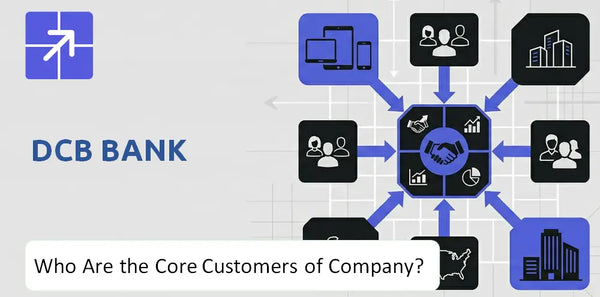
Prioritize products that match irregular cash flows – small business working capital and retail gold loans. See product fit in the DCB Bank BCG Matrix Analysis.
Who Is DCB Bank Trying to Win?
DCB Bank tries to win self-employed professionals and small business owners – micro-SMEs and SMEs in trading, manufacturing, and essential services – because they offer steady, granular lending opportunities that larger banks often underserve.
 Primary target: Self – employed professionals & small business owners
DCB Bank target customers are primarily self-employed professionals and small business owners who need mortgages and Loans Against Property (LAP); these products make up approximately 44 percent of the loan portfolio, with average mortgage ticket sizes around 3.5 – 4.5 million INR (approximately 42,000 – 54,000 USD), spreading risk across thousands of borrowers.
Secondary targets: Rural, semi – urban, Gold Loan & Agri
Secondary customer segments include rural and semi-urban retail banking customers DCB Bank serves via gold loans and agri-business lending; these provide high-yield, short-duration assets that support liquidity and margin stability.
Customer type and market role: Mixed retail – SME focus
DCB Bank customer segments are mixed: retail banking customers DCB Bank and small and medium enterprise customers DCB Bank dominate lending, while exposure to large corporate clients is intentionally limited to maintain portfolio granularity and credit diversification.
Most important segment by revenue and risk profile
The mortgage/LAP segment is most important by scale and risk management (44 percent of loans); it drives interest income and keeps average ticket sizes modest, so DCB Bank can manage credit concentration while targeting customers who lack easy access to large institutional credit.
See the bank's background and context in this article: History and Background of DCB Bank Company
DCB Bank SWOT Analysis
- Complete SWOT Breakdown
- Fully Customizable
- Editable in Excel & Word
- Professional Formatting
- Investor-Ready Format

What Do DCB Bank's Customers Care About Most?
DCB Bank target customers care most about fast, flexible credit decisions, collateral sensitivity for irregular incomes, and local relationship managers; savers prioritize competitive term deposit yields and perceived safety from strong capital ratios.

Speed and credit flexibility
Self-employed borrowers and SME owners demand rapid execution and flexible collateral evaluation because income documentation is often nonstandard; surrogate cash – flow assessment drives approvals and loan uptake.
Practical buying drivers
Retail banking customers DCB Bank choose term deposits for yields typically 50 to 75 basis points above top-tier private banks and SMEs pick tailored lending terms and local decisioning for convenience and performance.
Emotional and aspirational appeal
Clients prefer a human relationship – trusted branch managers and stable interest-rate expectations – over impersonal digital-only experiences; this supports pride in a bank that understands local business cycles.
What customers value most
Customers value speed of sanction, customized collateral treatment for irregular incomes, and financial safety – DCB Bank's capital adequacy ratio near 16.5 percent and retail deposits forming over 70 percent of total deposits (Q1 2026) are core.
Loyalty and repeat demand
Repeat deposits and loan renewals come from consistent yields on term products, relationship banking, and predictable pricing; SMEs return for quick top – ups and working – capital lines tied to local RM support.
Why customers choose DCB Bank
DCB Bank customer segments favor a blend of competitive deposit rates, flexible SME and self – employed underwriting, and regional relationship banking – this combination explains market wins and retention. Read the Sales and Marketing Strategy of DCB Bank Company for detailed tactics: Sales and Marketing Strategy of DCB Bank Company
DCB Bank Business Model Canvas
- One-time Payment
- No Research Needed – Save Hours of Work
- Built by Experts, Trusted by Consultants
- Instant Download, Ready to Use
- 100% Editable, Fully Customizable

Where Is Demand Strongest for DCB Bank?
Demand is strongest in Tier 2 – Tier 6 cities and rural corridors across India, where MSME formal banking penetration is low and mortgage, SME, and agri lending needs are concentrated. Urban demand exists but the highest expansion opportunity is outside major metros.
Main Market Location: Semi-Urban and Rural India
DCB Bank target customers are concentrated in Tier 2 – Tier 6 cities where formal credit gaps persist; states such as Maharashtra, Gujarat, and Karnataka show the largest mortgage and SME loan volumes. These regions matter because MSME and housing demand remains underserved, driving higher loan-ticket growth and repeat deposit relationships.
Secondary Markets: Agri, Micro, and Co-Lending Corridors
Agri-Business and co-lending with NBFCs have boosted micro-loan and tractor financing demand in rural belts, enabling DCB Bank customer segments to expand without heavy branch capex. Digital channels now support 92 percent of transactions as of early 2026, amplifying reach into remote areas.
Where DCB Bank Is Strongest: SME, Mortgage, and Co-Lending
DCB Bank's revenue mix and originations show strength in SME lending and mortgages, particularly in Maharashtra, Gujarat, and Karnataka; the bank's co-lending partnerships increase penetration into micro and tractor finance. The physical branch network – almost 480 locations by early 2026 – remains the trust anchor for high-value loan originations.
Fastest-Growing Demand Areas: Digital and Rural Credit Access
Demand grew fastest in 2025 – 2026 in digital adoption for retail banking customers DCB Bank and in rural co-lending channels for small and medium enterprise customers DCB Bank; micro-loans and agri-finance rose as co-lending scaled. For more on competitive positioning see Competitive Landscape of DCB Bank Company.
DCB Bank Marketing Mix
- Complete Marketing Mix Analysis
- Effortlessly Communicate Your Business Strategy
- Investor-Ready Format
- 100% Editable and Customizable
- Clear and Structured Layout

How Does DCB Bank Keep Its Audience Growing?
DCB Bank keeps its audience growing via a branch-led, digital-enabled model: cross-selling to SME borrowers, digital onboarding to lower acquisition costs, and strategic co-lending plus PSL certificate sales that widen reach and revenue.
How DCB Bank Expands Its Customer Base
DCB Bank targets new retail and SME customers by combining physical branch access with faster digital onboarding, which reduced customer acquisition costs by an estimated 12 percent year-over-year. Strategic co-lending deals and Priority Sector Lending (PSL) certificates extend geographic and sectoral reach into underserved MSME pockets, attracting adjacent segments like micro-enterprises and priority retail borrowers.
Customer Retention Drivers
Retention hinges on cross-selling integrated wealth and insurance products to the SME loan base, personalized branch relationships, and digital credit servicing that shortens turnaround times. Maintaining Net Interest Margin (NIM) near 3.6 – 3.8 percent and strong service SLAs keeps churn low and deposit stickiness high.
Loyalty, Repeat Demand, and Customer Depth
DCB Bank increases wallet share by offering bundled business banking, wealth management, and insurance to existing SME customers, driving repeat product adoption and deeper relationships. Priority banking and tailored MSME relationship managers lift average revenue per user; cross-sell rates to existing SME clients exceed typical retail benchmarks in the sector.
Strongest Customer-Base Growth Lever
The key lever is defending MSME territory through a branch-plus-digital approach that marries local relationship banking with improved digital underwriting. For 2025/2026, DCB Bank targets sustained credit growth of 18 – 20 percent while keeping NIM in the 3.6 – 3.8 percent band; this combination is expected to preserve its niche against fintech entrants and attract both SME and retail banking customers.
See further context on strategic priorities at Mission, Vision, and Values of DCB Bank Company
DCB Bank Boston Consulting Group Matrix
- Built by Experts, Trusted by Consultants
- Structured for Consultants, Students, and Founders
- 100% Editable in Microsoft Word & Excel
- Instant Digital Download – Use Immediately
- Compatible with Mac & PC – Fully Unlocked

Related Blogs
- What Is the History of DCB Bank Company and How Did It Evolve?
- What Is the Competitive Landscape of DCB Bank Company and How Does It Compete?
- What Is the Growth Outlook of DCB Bank Company and Where Is It Heading?
- How Does DCB Bank Company Work and What Drives Its Business Model?
- How Does DCB Bank Company Reach Customers and Turn Demand into Sales?
- What Do the Mission, Vision, and Core Values of DCB Bank Company Reveal?
- Who Owns DCB Bank Company Today and Who Holds Control?
Frequently Asked Questions
DCB Bank primarily targets self-employed professionals and small business owners, especially micro-SMEs and SMEs in trading, manufacturing, and essential services. It also serves rural and semi-urban customers through gold loans and agri-business lending. The focus is on borrowers who need flexible, granular credit and relationship-based banking.
Disclaimer
All information, articles, and product details provided on this website are for general informational and educational purposes only. We do not claim any ownership over, nor do we intend to infringe upon, any trademarks, copyrights, logos, brand names, or other intellectual property mentioned or depicted on this site. Such intellectual property remains the property of its respective owners, and any references here are made solely for identification or informational purposes, without implying any affiliation, endorsement, or partnership.
We make no representations or warranties, express or implied, regarding the accuracy, completeness, or suitability of any content or products presented. Nothing on this website should be construed as legal, tax, investment, financial, medical, or other professional advice. In addition, no part of this site - including articles or product references - constitutes a solicitation, recommendation, endorsement, advertisement, or offer to buy or sell any securities, franchises, or other financial instruments, particularly in jurisdictions where such activity would be unlawful.
All content is of a general nature and may not address the specific circumstances of any individual or entity. It is not a substitute for professional advice or services. Any actions you take based on the information provided here are strictly at your own risk. You accept full responsibility for any decisions or outcomes arising from your use of this website and agree to release us from any liability in connection with your use of, or reliance upon, the content or products found herein.