
Who are Fuji Electric's core customers in industrial automation and green energy markets?
Fuji Electric sells power semiconductors, inverters, and energy management systems to utilities, renewable developers, data centers, and manufacturers focused on decarbonization. This matters because Fuji Electric's 2025 operating margin near 10% reflects demand from these high-value customers and a shift toward power electronics.
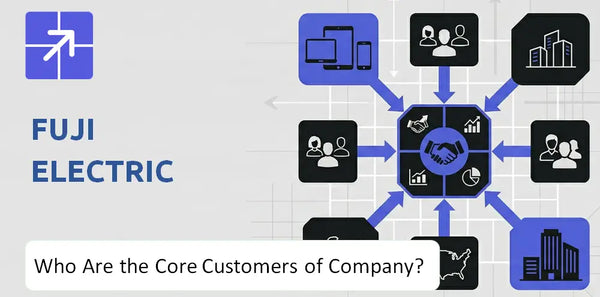
Key customers prioritize reliability and efficiency; target segments include utility-scale solar/wind, hyperscale data centers, and factory automation. See product fit in Fuji Electric BCG Matrix Analysis.
Who Is Fuji Electric Trying to Win?
Fuji Electric tries to win industrial OEMs and infrastructure operators that need high-performance power conversion and control, especially EV makers and hyperscale data centers; it prioritizes enterprise and utility customers over consumer markets.
 Main customer group: EV and automotive OEMs
Fuji Electric target market centers on electric vehicle manufacturers and automotive tier-one suppliers that buy high-efficiency power semiconductors and Silicon Carbide (SiC) modules; these customers drove roughly ~28% of power electronics revenues in fiscal 2025, per company disclosures and industry shipment trends.
Secondary customer groups: data centers, telco, and utilities
Hyperscale data center developers and telecommunications providers require large, efficient power supply systems for AI workloads; municipal utilities and smart-grid projects buy transformers, switchgear, and energy storage – industrial and energy clients that lift average contract size and margins.
Customer type and market role: B2B enterprise and institutional buyers
Fuji Electric core customers are businesses and institutions – OEMs, utilities, and large infrastructure operators – not retail consumers; procurement cycles are long, decisions are technical, and contracts are high-value.
Most important segment: high-margin industrial power solutions
The highest strategic importance is the power electronics and industrial automation segment – SiC modules, drives, and transformers – accounting for a disproportionate share of operating profit in fiscal 2025 as Fuji Electric shifted toward higher-margin power and automation customers; see the Competitive Landscape of Fuji Electric Company for context: Competitive Landscape of Fuji Electric Company
Fuji Electric SWOT Analysis
- Complete SWOT Breakdown
- Fully Customizable
- Editable in Excel & Word
- Professional Formatting
- Investor-Ready Format

What Do Fuji Electric's Customers Care About Most?
Fuji Electric target market customers prioritize reliability and total cost of ownership (TCO), plus measurable energy-efficiency gains and carbon-neutral solutions that cut operational cost and regulatory exposure. Purchase drivers center on uptime, energy conversion efficiency, and Scope 2 emissions reductions tied to ESG reporting and carbon taxes.

Avoiding costly downtime
Industrial and energy clients buy Fuji Electric products to prevent interruptions where even short outages can cost millions in lost output; reliability of inverters, power supplies, and drives is paramount.
Practical buying drivers: TCO and efficiency
Power and automation customers evaluate purchase on lifecycle cost: capex, maintenance, energy loss. Adoption of seventh-generation IGBTs and SiC power modules cuts conversion losses versus legacy silicon, improving fleet energy intensity by up to 5 – 15% in comparable applications.
Emotional and reputational impact
Manufacturing and utility buyers want vendors that signal operational excellence and ESG credibility; buying advanced power electronics supports sustainability narratives used in investor and customer communications.
What customers value most
Fuji Electric core customers value measurable outcomes: reduced unplanned downtime, lower TCO, and verifiable Scope 2 emissions reductions that feed into corporate ESG targets and potential carbon-tax savings.
Loyalty and repeat demand
Repeat purchases come from proven field reliability, long product lifecycles, and compatibility with existing factory automation and energy storage systems; service contracts and spare-parts availability further lock in procurement decisions.
Why customers choose Fuji Electric
Fuji Electric customers for industrial automation systems pick the company for its blend of high-efficiency power modules, proven reliability in mission-critical settings, and demonstrable impact on emissions reporting – key for corporate buyers facing stricter ESG rules and carbon pricing.
For a fuller company overview and revenue context tied to these product strengths, see How Fuji Electric Company Works and Makes Money
Fuji Electric Business Model Canvas
- One-time Payment
- No Research Needed – Save Hours of Work
- Built by Experts, Trusted by Consultants
- Instant Download, Ready to Use
- 100% Editable, Fully Customizable

Where Is Demand Strongest for Fuji Electric?
Demand for Fuji Electric solutions is strongest in North America and India, while Japan remains the largest single-market revenue base; activity concentrates where data centers, rail/utility upgrades, and factory automation investments occur.
Main Market: North America and India
North America drives demand via AI-ready data centers needing specialized power distribution and power electronics; India's modernization of rail and grid projects creates large contracts for stable power and traction systems. See Mission, Vision, and Values of Fuji Electric Company for corporate context.
Secondary Markets: Japan and East Asia Manufacturing
Japan remains the foundational revenue base, supplying utilities and industrial clients; East Asian factory automation buyers are increasing spend on motors, drives, and control systems as plants automate and adopt robotics.
Where Fuji Electric Is Strongest
Fuji Electric is strongest in power electronics and industrial automation, with a balanced mix across manufacturing, utilities, and transport OEMs; FY2025 revenue mix shows heavy weighting to power systems and semiconductors in core markets. FY2025 semiconductor allocations and power systems orders drove notable margin expansion.
Fastest-Growing Demand Areas (2025 – 2026)
Power semiconductors are the fastest-growing vertical with projected sales growth exceeding 15 percent in 2025 – 2026, fueled by EV electrification and grid-scale storage; AI data-center power gear and Indian rail/grid projects also show robust order pipelines.
Fuji Electric Marketing Mix
- Complete Marketing Mix Analysis
- Effortlessly Communicate Your Business Strategy
- Investor-Ready Format
- 100% Editable and Customizable
- Clear and Structured Layout

How Does Fuji Electric Keep Its Audience Growing?
Fuji Electric keeps its audience growing by investing heavily in SiC power semiconductor capacity and pivoting toward recurring lifecycle services, expanding into adjacent industrial and energy clients while strengthening long-term contracts and remote-monitoring ties with core customers.
Expanding Fuji Electric's Customer Base
Fuji Electric targets new power and automation customers by scaling SiC semiconductor production to meet rising EV OEM demand and by bundling integrated energy and environment solutions for manufacturing and utility buyers; this approach opens adjacent segments such as data centers and energy storage systems. In 2025 the company increased capital expenditure toward SiC capacity, supporting a projected 20 – 30% addressable market growth through 2026 for power electronics in EVs and renewables.
Customer Retention Drivers
Retention rests on lifecycle services – long-term maintenance, remote monitoring, and diagnostic services – that create high switching costs for Fuji Electric customers in industrial automation systems and utility companies. Recurring service revenue now represents a growing share of sales, improving predictability; management projects service-driven margins that stabilize cash flow versus project-only revenues.
Loyalty, Repeat Demand, and Customer Depth
Fuji Electric deepens account relationships via multi-product solutions – transformers, switchgear, drives, and SiC modules – so manufacturing and utility buyers consolidate procurement. Renewal contracts for service and spare parts, plus integrated digital platforms for remote diagnostics, drive repeat demand and increase customer lifetime value among Fuji Electric core customers.
Strongest Customer-Base Growth Lever
The biggest growth lever is capitalizing on electrification and AI-driven data center expansion by supplying SiC power semiconductors and turnkey energy systems; Fuji Electric's integrated offering positions it to capture share from OEMs and commercial refrigeration and semiconductor manufacturing clients. Read more on corporate structure in Ownership and Control of Fuji Electric Company.
Fuji Electric Boston Consulting Group Matrix
- Built by Experts, Trusted by Consultants
- Structured for Consultants, Students, and Founders
- 100% Editable in Microsoft Word & Excel
- Instant Digital Download – Use Immediately
- Compatible with Mac & PC – Fully Unlocked

Related Blogs
- What Is the History of Fuji Electric Company and How Did It Evolve?
- What Is the Competitive Landscape of Fuji Electric Company and How Does It Compete?
- What Is the Growth Outlook of Fuji Electric Company and Where Is It Heading?
- How Does Fuji Electric Company Work and What Drives Its Business Model?
- How Does Fuji Electric Company Reach Customers and Turn Demand into Sales?
- What Do the Mission, Vision, and Core Values of Fuji Electric Company Reveal?
- Who Owns Fuji Electric Company Today and Who Holds Control?
Frequently Asked Questions
Fuji Electric's core customers are businesses and institutions, not retail consumers. The company focuses on industrial OEMs, utilities, and large infrastructure operators that need high-performance power conversion and control. Its target market includes EV and automotive OEMs, plus data centers, telco providers, and smart-grid utility projects.
Disclaimer
All information, articles, and product details provided on this website are for general informational and educational purposes only. We do not claim any ownership over, nor do we intend to infringe upon, any trademarks, copyrights, logos, brand names, or other intellectual property mentioned or depicted on this site. Such intellectual property remains the property of its respective owners, and any references here are made solely for identification or informational purposes, without implying any affiliation, endorsement, or partnership.
We make no representations or warranties, express or implied, regarding the accuracy, completeness, or suitability of any content or products presented. Nothing on this website should be construed as legal, tax, investment, financial, medical, or other professional advice. In addition, no part of this site - including articles or product references - constitutes a solicitation, recommendation, endorsement, advertisement, or offer to buy or sell any securities, franchises, or other financial instruments, particularly in jurisdictions where such activity would be unlawful.
All content is of a general nature and may not address the specific circumstances of any individual or entity. It is not a substitute for professional advice or services. Any actions you take based on the information provided here are strictly at your own risk. You accept full responsibility for any decisions or outcomes arising from your use of this website and agree to release us from any liability in connection with your use of, or reliance upon, the content or products found herein.