
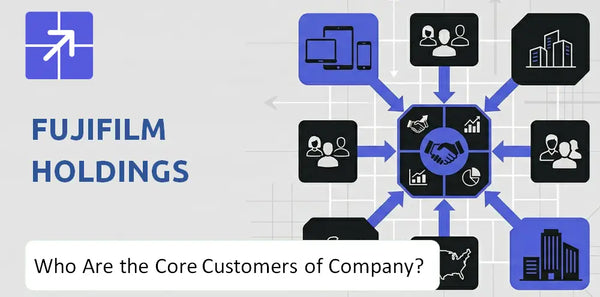
Who are the core customers for FUJIFILM Holdings Corporation in Healthcare and Electronics?
FUJIFILM Holdings Corporation targets hospitals, diagnostic labs, pharma firms, and semiconductor manufacturers; these B2B clients drive ~60% of revenue in early 2026. This matters because shift to high-margin healthcare and materials underpins recent ROE resilience and valuation re-rating.
Focus on procurement leads in hospitals and fabs; prioritize long-term service contracts and regulatory approvals to lock in recurring revenue. See product positioning in Fujifilm Holdings BCG Matrix Analysis.
Who Is Fujifilm Holdings Trying to Win?
FUJIFILM Holdings Corporation targets three core customer groups: global pharmaceutical and biotech firms needing CDMO services, healthcare providers buying medical imaging and AI diagnostics, and semiconductor manufacturers sourcing photoresists and CMP slurries; it also serves a profitable consumer niche of Gen Z, Millennial, and professional photographers for Instax and X-Series/GFX systems.
 Main customer group: CDMO clients in pharma and biotech
FUJIFILM target customers primarily consist of global pharmaceutical and biotech companies that contract development and manufacturing work; FUJIFILM has committed over 700 billion yen in capex to CDMO through 2026, reflecting the segment's strategic and revenue importance.
Secondary groups: healthcare providers and diagnostic centers
Hospitals and diagnostic centers form a key Fujifilm customer segment for medical imaging systems and AI-integrated diagnostic software; these healthcare providers drive recurring service, imaging consumables, and software licensing revenue.
Customer type and market role: mainly B2B with selective B2C
FUJIFILM core customers are businesses and institutions – pharma, hospitals, and semiconductor manufacturers – while a secondary consumer base includes Gen Z and Millennial retail photo service customers and professional photographers Fujifilm customers who buy cameras and instant film products.
Most important segment by strategic scale: CDMO and healthcare
By revenue impact and strategic scale, CDMO and healthcare equipment/services are most important: FUJIFILM reported strong growth in healthcare and life sciences in 2025, driven by CDMO investments and increased sales of imaging systems to hospitals using Fujifilm diagnostic equipment; see Ownership and Control of Fujifilm Holdings Company for corporate context Ownership and Control of Fujifilm Holdings Company.
Fujifilm Holdings SWOT Analysis
- Complete SWOT Breakdown
- Fully Customizable
- Editable in Excel & Word
- Professional Formatting
- Investor-Ready Format

What Do Fujifilm Holdings's Customers Care About Most?
Fujifilm target customers prioritize technical precision, regulatory reliability, and materials-driven performance; buyers seek faster time-to-market, higher diagnostic accuracy, and yield improvements as core purchase drivers.

Regulatory compliance and clinical accuracy
Healthcare providers Fujifilm market and pharmaceutical CDMO clients demand validated workflows, ISO 13485-grade processes, and imaging systems that reduce diagnostic error rates – key to faster approvals and improved patient outcomes.
Scalability and time-to-market
Fujifilm customers in healthcare and pharmaceuticals and businesses using Fujifilm products pick partners that shorten development cycles; CDMO contracts stress capacity, tech transfer, and single-digit month assay validation times where possible.
AI for diagnostic and process improvement
Hospitals using Fujifilm diagnostic equipment and research labs want embedded AI to boost image interpretation accuracy and workflow automation, improving throughput and reducing clinician variability.
Purity and yield for semiconductors
Fujifilm industrial and manufacturing clients in the Electronics segment value contamination control and thin-film precision; as architectures approach 2nm, clients prioritize chemical purity and yields that directly affect wafer economics.
Technological excellence versus analog tangibility
Professional photographers Fujifilm customers seek sensor performance and lens ecosystems, while Instax buyers – retail photo service customers of Fujifilm – buy for tactile, analog experience and brand nostalgia.
Materials science as a cross-divisional enabler
Fujifilm core customers across segments value advanced materials R&D that solves thermal, optical, and biochemical engineering problems – this capability underpins product differentiation and repeat procurement.
Reliability and long-term partnerships
Fujifilm enterprise customers for document solutions and CDMO partners prefer vendors with stable supply chains, multi-year service agreements, and field support – these drive retention and recurring revenue.
Why customers choose Fujifilm
Businesses that buy Fujifilm printing solutions and hospitals using Fujifilm diagnostic equipment pick the firm for integrated expertise in imaging, AI, and materials – evidenced by 2025 R&D investment that sustains product leadership; see Mission, Vision, and Values of Fujifilm Holdings Company for corporate priorities.
Fujifilm Holdings Business Model Canvas
- One-time Payment
- No Research Needed – Save Hours of Work
- Built by Experts, Trusted by Consultants
- Instant Download, Ready to Use
- 100% Editable, Fully Customizable

Where Is Demand Strongest for Fujifilm Holdings?
Demand for FUJIFILM Holdings Corporation concentrates in North America and the Asia-Pacific region, with healthcare and electronics driving most growth; retail imaging remains active in North America and Europe.
Main Market: North America (Healthcare & CDMO)
North America is the primary market for FUJIFILM target customers, led by hospitals using Fujifilm diagnostic equipment, healthcare providers, and biotech firms; the United States was the largest market for medical IT systems in the 2025/2026 fiscal cycle, supporting double-digit revenue growth in Healthcare and CDMO segments year-over-year.
Secondary Markets: Asia-Pacific (Electronics & Imaging)
Asia – notably Taiwan, South Korea, and China – drives demand for FUJIFILM customer segments in Electronics because these countries lead global semiconductor production; the Electronics division accounted for a material share of 2025 sales tied to semiconductor materials and film, attracting industrial and manufacturing clients.
Where FUJIFILM Is Strongest: Product Reach and Revenue Mix
FUJIFILM core customers span B2B and B2C: hospitals, CDMOs, semiconductor firms, and retail photo consumers. Imaging (Instax and cameras) and Healthcare together represented the largest combined share of 2025 revenue, with Instax maintaining dominant share in gift/social photo segments across North America and Europe.
Where Demand Is Growing: Digital Health, CDMO, and Semiconductor Materials
Fastest growth in 2025/2026 appears in digital health solutions (medical IT), CDMO services for biologics, and semiconductor-related materials; hospitals and businesses using Fujifilm products are increasing spend on diagnostic upgrades and contract manufacturing, while professional photographers and retail photo service customers sustain Instax and camera demand. Read more on the Sales and Marketing Strategy of Fujifilm Holdings Company
Fujifilm Holdings Marketing Mix
- Complete Marketing Mix Analysis
- Effortlessly Communicate Your Business Strategy
- Investor-Ready Format
- 100% Editable and Customizable
- Clear and Structured Layout

How Does Fujifilm Holdings Keep Its Audience Growing?
FUJIFILM Holdings Corporation grows its audience by reinvesting in R&D, expanding CDMO capacity, and refreshing consumer products like Instax to reach adjacent segments; retention comes from integrated platforms such as REiLI that bind healthcare systems and drive recurring demand across B2B and B2C channels.
Expanding Fujifilm target customers and adjacent markets
FUJIFILM adds new customers by enlarging its CDMO footprint in Denmark and the United States under Vision 2030 to capture antibody-drug and cell-therapy contracts, while iterative Instax product releases and lifestyle collaborations broaden Fujifilm customer segments into youth and creative markets; businesses using Fujifilm products gain access to end-to-end imaging and printing solutions to enter retail and enterprise channels.
Customer Retention Drivers in healthcare and consumer lines
Retention hinges on REiLI, FUJIFILM's AI-driven healthcare platform that integrates diagnostic imaging, PACS, and workflow software to lock in hospitals using Fujifilm diagnostic equipment; long-term CDMO contracts and capacity scale reduce supplier churn for pharmaceutical clients, while continual Instax iterations and limited collabs keep retail photo service customers returning.
Depth: loyalty, repeat demand, and ecosystem stickiness
FUJIFILM drives repeat purchases via consumables (film, medical consumables, reagents) and service contracts; professional photographers Fujifilm customers often upgrade within the mirrorless lineup, and hospitals using Fujifilm diagnostic equipment renew multi-year service agreements – supporting predictable revenue from Fujifilm customers in healthcare and pharmaceuticals and businesses that buy Fujifilm printing solutions.
Strongest growth lever for Fujifilm core customers in 2025/2026
The primary lever is healthcare scale-up: Vision 2030 CDMO expansion plus REiLI platform adoption should drive mid-single-digit consolidated revenue growth in fiscal 2025 with healthcare operating margins expected to stabilize above 10 percent as new manufacturing sites reach utilization; this is the key factor locking in hospitals, pharmaceutical partners, and enterprise Fujifilm target customers. Read more on company structure and revenue sources How Fujifilm Holdings Company Works and Makes Money.
Fujifilm Holdings Boston Consulting Group Matrix
- Built by Experts, Trusted by Consultants
- Structured for Consultants, Students, and Founders
- 100% Editable in Microsoft Word & Excel
- Instant Digital Download – Use Immediately
- Compatible with Mac & PC – Fully Unlocked

Related Blogs
- What Is the History of Fujifilm Holdings Company and How Did It Evolve?
- What Is the Competitive Landscape of Fujifilm Holdings Company and How Does It Compete?
- What Is the Growth Outlook of Fujifilm Holdings Company and Where Is It Heading?
- How Does Fujifilm Holdings Company Work and What Drives Its Business Model?
- How Does Fujifilm Holdings Company Reach Customers and Turn Demand into Sales?
- What Do the Mission, Vision, and Core Values of Fujifilm Holdings Company Reveal?
- Who Owns Fujifilm Holdings Company Today and Who Holds Control?
Frequently Asked Questions
Fujifilm Holdings mainly targets global pharmaceutical and biotech firms, healthcare providers such as hospitals and diagnostic centers, and semiconductor manufacturers. It also serves a consumer niche made up of Gen Z, Millennial, and professional photographers who buy Instax and X-Series/GFX products.
Disclaimer
All information, articles, and product details provided on this website are for general informational and educational purposes only. We do not claim any ownership over, nor do we intend to infringe upon, any trademarks, copyrights, logos, brand names, or other intellectual property mentioned or depicted on this site. Such intellectual property remains the property of its respective owners, and any references here are made solely for identification or informational purposes, without implying any affiliation, endorsement, or partnership.
We make no representations or warranties, express or implied, regarding the accuracy, completeness, or suitability of any content or products presented. Nothing on this website should be construed as legal, tax, investment, financial, medical, or other professional advice. In addition, no part of this site - including articles or product references - constitutes a solicitation, recommendation, endorsement, advertisement, or offer to buy or sell any securities, franchises, or other financial instruments, particularly in jurisdictions where such activity would be unlawful.
All content is of a general nature and may not address the specific circumstances of any individual or entity. It is not a substitute for professional advice or services. Any actions you take based on the information provided here are strictly at your own risk. You accept full responsibility for any decisions or outcomes arising from your use of this website and agree to release us from any liability in connection with your use of, or reliance upon, the content or products found herein.