
Who are HDFC Bank's core customers in India's retail and MSME segments?
HDFC Bank targets salaried professionals, mass-affluent households, and micro, small & medium enterprises (MSMEs) to drive retail and SME lending growth. This matters because as of 2025 HDFC Bank held about 20% credit market share, supporting a 3.5 – 3.7% NIM range post-merger adjustments.
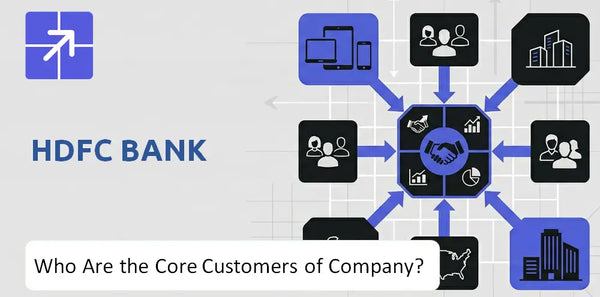
Focus on digital salaried acquisition and tailored MSME working-capital products to sustain low-cost deposits and superior asset quality; see HDFC Bank BCG Matrix Analysis for product-positioning insights.
Who Is HDFC Bank Trying to Win?
HDFC Bank tries to win mass-affluent retail customers, Micro, Small, and Medium Enterprises (MSMEs), and large corporate clients – groups that supply stable CASA deposits, fee income, and lending volumes.
 Main customer group: Mass-affluent retail (salaried & HNIs)
HDFC Bank target customers center on salaried professionals and high-net-worth individuals who deliver stable Current Account Savings Account (CASA) balances and recurring fee income. Post-2023 merger, mortgages are a primary acquisition channel to cross-sell insurance and investments to a projected 110 million customers by mid-2026.
Secondary groups: Semi-urban, rural, and young professionals
HDFC Bank customer segments include semi-urban and rural populations targeted through an expanded branch network of over 9,500 locations and plans to reach 200,000+ villages, plus students and young professionals for digital banking adoption and lifetime value growth.
Customer type and market role: Mixed retail and corporate franchise
HDFC Bank serves consumers (retail mortgages, deposits, wealth) and businesses (MSMEs, large corporates) with a mixed-market model: retail drives CASA and product cross-sell while corporate clients supply large-ticket lending and transaction banking fees.
Most important segment: Home-loan first retail customers
The most strategically important cohort is home-loan first customers: mortgages fuel liability gathering and provide cross-sell paths into insurance and mutual funds – key to hitting the bank's mid-2026 110 million customer projection and sustaining retail revenue growth; MSMEs are the next revenue-critical segment for fee and SME lending expansion. Read more in this Growth Outlook of HDFC Bank Company Growth Outlook of HDFC Bank Company.
HDFC Bank SWOT Analysis
- Complete SWOT Breakdown
- Fully Customizable
- Editable in Excel & Word
- Professional Formatting
- Investor-Ready Format

What Do HDFC Bank's Customers Care About Most?
HDFC Bank target customers care most about reliable institution-grade credit, a seamless digital experience, and integrated financial products that save time and liquidity. Retail users want one-stop mobile services; corporate and MSME clients prioritize credit availability and working-capital efficiency.

Reliable credit and liquidity access
Retail and corporate customers look for predictable credit lines and quick disbursals; HDFC Bank customer segments show demand for overdrafts, working-capital loans, and instant personal loans with rapid underwriting.
Practical buying drivers: speed, coverage, convenience
Customers pick HDFC Bank for fast digital payments (UPI, IMPS), broad branch/ATM reach, and bundled services – mortgages, cards, and insurance – reducing vendor count and friction in transactions.
Emotional and aspirational appeal: premium status
Affluent and HNI customer profile trends show demand for prestige products; Regalia and Infinia cardholders drive aspirational loyalty and higher spend per card compared with mass segments.
What customers value most: seamless digital ecosystem
Users value integrated experiences: one app for UPI, loans, investments, and card rewards. In 2025, digital transactions continued to grow, underpinning retention and share-of-wallet gains.
Loyalty and repeat demand drivers
Reward programs, premium card benefits, and credit line continuity support repeat use; the bank's loyalty cohorts (cards + loans + deposits) show higher retention and cross-sell rates.
Why customers choose HDFC Bank
HDFC Bank target market chooses the bank for institutional reliability, rapid credit scaling for MSMEs, and a dominant retail digital stack that combines payments, lending, and premium cards – backed by strong brand trust and distribution.
Refer to Ownership and Control analysis for governance context: Ownership and Control of HDFC Bank Company
HDFC Bank Business Model Canvas
- One-time Payment
- No Research Needed – Save Hours of Work
- Built by Experts, Trusted by Consultants
- Instant Download, Ready to Use
- 100% Editable, Fully Customizable

Where Is Demand Strongest for HDFC Bank?
Demand is strongest in Tier 2 and Tier 3 cities where rising incomes outpace public-bank infrastructure, while Mumbai, Bengaluru, and Delhi remain high-volume urban hubs; semi-urban and rural areas now supply roughly 32 percent of HDFC Bank's total business.
Main Market: Semi-Urban and Rural Growth Hubs
Tier 2 and Tier 3 cities drive the strongest demand for HDFC Bank target customers as disposable income climbs faster than local banking capacity; mortgage and gold loan uptake is notably high in these areas. The bank's post-merger branch expansion targets under-penetrated local markets previously served by smaller non-bank financial companies.
Secondary Markets: Urban Volume Centers
Mumbai, Bengaluru, and Delhi remain core volume hubs for HDFC Bank customer segments, supplying large retail and corporate deposits and transactional flows, while digital platforms extend reach from these centers into peripheries.
Where HDFC Bank Is Strongest: Branch + Digital Mix
HDFC Bank is strongest where its expanded physical footprint pairs with digital channels: branches in semi-urban networks plus PayZapp and SmartBuy for cross-selling. Retail banking customers and small business customers of HDFC Bank drive a diversified revenue mix across deposits, mortgages, and consumer loans.
Fastest-Growing Demand Areas in 2025
In 2025 the fastest growth is in mortgage and gold loan segments, each recording around 15 – 18 percent year-over-year growth as HDFC Bank leverages its reach; digital banking adoption via PayZapp and SmartBuy is also surging, expanding the HDFC Bank target market for digital banking and retail products.
For an in-depth look at strategy and customer targeting, see Sales and Marketing Strategy of HDFC Bank Company
HDFC Bank Marketing Mix
- Complete Marketing Mix Analysis
- Effortlessly Communicate Your Business Strategy
- Investor-Ready Format
- 100% Editable and Customizable
- Clear and Structured Layout

How Does HDFC Bank Keep Its Audience Growing?
HDFC Bank grows its audience by capturing payroll accounts from major corporations, cross-selling retail products, expanding into rural markets, and integrating wealth management to deepen customer relationships and reach adjacent segments.
How HDFC Bank Expands Its Customer Base
HDFC Bank wins low-cost access to thousands of retail borrowers by onboarding corporate payroll accounts and targets young professionals and salaried employees through digital onboarding and instant credit products, expanding the HDFC Bank target market into adjacent segments like SMEs and NRIs.
Customer Retention Drivers
Retention relies on the 10-second personal loan and Xpress Car Loan using AI credit scoring for instant liquidity, superior branch-plus-digital service, and payroll-linked stickiness – keeping churn rates well below digital-only peers.
Loyalty, Repeat Demand, and Customer Depth
Cross-selling to HDFC retail banking customers (deposits, cards, loans, wealth) increases product per customer; wealth management integration raises share-of-wallet among affluent and HNI customer profiles and boosts repeat transactions and long-term deposits.
Strongest Customer-Base Growth Lever
The payroll-to-retail cross-sell flywheel is the key lever: capturing payrolls reduces acquisition cost, enabling aggressive cross-sell and faster scaling while HDFC Bank normalizes its loan-to-deposit ratio toward 80% in 2025/2026 and targets rural penetration to capture a disproportionate share of India's projected 7% GDP growth; see Competitive Landscape of HDFC Bank Company for context: Competitive Landscape of HDFC Bank Company
HDFC Bank Boston Consulting Group Matrix
- Built by Experts, Trusted by Consultants
- Structured for Consultants, Students, and Founders
- 100% Editable in Microsoft Word & Excel
- Instant Digital Download – Use Immediately
- Compatible with Mac & PC – Fully Unlocked

Related Blogs
- What Is the History of HDFC Bank Company and How Did It Evolve?
- What Is the Competitive Landscape of HDFC Bank Company and How Does It Compete?
- What Is the Growth Outlook of HDFC Bank Company and Where Is It Heading?
- How Does HDFC Bank Company Work and What Drives Its Business Model?
- How Does HDFC Bank Company Reach Customers and Turn Demand into Sales?
- What Do the Mission, Vision, and Core Values of HDFC Bank Company Reveal?
- Who Owns HDFC Bank Company Today and Who Holds Control?
Frequently Asked Questions
HDFC Bank's core customers are mass-affluent retail clients, MSMEs, and large corporate clients. The bank also focuses on salaried professionals, high-net-worth individuals, semi-urban and rural customers, and young professionals, because these groups support deposits, lending, and fee income.
Disclaimer
All information, articles, and product details provided on this website are for general informational and educational purposes only. We do not claim any ownership over, nor do we intend to infringe upon, any trademarks, copyrights, logos, brand names, or other intellectual property mentioned or depicted on this site. Such intellectual property remains the property of its respective owners, and any references here are made solely for identification or informational purposes, without implying any affiliation, endorsement, or partnership.
We make no representations or warranties, express or implied, regarding the accuracy, completeness, or suitability of any content or products presented. Nothing on this website should be construed as legal, tax, investment, financial, medical, or other professional advice. In addition, no part of this site - including articles or product references - constitutes a solicitation, recommendation, endorsement, advertisement, or offer to buy or sell any securities, franchises, or other financial instruments, particularly in jurisdictions where such activity would be unlawful.
All content is of a general nature and may not address the specific circumstances of any individual or entity. It is not a substitute for professional advice or services. Any actions you take based on the information provided here are strictly at your own risk. You accept full responsibility for any decisions or outcomes arising from your use of this website and agree to release us from any liability in connection with your use of, or reliance upon, the content or products found herein.