
Who are ICBC's core customers in China's corporate and retail banking markets?
ICBC serves large state-owned enterprises, multinational corporates, and mass retail clients; this mix matters because scale drives net interest margins and fee income. In 2025 ICBC reported total assets of 49 trillion CNY, reflecting its systemic role and retail reach.
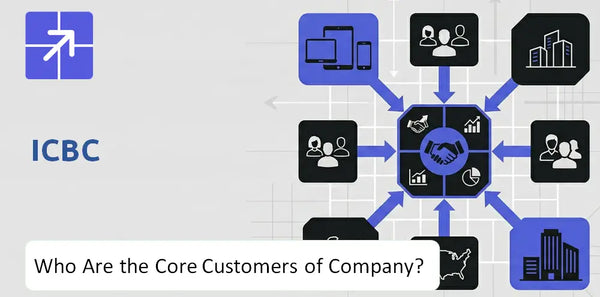
Focus on client segmentation: prioritize corporates for treasury services and affluent retail for wealth management. See product linkage for strategic tools: ICBC BCG Matrix Analysis
Who Is ICBC Trying to Win?
Industrial and Commercial Bank of China (ICBC) targets large state-owned and major private corporations in strategic sectors, the broad Chinese mass retail market including an expanding affluent middle class, plus SMEs and international firms linked to Belt and Road trade.
 Core institutional clients: SOEs and big corporates
ICBC core customers are large State-Owned Enterprises and major private firms in high-tech manufacturing, green energy, and infrastructure that need large credit lines and complex treasury services; these institutional relationships drive much of corporate lending and fee income.
Secondary customers: SMEs, cross-border corporates
ICBC target customers include Small and Medium Enterprises for working-capital and trade finance, and international corporations operating under Belt and Road who use ICBC for cross-border settlement and export finance solutions.
Customer type and market role: mixed institutional and retail bank
ICBC serves a mixed base: institutional corporate clients for large corporate banking and retail banking customers ICBC for deposits, mortgages, payments, and wealth management; retail scale supports liquidity while corporate clients drive higher-margin lending.
Most important segment by scale and revenue: retail reach and corporate scale
By 2025 ICBC serves over 765 million personal customers, while corporate lending to SOEs and large private groups accounts for a significant share of interest income and large-ticket balances, making both retail scale and corporate relationships strategically crucial. Read more on Ownership and Control of ICBC Company Ownership and Control of ICBC Company.
ICBC SWOT Analysis
- Complete SWOT Breakdown
- Fully Customizable
- Editable in Excel & Word
- Professional Formatting
- Investor-Ready Format

What Do ICBC's Customers Care About Most?
ICBC target customers care most about capital certainty, low funding costs, liquidity management, digital convenience, and secure wealth-growth options; institutional clients seek underwriting scale and market stability, while retail customers demand seamless mobile services and diversified wealth and green finance choices.

Capital certainty and underwriting scale
Institutional and government clients need reliable execution on large bond issuances and syndicated loans; ICBC's balance sheet and market-making capacity reduce execution risk during volatility.
Low cost of funding and liquidity solutions
Corporate clients prioritize cheap, stable funding and sophisticated liquidity management; they choose ICBC for cash-pooling, repo access, and interbank funding platforms that lower overall funding costs.
Digital convenience and security
Retail banking customers ICBC expect fast, secure mobile access; ICBC's mobile platform reached 560 million users by Q1 2026, showing demand for seamless payments, onboarding, and biometric security.
Wealth management and Green Finance
High net worth clients ICBC and growing retail investors want diversified WMPs and sustainable products; shifts from property to financial assets are increasing demand for ESG-labelled bonds and green loans.
Integrated lifestyle banking
Customers value financial services embedded into daily life – tax payments, healthcare, and e-commerce – so integrated APIs and partnerships drive stickiness for younger, urban segments.
Loyalty through reliability and product breadth
Repeat demand comes from trust in capital stability, broad product suites (corporate finance, trade, wealth), and digital convenience; institutional clients value counterparty strength, retail users value platform ubiquity.
Why customers choose ICBC
Clients pick ICBC for underwriting scale, low funding costs, deep liquidity services, and a mass digital platform – combining institutional-grade capabilities with retail digital reach. Read more on how ICBC Company operates and monetizes these strengths: How ICBC Company Works and Makes Money
ICBC Business Model Canvas
- One-time Payment
- No Research Needed – Save Hours of Work
- Built by Experts, Trusted by Consultants
- Instant Download, Ready to Use
- 100% Editable, Fully Customizable

Where Is Demand Strongest for ICBC?
Demand for Industrial and Commercial Bank of China (ICBC) is strongest in China's high-growth zones – the Yangtze River Delta, Pearl River Delta, and Beijing-Tianjin-Hebei – plus fast-growing international corridors in Southeast Asia and the Middle East; most activity now occurs in digital channels where routine volumes cluster.
Main Market Location: China's Economic Belts
The Yangtze River Delta, Pearl River Delta, and Beijing-Tianjin-Hebei drive the bulk of ICBC target customers for corporate lending and trade finance, accounting for roughly 45 – 55% of domestic corporate loan origination in 2025, reflecting heavy industrial upgrade and digital transformation demand.
Secondary Markets: Regional and International Growth
Southeast Asia and the Middle East are the fastest-growing external markets for ICBC core customers, where cross-border RMB services and export finance expanded merchant flows by about 12 – 18% year-over-year in 2025 through over 400 overseas institutions.
Where ICBC Is Strongest: Digital Reach and Corporate Banking
ICBC is strongest in large-enterprise and institutional banking and digital retail channels: its E-ICBC ecosystem handled over 99% of routine transactions in 2025, while corporate clients and high net worth clients ICBC contribute the largest fee and interest income mix.
Where Demand Is Growing Fastest: Digital Cross-Border and Advisory
Demand rose fastest in RMB internationalization services and digital trade finance platforms in 2025, with SE Asia corridors and Middle East corridors showing the largest increases; branches have repositioned as advisory hubs for wealth management and corporate restructuring to serve ICBC customer segments needing complex solutions. Read more in Sales and Marketing Strategy of ICBC Company
ICBC Marketing Mix
- Complete Marketing Mix Analysis
- Effortlessly Communicate Your Business Strategy
- Investor-Ready Format
- 100% Editable and Customizable
- Clear and Structured Layout

How Does ICBC Keep Its Audience Growing?
ICBC keeps its audience growing by embedding banking services into government platforms, corporate supply chains, and digital wallets, widening reach into retail, SME, corporate, and cross-border segments while raising retention through high switching costs and steady dividend returns.
Expanding ICBC's Customer Base
ICBC adds customers by integrating clearing and settlement into municipal and central government administrative systems and by partnering with e-commerce and logistics platforms to reach SMEs and retail banking customers ICBC. Cross-border digital payment rails and RMB internationalization bring in international trade clients and expatriate account holders.
Customer Retention Drivers
High switching costs from embedded corporate and government integrations, a customer-first digital strategy, and competitive pricing on core cash-management products reduce churn for ICBC core customers. A consistent dividend policy – 30 percent payout ratio in 2025 – also attracts long-term investors and stabilizes high net worth clients ICBC retention.
Loyalty, Repeat Demand, and Customer Depth
Embedding services in corporate supply chains and government platforms creates repeat demand for settlement and treasury services, deepening relationships with corporate clients ICBC and international trade clients. Wealth management and private banking offerings increase share-of-wallet among high net worth clients ICBC.
Strongest Customer-Base Growth Lever
The key growth lever is ecosystem integration: tying clearing, settlement, and digital payments into public-sector and corporate workflows locks in ICBC target customers and supports scale into SMEs and retail. With a Tier 1 capital adequacy ratio above 15.5 percent in 2025 and emphasis on non-interest income, ICBC is positioned to capture sustainable finance and cross-border payment demand; see Competitive Landscape of ICBC Company for context: Competitive Landscape of ICBC Company
ICBC Boston Consulting Group Matrix
- Built by Experts, Trusted by Consultants
- Structured for Consultants, Students, and Founders
- 100% Editable in Microsoft Word & Excel
- Instant Digital Download – Use Immediately
- Compatible with Mac & PC – Fully Unlocked

Related Blogs
- What Is the History of ICBC Company and How Did It Evolve?
- What Is the Competitive Landscape of ICBC Company and How Does It Compete?
- What Is the Growth Outlook of ICBC Company and Where Is It Heading?
- How Does ICBC Company Work and What Drives Its Business Model?
- How Does ICBC Company Reach Customers and Turn Demand into Sales?
- What Do the Mission, Vision, and Core Values of ICBC Company Reveal?
- Who Owns ICBC Company Today and Who Holds Control?
Frequently Asked Questions
ICBC's core customers are large State-Owned Enterprises and major private firms in strategic sectors. The bank also serves SMEs, cross-border corporates, and a broad retail base, but big institutional clients drive much of its corporate lending and fee income.
Disclaimer
All information, articles, and product details provided on this website are for general informational and educational purposes only. We do not claim any ownership over, nor do we intend to infringe upon, any trademarks, copyrights, logos, brand names, or other intellectual property mentioned or depicted on this site. Such intellectual property remains the property of its respective owners, and any references here are made solely for identification or informational purposes, without implying any affiliation, endorsement, or partnership.
We make no representations or warranties, express or implied, regarding the accuracy, completeness, or suitability of any content or products presented. Nothing on this website should be construed as legal, tax, investment, financial, medical, or other professional advice. In addition, no part of this site - including articles or product references - constitutes a solicitation, recommendation, endorsement, advertisement, or offer to buy or sell any securities, franchises, or other financial instruments, particularly in jurisdictions where such activity would be unlawful.
All content is of a general nature and may not address the specific circumstances of any individual or entity. It is not a substitute for professional advice or services. Any actions you take based on the information provided here are strictly at your own risk. You accept full responsibility for any decisions or outcomes arising from your use of this website and agree to release us from any liability in connection with your use of, or reliance upon, the content or products found herein.