
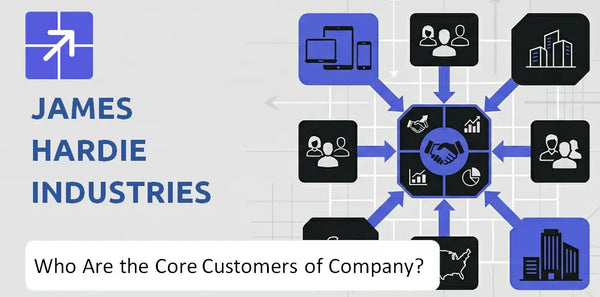
Who are James Hardie Industries' core customers in the premium exterior cladding market?
James Hardie Industries targets builders, remodelers, and specification-driven architects focusing on premium, durable exteriors. This matters because the firm's brand allows 29 – 31% adjusted EBITDA margins in 2025, driven by repair/remodel demand and premium pricing supported by product acceptance in North America and APAC.
Prioritize remodelers and architects for margin stability; product specs and warranty credibility drive repeat demand. See James Hardie Industries BCG Matrix Analysis
Who Is James Hardie Industries Trying to Win?
James Hardie Industries targets professional installers, national homebuilders, and high-intent remodel homeowners; the core focus is siding contractors who specify materials on most residential projects and drive volume.
 Primary: Professional Contractors
Professional contractors – especially siding specialists – are the main customer group because they influence material choice on about 80 percent of North American residential projects, making them decisive for sales and specification.
Secondary: National Homebuilders & Developers
James Hardie targets the top 20 U.S. homebuilders who need standardized performance and reliable supply; these builders support large, repeat orders and reduce unit-cost volatility for the company.
Customer Type: Mixed B2B and B2C Focus
James Hardie serves both businesses (builders, contractors, distributors) and consumers (high-end homeowners and remodelers), with a B2B tilt since contractors and builders control specifications and bulk purchasing.
Most Important Segment: Repair & Remodel Homeowners
The repair and remodel segment accounts for roughly 65 percent of North American volume for James Hardie, giving resilience versus new-construction cyclicality and making remodelers and high-intent homeowners strategically critical.
For context and further reading on market positioning and growth, see Growth Outlook of James Hardie Industries Company
James Hardie Industries SWOT Analysis
- Complete SWOT Breakdown
- Fully Customizable
- Editable in Excel & Word
- Professional Formatting
- Investor-Ready Format

What Do James Hardie Industries's Customers Care About Most?
James Hardie target customers prioritize long-term durability, fire resistance, and low-maintenance aesthetics; professional builders want fast, error-free installs, while homeowners seek safety and curb appeal that lasts. Purchase drivers are performance in climate, reduced lifecycle cost, and factory-finished options that cut onsite labor.

Durability and Climate Performance
James Hardie core customers buy for proven longevity: fiber cement resists rot, pests, and moisture better than vinyl. The HardieZone system tailors product specs to climate, a key selling point for builders and contractors in coastal, cold, or humid markets.
Practical Installation and Cost Drivers
Contractors and builders value ease of installation and fewer callbacks; factory-finished ColorPlus Technology reduces onsite painting and labor. With construction labor shortages in 2025, factory finishes lower total installed cost and speed projects.
Safety and Fire Resistance
Homeowners looking for durable fiber cement siding prioritize non-combustible materials in wildfire-prone areas; fiber cement offers a competitive advantage over vinyl for safety-conscious buyers and insurers.
Aesthetics and Low Maintenance
Homeowners and remodelers prefer factory-applied color for consistent curb appeal without repainting. In 2025 demand shifted noticeably toward ColorPlus, reflecting a preference for low-maintenance, high-quality finishes.
Loyalty and Repeat Specification
Architects and specifiers repeat James Hardie product specs when performance data and warranty back claims; long-tail customers like new home builders and commercial developers return when installations lower lifecycle costs and warranty claims remain low.
Why Customers Choose James Hardie
Customers choose James Hardie for climate-tailored performance, factory-finished ColorPlus convenience, and non-combustible durability that reduces insurance and maintenance expenses. See a market-focused review in Competitive Landscape of James Hardie Industries Company.
James Hardie Industries Business Model Canvas
- One-time Payment
- No Research Needed – Save Hours of Work
- Built by Experts, Trusted by Consultants
- Instant Download, Ready to Use
- 100% Editable, Fully Customizable

Where Is Demand Strongest for James Hardie Industries?
Demand is strongest in North American residential markets, especially the Southern and Western United States, where migration and new housing drive growth; North America accounts for over 70 percent of James Hardie Industries Company's total EBIT.
Main Market: North American Residential Corridors
The primary James Hardie target customers are new home builders, remodelers, and homeowners seeking durable fiber cement siding in the U.S.; the Southern and Western United States show the highest demand due to sustained migration and housing formation, supporting installation volume and pricing power.
Secondary Markets: Pacific Northwest, Northeast, and Australia
James Hardie core customers also include contractors and architects in the Pacific Northwest and Northeast where fiber cement is taking share from wood siding, plus the Australia market in Asia-Pacific where penetration in detached housing is near-ubiquitous.
Where James Hardie Is Strongest: Channels and Products
Revenue mix is strongest through professional distribution networks and big-box retailers such as Home Depot, reaching builders and contractors as well as contractors specializing in James Hardie installation and sophisticated DIY homeowners; backer board and trim products capture smaller-scale contractors and remodelers.
Where Demand Is Growing Fastest (2025 – 2026)
Fastest growth corridors are Southern and Western U.S. metros plus accelerating uptake in the Pacific Northwest and Northeast as homeowners and specifiers shift from wood to fiber cement; Asia-Pacific expansion remains stable with high market share in Australia. Read the Sales and Marketing Strategy of James Hardie Industries Company for deeper channel and customer-segment detail: Sales and Marketing Strategy of James Hardie Industries Company
James Hardie Industries Marketing Mix
- Complete Marketing Mix Analysis
- Effortlessly Communicate Your Business Strategy
- Investor-Ready Format
- 100% Editable and Customizable
- Clear and Structured Layout

How Does James Hardie Industries Keep Its Audience Growing?
James Hardie Industries grows its audience by expanding manufacturing capacity and shifting sales toward higher-margin products, entering adjacent segments like modern architecture and light commercial while strengthening installer loyalty and trade relationships.
Capacity expansion to reach more builders and homeowners
James Hardie target customers expand as the company invests in a multi-year CAPEX program, including Prattville, Alabama and new Australian capacity, supporting a push to 35 percent North American siding share and enabling supply to builders and contractors and homeowners seeking fiber cement siding.
Shifting product mix to penetrate new segments
The 2025 – 2026 strategic tilt to the Architectural Collection targets architects and specifiers, remodelers preferring James Hardie siding, and commercial developers choosing James Hardie products, growing presence in modern contemporary and light commercial projects.
Installer programs and technical training
Extensive technical training and certification for contractors specializing in James Hardie installation raise switching costs, so remodelers and new home builders using James Hardie siding stay with the brand and siding distributors for James Hardie brands keep stocking it.
Loyalty and repeat demand via Hardie Rewards
The Hardie Rewards program deepens customer depth – encouraging repeat purchases from contractors and homeowners looking for durable fiber cement siding – and links to specifier preferences, increasing lifetime value and referral-driven growth.
Pricing power and resilience as the growth lever
James Hardie Industries leverages superior pricing power and a structural shift toward resilient, high-performance envelopes to outpace building materials; management expects continued outperformance in 2026 as demand for premium siding holds.
Where to read more on strategy and values
See the company's guiding principles and strategy in Mission, Vision, and Values of James Hardie Industries Company
James Hardie Industries Boston Consulting Group Matrix
- Built by Experts, Trusted by Consultants
- Structured for Consultants, Students, and Founders
- 100% Editable in Microsoft Word & Excel
- Instant Digital Download – Use Immediately
- Compatible with Mac & PC – Fully Unlocked

Related Blogs
- What Is the History of James Hardie Industries Company and How Did It Evolve?
- What Is the Competitive Landscape of James Hardie Industries Company and How Does It Compete?
- What Is the Growth Outlook of James Hardie Industries Company and Where Is It Heading?
- How Does James Hardie Industries Company Work and What Drives Its Business Model?
- How Does James Hardie Industries Company Reach Customers and Turn Demand into Sales?
- What Do the Mission, Vision, and Core Values of James Hardie Industries Company Reveal?
- Who Owns James Hardie Industries Company Today and Who Holds Control?
Frequently Asked Questions
James Hardie Industries targets professional contractors, national homebuilders, and high-intent remodel homeowners. The core focus is siding contractors because they specify materials on most residential projects and strongly influence purchase decisions. The company also serves builders, distributors, and consumers, with a B2B tilt overall.
Disclaimer
All information, articles, and product details provided on this website are for general informational and educational purposes only. We do not claim any ownership over, nor do we intend to infringe upon, any trademarks, copyrights, logos, brand names, or other intellectual property mentioned or depicted on this site. Such intellectual property remains the property of its respective owners, and any references here are made solely for identification or informational purposes, without implying any affiliation, endorsement, or partnership.
We make no representations or warranties, express or implied, regarding the accuracy, completeness, or suitability of any content or products presented. Nothing on this website should be construed as legal, tax, investment, financial, medical, or other professional advice. In addition, no part of this site - including articles or product references - constitutes a solicitation, recommendation, endorsement, advertisement, or offer to buy or sell any securities, franchises, or other financial instruments, particularly in jurisdictions where such activity would be unlawful.
All content is of a general nature and may not address the specific circumstances of any individual or entity. It is not a substitute for professional advice or services. Any actions you take based on the information provided here are strictly at your own risk. You accept full responsibility for any decisions or outcomes arising from your use of this website and agree to release us from any liability in connection with your use of, or reliance upon, the content or products found herein.