
Who are LIFEDRINK COMPANY Inc.'s core customers among price-sensitive Japanese households?
LIFEDRINK COMPANY Inc. serves value-seeking Japanese families and single households trading down from premium labels; this matters because sales grew over 12% annually into 2025 as private-label demand rose amid weak real wages. See product detail: Lifedrink BCG Matrix Analysis
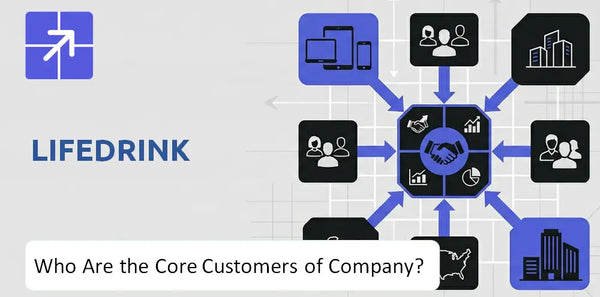
LIFEDRINK's core customers prioritize affordability and consistent quality; retailers report rising private-label share in 2025, so focus on supply-chain cost control to retain volume.
Who Is Lifedrink Trying to Win?
LIFEDRINK COMPANY Inc. targets budget-conscious stock-up households and large retail distributors – suburban families and urban professionals who buy bottled water and green tea in bulk to cut unit cost, plus supermarket and drugstore chains seeking private-label margin. Vending operators are secondary; the focus is high-frequency, high-volume household buyers.
 Main household buyer group
Suburban families and urban professionals who see bottled water and green tea as everyday staples, buying multipacks online or at discount retailers to minimize cost per unit – this segment drives repeat volume and accounts for an estimated 60% of retail sales in similar value beverage categories.
Secondary and adjacent buyer segments
Vending machine operators, college housing buyers, and price-sensitive seniors represent smaller but relevant channels; combined they often contribute 15 – 25% incremental volume depending on regional deployment and seasonality.
Customer type and market role
LIFEDRINK serves a mixed base: primarily consumers (households) plus business-to-business partners (retail chains and wholesalers). Institutional accounts provide stable, high-volume purchase orders and improve gross margin via private-label agreements.
Most important revenue segment
The high-frequency, high-volume household buyer is most important by revenue and scale – bulk e-commerce and discount retail channels typically deliver the highest SKU velocity and repeat purchase rates, often representing over 50% of channel sales for value beverage brands. See Ownership and Control of Lifedrink Company for corporate context: Ownership and Control of Lifedrink Company
Lifedrink SWOT Analysis
- Complete SWOT Breakdown
- Fully Customizable
- Editable in Excel & Word
- Professional Formatting
- Investor-Ready Format

What Do Lifedrink's Customers Care About Most?
Lifedrink core customers prioritize low price paired with guaranteed Made in Japan quality and safety; they want functional, silica-rich waters and teas that support daily health without premium markups, plus simpler recycling via label-less packaging.

Affordability with Certified Japanese Quality
Many in the Lifedrink target market demand prices 20 – 30% below Suntory or Kirin while requiring Japan-origin production and safety certifications (JAS, 食品衛生法 compliance) to avoid perceived quality trade-offs.
Practical Buying Drivers: Price, Safety, Convenience
Purchase drivers are price competitiveness, clear Made in Japan labeling, silica mineral content claims for water, and label-less bottles that lower household recycling effort and marginally reduce pack cost.
Minimal Aspirational Pull; Functional Health Wins
Emotional or prestige motives are weak; buyers favor functional tea ingredients and silica-rich water for daily wellness rather than status. Aspiration scores in surveys fall below 15% for purchase drivers.
What Customers Value Most: Safety, Efficacy, Cost
Customers value verifiable safety standards, measurable functional benefits (e.g., silica ppm) and transparent pricing; willingness-to-pay studies show sensitivity above a 20% premium triggers churn.
Loyalty Drivers: Consistent Quality and Low Price
Repeat demand hinges on consistent Made in Japan batches, steady silica/functional ingredient labeling, and subscription or bulk pricing; retention lifts by ~12 – 18% with auto-reorder discounts.
Why Customers Choose Lifedrink
Core buyers pick Lifedrink because it matches required safety standards while offering 20 – 30% lower price points and label-less, recyclable packaging – practical value for health-conscious, budget-sensitive consumers.
Competitive Landscape of Lifedrink Company
Lifedrink Business Model Canvas
- One-time Payment
- No Research Needed – Save Hours of Work
- Built by Experts, Trusted by Consultants
- Instant Download, Ready to Use
- 100% Editable, Fully Customizable

Where Is Demand Strongest for Lifedrink?
Demand is strongest online, with e-commerce accounting for approximately 18 percent of LIFEDRINK COMPANY Inc.'s total sales in the 2025 fiscal cycle; Kanto and Kansai show the highest volumes, while Kyushu and Northern Japan are the fastest-growing regions after 2025 regional production expansion.
Main Market Location: Metropolitan E – commerce Hubs
Online marketplaces drive the Lifedrink target market: Rakuten and Amazon Japan lead category rankings for Water and Tea, concentrating sales among urban shoppers in Kanto and Kansai where dense populations and reliable home delivery lower unit distribution costs.
Secondary Markets: Regional Growth Corridors
Beyond metro areas, Kyushu and Northern Japan are notable Lifedrink customer segments after the 2025 opening of regional production sites; localized supply cut shipping costs and improved price leadership for retailers and wholesale partners.
Where LIFEDRINK COMPANY Inc. Is Strongest
LIFEDRINK COMPANY Inc. is strongest in e-commerce reach and category rankings, where online sales mix (~18 percent) yields the highest margin growth; dominance in Water and Tea on major platforms translates to strong share among health-conscious consumers and young professionals.
Where Demand Is Growing Fastest
Fastest growth is in Kyushu and Northern Japan post-2025 production expansion, with early data showing double-digit volume increases versus 2024 in some prefectures as lower logistics costs boost competitive pricing and adoption among local consumer segments; see the company mission context Mission, Vision, and Values of Lifedrink Company.
Lifedrink Marketing Mix
- Complete Marketing Mix Analysis
- Effortlessly Communicate Your Business Strategy
- Investor-Ready Format
- 100% Editable and Customizable
- Clear and Structured Layout

How Does Lifedrink Keep Its Audience Growing?
LIFEDRINK COMPANY Inc. grows its audience by controlling costs via vertical integration, locking repeat buyers with subscription channels, and expanding into functional beverages and carbonated water to reach adjacent segments in 2025 – 2026.
Expanding into adjacent beverage segments
LIFEDRINK targets new Lifedrink target market cohorts by adding functional beverages and carbonated water, aiming to capture health-conscious consumers and young professionals; product diversification supports entry into retail and DTC channels and broadens Lifedrink customer segments.
Customer Retention Drivers
Retention relies on subscription-based purchasing on digital platforms, stable low pricing from vertical integration, and predictable inventory and delivery through final-mile logistics, which together reduce churn and increase lifetime value for Lifedrink core customers.
Loyalty, Repeat Demand, and Customer Depth
Auto-renew subscriptions, bundled SKUs (functional + carbonated lines), and targeted promotions to fitness enthusiasts and parents increase repeat purchases; loyalty metrics forecast an increase in average order frequency by +18% after 2025 product launches.
Strongest Customer-Base Growth Lever
The primary lever is vertical integration that delivers the lowest-cost position; combined with subscription revenue, management projects an operating margin of 9.2 percent in fiscal 2025 and a 15 percent increase in production capacity to serve expanded consumer segments.
For tactical detail on channels and segmentation, see Sales and Marketing Strategy of Lifedrink Company
Lifedrink Boston Consulting Group Matrix
- Built by Experts, Trusted by Consultants
- Structured for Consultants, Students, and Founders
- 100% Editable in Microsoft Word & Excel
- Instant Digital Download – Use Immediately
- Compatible with Mac & PC – Fully Unlocked

Related Blogs
- What Is the History of Lifedrink Company and How Did It Evolve?
- What Is the Competitive Landscape of Lifedrink Company and How Does It Compete?
- What Is the Growth Outlook of Lifedrink Company and Where Is It Heading?
- How Does Lifedrink Company Work and What Drives Its Business Model?
- How Does Lifedrink Company Reach Customers and Turn Demand into Sales?
- What Do the Mission, Vision, and Core Values of Lifedrink Company Reveal?
- Who Owns Lifedrink Company Today and Who Holds Control?
Frequently Asked Questions
Lifedrink's main target customers are budget-conscious stock-up households, especially suburban families and urban professionals. They buy bottled water and green tea in bulk to lower unit cost. Large retail distributors, supermarket chains, and drugstore chains are also important because they seek private-label margin and stable high-volume orders.
Disclaimer
All information, articles, and product details provided on this website are for general informational and educational purposes only. We do not claim any ownership over, nor do we intend to infringe upon, any trademarks, copyrights, logos, brand names, or other intellectual property mentioned or depicted on this site. Such intellectual property remains the property of its respective owners, and any references here are made solely for identification or informational purposes, without implying any affiliation, endorsement, or partnership.
We make no representations or warranties, express or implied, regarding the accuracy, completeness, or suitability of any content or products presented. Nothing on this website should be construed as legal, tax, investment, financial, medical, or other professional advice. In addition, no part of this site - including articles or product references - constitutes a solicitation, recommendation, endorsement, advertisement, or offer to buy or sell any securities, franchises, or other financial instruments, particularly in jurisdictions where such activity would be unlawful.
All content is of a general nature and may not address the specific circumstances of any individual or entity. It is not a substitute for professional advice or services. Any actions you take based on the information provided here are strictly at your own risk. You accept full responsibility for any decisions or outcomes arising from your use of this website and agree to release us from any liability in connection with your use of, or reliance upon, the content or products found herein.