
Who are Samsonite International's core customers in the global luggage market?
Samsonite International S.A. targets affluent business travelers and value-conscious younger tourists across a price-point pyramid. This matters because a 17% market share in 2025 lets the firm sustain margins by serving both luxury and budget segments, as seen in 2025 sales mix shifts.
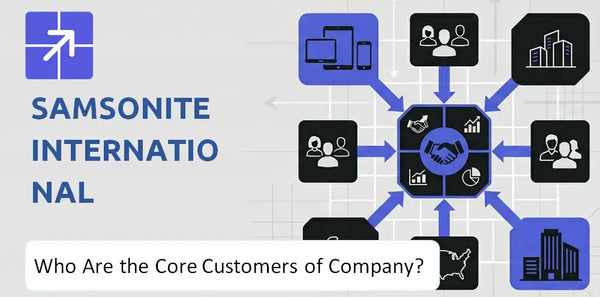
Focus on product tiers: prioritize premium carry-on lines for business travel and entry models for Gen Z leisure. See Samsonite International BCG Matrix Analysis for portfolio implications: Samsonite International BCG Matrix Analysis
Who Is Samsonite International Trying to Win?
Samsonite International S.A. targets three tiers: a Premium Professional segment via Tumi, a mass Reliable Voyager through Samsonite, and an Entry-Level Explorer via American Tourister and Kamiliant, aiming to capture affluent business travelers, middle-to-upper-income families, and younger/emerging-market buyers.
 Premium Professional: high-net-worth business travelers
Tumi targets frequent business travelers and affluent buyers who treat luggage as a status and productivity tool; corporate procurement of premium briefcases and carry-ons fuels higher ASPs and recurring upgrade cycles.
Reliable Voyager: mainstream frequent flyers and families
Samsonite serves middle-to-upper-income family travelers and frequent flyers prioritizing durability and long-term value; this segment drives the largest share of unit sales and steady revenue in developed markets.
Entry-Level Explorer: younger and emerging-market consumers
American Tourister and Kamiliant focus on millennials, Gen Z, students, and the growing middle class in India and Southeast Asia; price-sensitive buyers and first-time suitcase purchasers expand volume and market penetration.
Customer type and market role: mixed consumer-led market
Samsonite target market is predominantly consumers across income tiers, with notable B2B sales for corporate procurement and travel-retailer wholesale channels; retail partners and online platforms split distribution.
Most important segment by revenue and scale
The Reliable Voyager segment (Samsonite brand) appears most important: it generates the bulk of global unit volume and steady revenue, while Tumi delivers higher average selling prices and margins – together accounting for the firm's geographic reach and channel mix. See more on market strategy in How Samsonite International Company Works and Makes Money.
Samsonite International SWOT Analysis
- Complete SWOT Breakdown
- Fully Customizable
- Editable in Excel & Word
- Professional Formatting
- Investor-Ready Format

What Do Samsonite International's Customers Care About Most?
Samsonite International S.A. customers want durable, lightweight luggage that looks premium and supports modern travel routines; they buy for functional innovation, brand trust, and post-purchase service. Demand is led by business and frequent flyers seeking strength-to-weight performance plus Bleisure features like integrated charging and modular packing.

Strength-to-weight performance
Customers need luggage that stays under airline weight limits while surviving heavy use; proprietary materials such as Curv and recycled Roxkin shells deliver high impact resistance with low mass, reducing the risk of overweight baggage fees for frequent flyers and business travelers for Samsonite.
Practical buying drivers: functionality and tech
Buyers prioritize integrated tech (USB/USB-C charging), modular compartments for laptops and garments, and easy maneuverability; in 2025, Bleisure functionality rose materially as a purchase driver among millennials and Gen Z consumers of Samsonite products.
Emotional and aspirational appeal
Brand prestige and reliability matter – customers view Samsonite as a safe, long-lasting choice that signals professionalism for corporate procurement of Samsonite luggage and briefcases and status for luxury buyers interested in high-end Samsonite collections.
What customers value most
Customers value a combination of durability, low weight, and service – specifically a global repair network and warranties that protect post-purchase value; survey data in 2025 shows ~62% of frequent travelers list after-sales support among top three priorities.
Loyalty and repeat demand
Repeat purchases are driven by repairable products, brand trust, and product lifecycles; Samsonite's global repair capability and multi-year warranties convert first-time buyers – including family travelers buying Samsonite and college students buying Samsonite backpacks and luggage – into repeat customers.
Why customers choose Samsonite
Samsonite wins because it pairs patented materials and thoughtful Bleisure features with an established global service network; this beats many digitally native, direct-to-consumer startups on total cost-of-ownership and post-sale reliability. Read more in Growth Outlook of Samsonite International Company
Samsonite International Business Model Canvas
- One-time Payment
- No Research Needed – Save Hours of Work
- Built by Experts, Trusted by Consultants
- Instant Download, Ready to Use
- 100% Editable, Fully Customizable

Where Is Demand Strongest for Samsonite International?
Demand is strongest in Asia-Pacific, driven by China outbound travel recovery and India's middle-class growth; DTC and high-traffic airport hubs show the most active purchasing behavior.
Main Market Location: Asia-Pacific
Asia-Pacific generates about 39 percent of Samsonite International S.A. net sales in fiscal 2025, led by full normalization of Chinese outbound tourism and rapid expansion of India's middle class, making it the Samsonite target market focus.
Secondary Markets: North America and E-commerce Hubs
North America remains a stable cash-flow region with strong corporate and frequent flyer demand, while global e-commerce marketplaces and airport retail hubs capture rising travel-intent purchases and impulse buys.
Where Samsonite International S.A. Is Strongest
Samsonite International S.A. is strongest in Direct-to-Consumer channels, which now represent nearly 40 percent of total revenue mix, and in travel retail at major international airports where brand visibility and higher average transaction values prevail.
Fastest-Growing Demand Areas (2025 – 2026)
Fastest growth is in airport retail hubs and online marketplaces using data-driven pricing to respond to travel intent; digital channels, driven by millennials and Gen Z e-commerce shoppers, and Indian urban markets show the steepest CAGR.
Competitive Landscape of Samsonite International Company
Samsonite International Marketing Mix
- Complete Marketing Mix Analysis
- Effortlessly Communicate Your Business Strategy
- Investor-Ready Format
- 100% Editable and Customizable
- Clear and Structured Layout

How Does Samsonite International Keep Its Audience Growing?
Samsonite International S.A. grows its audience by diversifying into lifestyle categories, expanding digital marketing to Gen Z and Millennials, and leaning into sustainability to boost retention and brand relevance.
How Samsonite Expands Its Customer Base
Samsonite target market expansion combines product diversification (Tumi added premium handbags, eyewear, golf gear) and digital-first channels to reach adjacent segments like millennials, Gen Z, and luxury buyers. Tumi's lifestyle push raised its total addressable market by an estimated 15 percent in 2025, opening cross-sell into fashion and sports categories.
Customer Retention Drivers
Retention relies on product breadth, consistent quality, and sustainability credentials that resonate with eco-conscious travelers. Samsonite allocates about 7 percent of net sales to targeted social commerce and influencer partnerships, improving engagement with frequent flyers Samsonite customers and business travelers for Samsonite.
Loyalty, Repeat Demand, and Customer Depth
Loyalty stems from multi-category ownership (carry-on, backpacks, premium bags) and retailer partnerships that drive repeat purchases from family vacationers choosing Samsonite suitcases and corporate procurement of Samsonite luggage. Ecosystem stickiness increases as digital channels personalize offers for college students buying Samsonite backpacks and digital nomads choosing Samsonite carry-on luggage.
The Strongest Customer-Base Growth Lever
The biggest lever is lifestyle-driven product diversification plus a sophisticated digital marketing engine. With a projected net sales CAGR of 6 – 8 percent for 2025 – 2026 and a targeted 19 percent EBITDA margin, Samsonite International S.A. pairs category expansion with sustainable positioning to win millennials and Gen Z consumers of Samsonite products. Read more on corporate strategy in this article: Mission, Vision, and Values of Samsonite International Company
Samsonite International Boston Consulting Group Matrix
- Built by Experts, Trusted by Consultants
- Structured for Consultants, Students, and Founders
- 100% Editable in Microsoft Word & Excel
- Instant Digital Download – Use Immediately
- Compatible with Mac & PC – Fully Unlocked

Related Blogs
- What Is the History of Samsonite International Company and How Did It Evolve?
- What Is the Competitive Landscape of Samsonite International Company and How Does It Compete?
- What Is the Growth Outlook of Samsonite International Company and Where Is It Heading?
- How Does Samsonite International Company Work and What Drives Its Business Model?
- How Does Samsonite International Company Reach Customers and Turn Demand into Sales?
- What Do the Mission, Vision, and Core Values of Samsonite International Company Reveal?
- Who Owns Samsonite International Company Today and Who Holds Control?
Frequently Asked Questions
Samsonite International targets three main groups: premium professionals through Tumi, mainstream frequent flyers and families through Samsonite, and younger or emerging-market buyers through American Tourister and Kamiliant. The company also serves some corporate procurement and wholesale channels, but its core market is consumer-led across income tiers.
Disclaimer
All information, articles, and product details provided on this website are for general informational and educational purposes only. We do not claim any ownership over, nor do we intend to infringe upon, any trademarks, copyrights, logos, brand names, or other intellectual property mentioned or depicted on this site. Such intellectual property remains the property of its respective owners, and any references here are made solely for identification or informational purposes, without implying any affiliation, endorsement, or partnership.
We make no representations or warranties, express or implied, regarding the accuracy, completeness, or suitability of any content or products presented. Nothing on this website should be construed as legal, tax, investment, financial, medical, or other professional advice. In addition, no part of this site - including articles or product references - constitutes a solicitation, recommendation, endorsement, advertisement, or offer to buy or sell any securities, franchises, or other financial instruments, particularly in jurisdictions where such activity would be unlawful.
All content is of a general nature and may not address the specific circumstances of any individual or entity. It is not a substitute for professional advice or services. Any actions you take based on the information provided here are strictly at your own risk. You accept full responsibility for any decisions or outcomes arising from your use of this website and agree to release us from any liability in connection with your use of, or reliance upon, the content or products found herein.