
Who are Spicers Company's core customers in industrial packaging and visual signage markets?
Spicers anchors Australian and New Zealand manufacturers, printers, and sign businesses with stocked paper, packaging, and sign materials, reducing lead times and price volatility. This matters because by 2025 Spicers strengthened logistics and inventory depth under Kokusai Pulp and Paper, boosting service reliability.
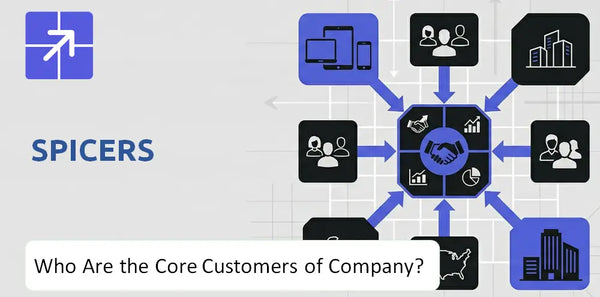
Focus on manufacturers and large print shops that need reliable supply and higher-margin packaging and signage; consider the Spicers BCG Matrix Analysis for portfolio positioning.
Who Is Spicers Trying to Win?
Spicers tries to win high-volume commercial printers, packaging manufacturers, and visual communication firms that deliver predictable, contract-based B2B revenue rather than one-off retail sales.
 Core: Commercial Printers and Digital Print Houses
Spicers targets commercial printers and digital print houses that need reliable bulk paper for publishing, direct mail, and marketing collateral; these customers historically generate the largest volumes and account for a substantial share of paper sales.
Secondary: Packaging Manufacturers and Converters
Spicers pursues packaging manufacturers using industrial boards and flexible packaging for food, beverage, and e-commerce; this segment grew industry-wide by roughly 6 – 8% annual demand in 2024 – 2025 and offers higher margins via specialty board products.
Adjacents: Visual Communication and Signage Firms
Spicers targets sign-writers and large-format display producers for architectural signage and retail displays; these customers provide recurring orders for specialty substrates and coatings, shifting revenue from legacy transactional print.
Customer Type: B2B Focus with Institutional Accounts
Spicers primarily serves business customers, including SMEs and corporate procurement managers, with institutional buyers like universities and wholesalers forming part of the long tail; contract-based industrial accounts are prioritized for predictable revenue.
Most Important Segment by Strategic Value
The most important segment is contract-based industrial packaging and large-format signage accounts because they deliver steadier, higher-margin revenue; targeting these has improved gross mix toward specialty board products in recent fiscal years – see Growth Outlook of Spicers Company.
Spicers SWOT Analysis
- Complete SWOT Breakdown
- Fully Customizable
- Editable in Excel & Word
- Professional Formatting
- Investor-Ready Format

What Do Spicers's Customers Care About Most?
Spicers target customers prioritize fast, reliable supply and technical support to keep production lines running; they demand guaranteed availability, next-day delivery, and integrated service for wide-format hardware. Sustainability and total cost of ownership now heavily influence procurement decisions for Spicers core customers.

Speed and guaranteed availability
Spicers customer segments – commercial printers Spicers, retail partners Spicers, and business customers Spicers – need stock certainty to avoid downtime; top-tier clients now expect 97% or higher on-time-in-full (OTIF) to meet production schedules and many require next-day delivery for critical SKUs.
Practical buying drivers: uptime and TCO
Procurement managers and B2B paper supply buyers and wholesalers judge suppliers on total cost of ownership (TCO) – uptime, waste reduction, and service – rather than raw price; customers report paying premiums when uptime improvements cut waste by 15 – 25%.
Technical competence and service integration
Spicers customers small and medium enterprises and commercial print shops expect installation, color management, and ongoing maintenance bundled with wide-format hardware; technical service availability often determines vendor selection for graphic designers and creative agencies.
Sustainability requirements rising
Corporate procurement managers increasingly specify recycled content or certified sustainable forestry materials; in 2025 over 70% of new tenders referenced recycled or certified substrates, making eco-compliance a procurement gate.
Emotional and aspirational appeal
Retail partners Spicers and educational institutions seeking brand alignment value suppliers who project reliability and sustainability; choosing a supplier signals environmental responsibility to stakeholders and customers.
What customers value most
Customers value demonstrable uptime, fast replenishment, and certified sustainable substrates; for many buyers the decisive metric is predictable production continuity backed by service and availability guarantees.
Loyalty and repeat demand drivers
Consistent OTIF performance, preventative maintenance agreements, and verified sustainable sourcing drive repeat orders from Spicers wholesale paper and board customers and long-term contracts with corporate buyers.
Why customers choose Spicers
Spicers wins when it combines inventory reliability, next-day delivery capability, and integrated technical services that reduce TCO for print shops and commercial printers; see market context in Competitive Landscape of Spicers Company.
Spicers Business Model Canvas
- One-time Payment
- No Research Needed – Save Hours of Work
- Built by Experts, Trusted by Consultants
- Instant Download, Ready to Use
- 100% Editable, Fully Customizable

Where Is Demand Strongest for Spicers?
Demand is strongest in industrial packaging and Wide Format Signage, concentrated in Sydney, Melbourne, and Brisbane logistics and manufacturing hubs, with resilient export packaging demand in New Zealand's primary industries.
Main Market Location – Urban logistics and manufacturing hubs
Sydney, Melbourne, and Brisbane account for the bulk of demand because e-commerce fulfillment centers and manufacturers require constant protective packaging, labels, and corrugated materials; these metros drove roughly ~48% of regional revenue from industrial packaging and Wide Format Signage in H1 2026.
Secondary Markets – New Zealand primary industries and regional retail
New Zealand's horticulture and viticulture sectors sustain steady demand for durable export packaging and crate liners; regional retail and out-of-home advertising show growing need for signage and display substrates among retail partners Spicers and commercial printers Spicers services.
Where Spicers Is Strongest – Industrial packaging and Wide Format Signage mix
Spicers' revenue mix is strongest where protective packaging meets signage supply: industrial packaging plus Wide Format Signage represented about 48% of regional revenue in H1 2026, reflecting deep relationships with B2B paper supply buyers and wholesalers, corporate procurement managers, and Spicers customers small and medium enterprises in logistics.
Where Demand May Be Growing – Digital textile printing and short-run retail displays
Digital textile printing and out-of-home advertising are the fastest-growing niches in 2025 – 2026 as retail brands favor short-run, high-impact physical displays; commercial printers Spicers supplies are increasing orders for display substrates and textile media, up low-double-digits year-over-year in Q4 2025.
See more on company origins and market positioning in this piece: History and Background of Spicers Company
Spicers Marketing Mix
- Complete Marketing Mix Analysis
- Effortlessly Communicate Your Business Strategy
- Investor-Ready Format
- 100% Editable and Customizable
- Clear and Structured Layout

How Does Spicers Keep Its Audience Growing?
Spicers keeps its audience growing by cross-selling legacy paper customers into higher-margin packaging and hardware, offering end-to-end solutions and a digital platform that embeds procurement workflows and raises switching costs.
Expanding Reach into Adjacent Segments
Spicers acquires new Spicers target customers by transitioning commercial printers Spicers and office supply retailers into packaging buyers and industrial hardware buyers, adding SME accounts and retail partners Spicers via bundled offerings. The firm sells printers, ink, and substrate together, converting paper-only buyers into multi-category clients and broadening the Spicers customer segments it serves.
Customer Retention Drivers
Retention relies on the Spicers Portfolio digital platform that by early 2026 streamlined about 85 percent of B2B transactions and gives real-time inventory visibility, locking in procurement managers and corporate procurement managers. High switching costs come from integrated supply bundles and recurring consumables sales to commercial printers Spicers and Spicers B2B paper supply buyers and wholesalers.
Loyalty, Repeat Demand, and Customer Depth
Spicers drives repeat purchases through consumables (ink, substrates) and service contracts for technical services; renewals for procurement teams and long-tail SME customers increase lifetime value. Ecosystem stickiness is reinforced for educational institutions and universities and graphic designers via sustainable product lines and account management, so customers stay within Spicers' supply ecosystem.
Strongest Growth Lever in 2025/2026
The main lever is cross-selling plus digital lock-in: shifting paper demand into packaging and technical services. With traditional commercial print volumes projected to decline by about 2 percent annually in 2025, Spicers' push into sustainable industrial solutions and services targets a consolidated regional revenue growth of 4 – 6 percent, solidifying its role for Spicers core customers and business customers Spicers. Read more: Sales and Marketing Strategy of Spicers Company
Spicers Boston Consulting Group Matrix
- Built by Experts, Trusted by Consultants
- Structured for Consultants, Students, and Founders
- 100% Editable in Microsoft Word & Excel
- Instant Digital Download – Use Immediately
- Compatible with Mac & PC – Fully Unlocked

Related Blogs
- What Is the History of Spicers Company and How Did It Evolve?
- What Is the Competitive Landscape of Spicers Company and How Does It Compete?
- What Is the Growth Outlook of Spicers Company and Where Is It Heading?
- How Does Spicers Company Work and What Drives Its Business Model?
- How Does Spicers Company Reach Customers and Turn Demand into Sales?
- What Do the Mission, Vision, and Core Values of Spicers Company Reveal?
- Who Owns Spicers Company Today and Who Holds Control?
Frequently Asked Questions
Spicers's core target customers are high-volume commercial printers, digital print houses, packaging manufacturers, and visual communication firms. The company focuses on B2B buyers that generate predictable, contract-based revenue, with institutional accounts and SMEs also part of the customer mix.
Disclaimer
All information, articles, and product details provided on this website are for general informational and educational purposes only. We do not claim any ownership over, nor do we intend to infringe upon, any trademarks, copyrights, logos, brand names, or other intellectual property mentioned or depicted on this site. Such intellectual property remains the property of its respective owners, and any references here are made solely for identification or informational purposes, without implying any affiliation, endorsement, or partnership.
We make no representations or warranties, express or implied, regarding the accuracy, completeness, or suitability of any content or products presented. Nothing on this website should be construed as legal, tax, investment, financial, medical, or other professional advice. In addition, no part of this site - including articles or product references - constitutes a solicitation, recommendation, endorsement, advertisement, or offer to buy or sell any securities, franchises, or other financial instruments, particularly in jurisdictions where such activity would be unlawful.
All content is of a general nature and may not address the specific circumstances of any individual or entity. It is not a substitute for professional advice or services. Any actions you take based on the information provided here are strictly at your own risk. You accept full responsibility for any decisions or outcomes arising from your use of this website and agree to release us from any liability in connection with your use of, or reliance upon, the content or products found herein.