
Who are Tate & Lyle's core customers among food and beverage manufacturers?
Tate & Lyle serves large food and beverage manufacturers needing specialty ingredients for health-focused products; this matters because its 2025 shift away from bulk sweeteners drove a push into higher-margin, science-led solutions, supporting a projected 20 – 22% 2026 EBITDA margin signal.
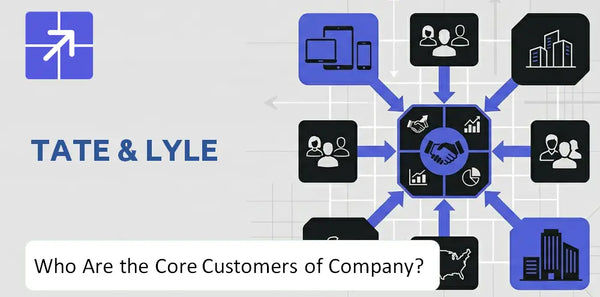
Focus on formulators of low – sugar, high – fiber, and clean – label products; they value technical support, regulatory expertise, and tailored ingredient systems. See product context in Tate & Lyle BCG Matrix Analysis.
Who Is Tate & Lyle Trying to Win?
Tate & Lyle tries to win large, tier-one food and beverage manufacturers reformulating for lower sugar and higher fiber, plus fast-growing challenger brands that lack in-house R&D. The company also targets pharmaceutical and industrial buyers needing specialty texturants and stabilizers.
 Main customer group: Global food and beverage manufacturers
Tate & Lyle target market centers on multinational ingredient buyers and formulators at Nestlé, PepsiCo, and Unilever who need sugar-reduction and fiber-enrichment solutions; these accounts drive the bulk of ingredient volumes and repeat R&D partnerships.
Secondary customer groups: Challenger brands and adjacent industries
Rapidly scaling health and wellness brands, plant-based startups, and private-label food manufacturers rely on Tate & Lyle customers for formulation support; pharmaceutical, nutraceutical, and industrial clients use specialized stabilizers and texturants.
Customer type and market role: B2B ingredient partner
Tate & Lyle customers are businesses and institutions – not consumers – so the firm functions as an R&D and supply-chain partner providing scalable ingredient solutions, samples, pilot runs, and regulatory support.
Most important segment: Tier-one beverage and dairy manufacturers
The highest-revenue segment is beverage and dairy manufacturers pursuing sugar reduction and clean-label reformulation; these customers accounted for a significant share of Tate & Lyle's ingredient sales in fiscal 2025, when branded solutions and sweetener platforms supported global contract volumes and contributed to reported ingredient segment margins.
Mission, Vision, and Values of Tate & Lyle Company
Tate & Lyle SWOT Analysis
- Complete SWOT Breakdown
- Fully Customizable
- Editable in Excel & Word
- Professional Formatting
- Investor-Ready Format

What Do Tate & Lyle's Customers Care About Most?
Tate & Lyle customers prioritize nutritional optimization, regulatory compliance, and cost-in-use efficiency – driven by sugar taxes, clean-label demand, and shifting consumption from GLP-1 medication trends. Food and beverage manufacturers and ingredient buyers seek proven sugar-reduction, nature-based texturants, and fiber fortification that preserve taste, texture, and shelf life.

Nutritional optimization and sugar reduction
Manufacturers need solutions to cut sugar while keeping taste; with sugar taxes in over 50 jurisdictions by early 2026, Tate & Lyle target market companies prioritize stevia and allulose portfolios to meet reformulation targets and excise-driven price pressures.
Practical buying drivers: regulatory and cost pressures
Ingredient buyers and formulators choose ingredients that simplify compliance and reduce cost-in-use; customers evaluate per-unit formulation costs, supplier technical support, and documented efficacy – areas where Tate & Lyle customers expect clear ROI metrics.
Emotional and brand positioning appeal
Health and wellness brands and retail private labels aim for clean-label positioning; using nature-based texturants signals authenticity to consumers and supports premium shelf positioning and brand trust among health-conscious shoppers.
What customers value most: clean label + performance
Customers value ingredients that are nature-based, deliver equivalent mouthfeel and shelf stability, and enable sugar reduction without reformulation risk – fiber fortification that enhances satiety is increasingly prized as portion sizes shrink.
Loyalty drivers and repeat demand
Repeat demand is driven by consistent supply, technical co-development, and measurable cost-in-use benefits; long-term contracts and multi-year reformulation programs with Tate & Lyle customers reduce churn among food manufacturers.
Why customers choose Tate & Lyle
Customers select Tate & Lyle for proven sugar-reduction technologies, nature-based texturants, and fiber solutions that align with regulatory trends and changing diets – especially relevant for Tate & Lyle core customers in beverages, confectionery, and health brands. Read more on company context in this History and Background of Tate & Lyle Company.
Tate & Lyle Business Model Canvas
- One-time Payment
- No Research Needed – Save Hours of Work
- Built by Experts, Trusted by Consultants
- Instant Download, Ready to Use
- 100% Editable, Fully Customizable

Where Is Demand Strongest for Tate & Lyle?
Demand for Tate & Lyle ingredients is largest in North America, driven by functional foods and strict labeling; growth is fastest in Asia-Pacific and Latin America as middle classes shift to packaged goods. Stabilizers and gums demand jumped after the CP Kelco integration, notably in Western Europe and North America.
Main market: North America
North America remains the primary market for the Tate & Lyle target market because food and beverage manufacturers demand clean-label sweeteners, texturizers, and fiber solutions; it contributed the largest share of revenue in fiscal 2025, with North American volumes up low-single digits year-on-year.
Secondary markets: Asia – Pacific and Latin America
Asia – Pacific and Latin America are the fastest-growing regions for Tate & Lyle customers, showing volume growth of 6% – 9% in 2025 as ingredient buyers and formulators serve expanding middle classes and rising demand for fortified and convenient packaged foods.
Where Tate & Lyle is strongest: ingredient breadth in B2B channels
Tate & Lyle customers include food and beverage manufacturers, health and wellness brands, and confectionery producers; strength comes from a diversified portfolio – sweeteners, fibers, stabilizers – and wide distributor reach, with the stabilizers and gums category adding material revenue after CP Kelco integration.
Fastest-growing demand areas in 2025
Demand rose fastest in plant-based dairy and meat alternatives – requiring advanced texturization – and in stabilizers and gums where post – 2024 integration lifted capability; Western Europe and North America saw notable uptake, while Asia – Pacific and Latin America led overall volume growth in 2025. Read more on ownership and strategic moves in this article: Ownership and Control of Tate & Lyle Company
Tate & Lyle Marketing Mix
- Complete Marketing Mix Analysis
- Effortlessly Communicate Your Business Strategy
- Investor-Ready Format
- 100% Editable and Customizable
- Clear and Structured Layout

How Does Tate & Lyle Keep Its Audience Growing?
Tate & Lyle keeps its audience growing by launching high-intensity innovations and expanding geographically, embedding scientists with clients to lock in long-term relationships, and cross-selling pectin and specialty gums into adjacent food and beverage segments.
How Tate & Lyle Expands Its Customer Base
Tate & Lyle targets food and beverage manufacturers and health and wellness brands by introducing new ingredients: 18 – 20% of 2025 revenue came from products launched in the past seven years, helping reach adjacent segments like beverages, confectionery, and nutraceuticals.
Customer Retention Drivers
Retention rests on Solution Selling: R&D teams integrate into clients' formulation cycles, creating high switching costs for ingredient buyers and formulators and supporting repeat purchases across Tate & Lyle customers.
Loyalty, Repeat Demand, and Customer Depth
Cross-selling the expanded pectin and specialty gums portfolio increases customer depth; professional judgment sees robust demand in 2025 – 2026 and supports organic revenue growth of 4 – 6% through 2026 as reformulation for healthier products is non-discretionary.
Strongest Customer-Base Growth Lever
The top lever is the R&D-to-commercialization pipeline plus Solution Selling: combining recent-product contribution (18 – 20% of 2025 revenue) with embedded technical service drives share expansion among Tate & Lyle target market accounts. Read more in Sales and Marketing Strategy of Tate & Lyle Company
Tate & Lyle Boston Consulting Group Matrix
- Built by Experts, Trusted by Consultants
- Structured for Consultants, Students, and Founders
- 100% Editable in Microsoft Word & Excel
- Instant Digital Download – Use Immediately
- Compatible with Mac & PC – Fully Unlocked

Related Blogs
- What Is the History of Tate & Lyle Company and How Did It Evolve?
- What Is the Competitive Landscape of Tate & Lyle Company and How Does It Compete?
- What Is the Growth Outlook of Tate & Lyle Company and Where Is It Heading?
- How Does Tate & Lyle Company Work and What Drives Its Business Model?
- How Does Tate & Lyle Company Reach Customers and Turn Demand into Sales?
- What Do the Mission, Vision, and Core Values of Tate & Lyle Company Reveal?
- Who Owns Tate & Lyle Company Today and Who Holds Control?
Frequently Asked Questions
Tate & Lyle's core customers are large global food and beverage manufacturers. The company also serves challenger brands, private-label food makers, and buyers in pharmaceutical, nutraceutical, and industrial markets who need specialty texturants, stabilizers, and formulation support.
Disclaimer
All information, articles, and product details provided on this website are for general informational and educational purposes only. We do not claim any ownership over, nor do we intend to infringe upon, any trademarks, copyrights, logos, brand names, or other intellectual property mentioned or depicted on this site. Such intellectual property remains the property of its respective owners, and any references here are made solely for identification or informational purposes, without implying any affiliation, endorsement, or partnership.
We make no representations or warranties, express or implied, regarding the accuracy, completeness, or suitability of any content or products presented. Nothing on this website should be construed as legal, tax, investment, financial, medical, or other professional advice. In addition, no part of this site - including articles or product references - constitutes a solicitation, recommendation, endorsement, advertisement, or offer to buy or sell any securities, franchises, or other financial instruments, particularly in jurisdictions where such activity would be unlawful.
All content is of a general nature and may not address the specific circumstances of any individual or entity. It is not a substitute for professional advice or services. Any actions you take based on the information provided here are strictly at your own risk. You accept full responsibility for any decisions or outcomes arising from your use of this website and agree to release us from any liability in connection with your use of, or reliance upon, the content or products found herein.