
Who are The Tile Shop's core customers among premium homeowners and trade professionals?
The Tile Shop targets design-focused homeowners and professional contractors who prioritize premium materials and specialty services. This matters because 2025 sales skew toward renovation-driven demand, and the company reported stronger AOVs (average order values) in fiscal 2025, signaling resilient pricing power.
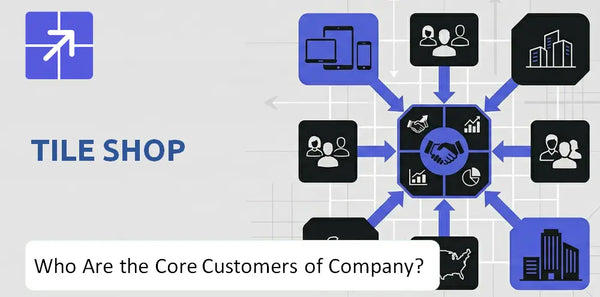
Focus on higher AOVs and trade programs to retain pro accounts and reduce sensitivity to DIY cycles; see Tile Shop BCG Matrix Analysis for product-level positioning.
Who Is Tile Shop Trying to Win?
The Tile Shop targets professional buyers first – interior designers, contractors, and custom home builders – followed by affluent Do-It-For-Me homeowners; DIY hobbyists are tertiary. These groups drive showroom visits, high average tickets, and repeat revenue.
 Primary focus: Professional buyers (Pros)
Pros – contractors, interior designers, and custom builders – account for roughly 65 percent of total revenue as of early 2026 and are high-frequency, project-driven purchasers who need technical specs, reliable inventory, and volume pricing.
Secondary: Do-It-For-Me (DIFM) homeowners
Affluent homeowners who outsource installation value premium materials and design services; they produce higher average order values than DIY customers and favor showroom consultations and curated product bundles.
Customer type and market role
The Tile Shop serves a mixed customer base: B2B-focused professionals plus B2C homeowners. The business model and showroom-led service mix prioritize trade relationships while maintaining retail appeal for homeowners buying tile.
Most important segment by revenue
The pro segment is the strategic revenue driver – ~65 percent of sales – and delivers repeat business, larger tickets, and project pipeline visibility, making it central to inventory and merchandising strategy.
For context on company evolution and channel strategy see History and Background of Tile Shop Company.
Tile Shop SWOT Analysis
- Complete SWOT Breakdown
- Fully Customizable
- Editable in Excel & Word
- Professional Formatting
- Investor-Ready Format

What Do Tile Shop's Customers Care About Most?
Customers care most about selection, immediate availability, and technical reliability – choices that keep projects moving and reduce risk. Professionals prioritize volume, credit and service; homeowners value in-house design help and tactile showroom assurance.

Depth of selection
With a catalog exceeding 4,000 SKUs of natural stone and manufactured tiles, tile shop target customers expect variety across finishes, sizes, and price tiers to match design intents and project specs.
Practical buying drivers
Availability of setting materials, waterproof membranes, and trims in stock matters most; professional contractors tile purchasing decisions hinge on bulk pricing, credit terms, and timely fulfillment to avoid downtime.
Emotional and aspirational appeal
Homeowners buying tile seek design confidence and status from premium looks; seeing and touching tile in a showroom reduces anxiety about long-term durability and aesthetic fit.
What customers value most
Customers value continuity: immediate stock for project phases, reliable technical specs, and access to design guidance – key when bathroom remodelers and kitchen renovation tile buyers need exact matches.
Loyalty and repeat demand
Professionals stick with suppliers offering tiered pricing and account reps; homeowners return when design consultants and consistent product availability streamline renovations – this supports repeat sales and referrals.
Why customers choose Tile Shop Company
Tile Shop Company wins on breadth (over 4,000 SKUs), Pro Market services – tiered pricing, credit and account management – and showroom-driven experiential selling that reduces purchase risk for homeowners and pros alike. See a market overview in Competitive Landscape of Tile Shop Company.
Tile Shop Business Model Canvas
- One-time Payment
- No Research Needed – Save Hours of Work
- Built by Experts, Trusted by Consultants
- Instant Download, Ready to Use
- 100% Editable, Fully Customizable

Where Is Demand Strongest for Tile Shop?
Demand is strongest in affluent suburban corridors and major metros with aging high-end housing stock needing modernization; customers concentrate where renovation spend per home is highest and contractor density supports big-ticket tile sales.
Affluent suburbs and major metropolitan renovation corridors
Tile Shop Company finds the primary market in high-income suburbs and metro cores – places with older luxury homes where homeowners buying tile favor in-person selection for stone, marble, and large-format porcelain; these areas drive the largest average order values.
Secondary: growing urban infill and high-end condo projects
Secondary demand shows up in urban infill, luxury condominium remodels, and coastal markets where interior designers tile suppliers and commercial developers procuring tile from Tile Shop seek premium finishes; professional contractors tile purchasing there remains meaningful.
Where Tile Shop Company is strongest
With over 140 physical showrooms in 2025 acting as regional hubs, Tile Shop Company is strongest in omnichannel sales where online browsing leads to in-store high-value purchases; showrooms also support contractor networking and local spec leads.
Where demand is accelerating in 2025 – 2026
Demand is growing fastest in renovation hotspots with aging luxury inventory – Sun Belt metros and select Northeast suburbs – where kitchen renovation tile buyers at Tile Shop and bathroom remodelers choosing Tile Shop products are increasing order frequency and average tickets.
Omnichannel remains key: the e-commerce platform drives research and accessory sales, but the highest revenue growth ties to in-store verification for color, texture, and lot consistency; see Sales and Marketing Strategy of Tile Shop Company for context: Sales and Marketing Strategy of Tile Shop Company
Tile Shop Marketing Mix
- Complete Marketing Mix Analysis
- Effortlessly Communicate Your Business Strategy
- Investor-Ready Format
- 100% Editable and Customizable
- Clear and Structured Layout

How Does Tile Shop Keep Its Audience Growing?
The Tile Shop keeps its audience growing by expanding its Pro Loyalty program, refining stores into under-penetrated high-wealth ZIP codes, and integrating digital visualizers and an enhanced Pro Dashboard to boost retention among trade professionals.
Expanding Reach into Premium and Trade Segments
The Tile Shop adds customers by opening stores and micro-markets in high-wealth ZIP codes, launching exclusive premium product lines, and using digital visualizer tools to convert homeowners and interior designers; this drives both foot traffic and online conversions, supporting a target of +8 – 12% new market penetration in 2025.
Customer Retention Drivers
Retention hinges on the Pro Dashboard for streamlined ordering, trade pricing, and project management; enhanced in-store service and specialty assortments raise repeat purchase rates among homeowners and professional contractors tile purchasing, with trade retention improving toward 70 – 75% cohort retention in 2025.
Loyalty, Repeat Demand, and Customer Depth
The Pro Loyalty program expands depth by offering volume discounts, priority fulfillment, and project tools that increase average order value for professional contractors and interior designers tile suppliers; repeat demand from bathroom remodelers and kitchen renovation tile buyers is forecast to lift AOV by 15 – 20% vs. retail-only buyers in 2025.
Strongest Growth Lever for 2025/2026
The dominant lever is trade professional focus: scaling the Pro Loyalty program plus exclusive premium assortments captures high-margin accounts and shields the business from retail volatility; gross margin remains consistently near 65%, positioning The Tile Shop to gain market share as remodeling demand rebounds in 2025 – 2026.
For deeper context on strategic priorities and values that guide expansion and trade engagement see Mission, Vision, and Values of Tile Shop Company.
Tile Shop Boston Consulting Group Matrix
- Built by Experts, Trusted by Consultants
- Structured for Consultants, Students, and Founders
- 100% Editable in Microsoft Word & Excel
- Instant Digital Download – Use Immediately
- Compatible with Mac & PC – Fully Unlocked

Related Blogs
- What Is the History of Tile Shop Company and How Did It Evolve?
- What Is the Competitive Landscape of Tile Shop Company and How Does It Compete?
- What Is the Growth Outlook of Tile Shop Company and Where Is It Heading?
- How Does Tile Shop Company Work and What Drives Its Business Model?
- How Does Tile Shop Company Reach Customers and Turn Demand into Sales?
- What Do the Mission, Vision, and Core Values of Tile Shop Company Reveal?
- Who Owns Tile Shop Company Today and Who Holds Control?
Frequently Asked Questions
Tile Shop's core customers are professional buyers first, especially contractors, interior designers, and custom home builders. Affluent Do-It-For-Me homeowners are the secondary audience, while DIY hobbyists are tertiary. The article says the pro segment drives most revenue and repeat project demand.
Disclaimer
All information, articles, and product details provided on this website are for general informational and educational purposes only. We do not claim any ownership over, nor do we intend to infringe upon, any trademarks, copyrights, logos, brand names, or other intellectual property mentioned or depicted on this site. Such intellectual property remains the property of its respective owners, and any references here are made solely for identification or informational purposes, without implying any affiliation, endorsement, or partnership.
We make no representations or warranties, express or implied, regarding the accuracy, completeness, or suitability of any content or products presented. Nothing on this website should be construed as legal, tax, investment, financial, medical, or other professional advice. In addition, no part of this site - including articles or product references - constitutes a solicitation, recommendation, endorsement, advertisement, or offer to buy or sell any securities, franchises, or other financial instruments, particularly in jurisdictions where such activity would be unlawful.
All content is of a general nature and may not address the specific circumstances of any individual or entity. It is not a substitute for professional advice or services. Any actions you take based on the information provided here are strictly at your own risk. You accept full responsibility for any decisions or outcomes arising from your use of this website and agree to release us from any liability in connection with your use of, or reliance upon, the content or products found herein.