
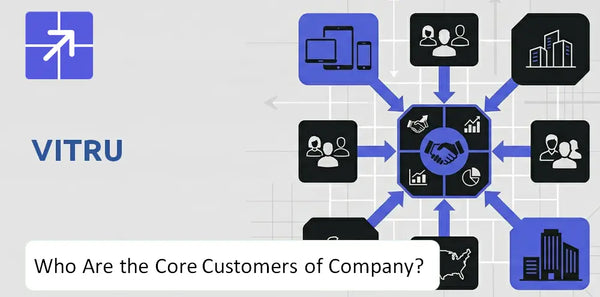
Who are Vitru Limited's core customers among Brazil's working-class post-secondary learners?
Vitru Limited targets Brazil's underserved working-class adults seeking affordable, career-focused post-secondary credentials. This matters because Brazil's shift to decentralized digital learning drove Vitru's 37.5 percent adjusted EBITDA margin in recent fiscal cycles, signaling scalable demand into 2026.
Focus on short, career-upgrade programs and local student support to retain volume and reduce churn; see the Vitru BCG Matrix Analysis for product positioning.
Who Is Vitru Trying to Win?
Vitru Limited targets working learners aged 25 – 45 who need extreme scheduling flexibility and seek career advancement without a degree; this group is over 80% of the student base. Secondary targets are price-sensitive recent high-school grads and the emerging middle class in C/D socio-economic brackets prioritizing social mobility.
 Main customer group: Working learners
Vitru Company core customers are adults 25 – 45 in employment lacking degrees; they choose Vitru for flexible schedules and vocational-upskilling tied to immediate earnings. This segment drives enrollment volume and often pays via monthly plans or employer sponsorships.
Secondary customer groups: Graduates and emerging middle class
Vitru target market includes recent high-school graduates seeking low-cost, vocational-heavy undergrads, and C/D socio-economic consumers in secondary cities aiming for upward mobility. These buyers prioritize price and clear job pathways.
Customer type and market role: Mixed consumer-institutional base
Vitru customer segments are mainly individual consumers (working learners and grads) with growing institutional demand from SMEs and employers sponsoring cohorts for reskilling. Geographic markets emphasize secondary and tertiary cities – interiorization drives scale.
Most important segment by scale: Working learners in secondary cities
The most important segment is working learners in secondary/tertiary cities, comprising over 80% of students and accounting for the majority of revenue and lifetime value due to recurring payments and employer partnerships. See Competitive Landscape of Vitru Company for market context: Competitive Landscape of Vitru Company
Vitru SWOT Analysis
- Complete SWOT Breakdown
- Fully Customizable
- Editable in Excel & Word
- Professional Formatting
- Investor-Ready Format

What Do Vitru's Customers Care About Most?
Vitru Company core customers prioritize a phygital experience that pairs low-cost distance education with local hub support; affordability, employability, and mobile-first access drive enrollment decisions.

Phygital access: blended convenience and local credibility
Vitru target market students need digital coursework they can access anywhere plus trusted in-person hubs for tutoring, verification, and administration; this solves connectivity and trust gaps in remote learning.
Practical buying drivers: price and mobile usability
With average monthly tuition at 280 to 320 Reais, Vitru buyer personas select programs that fit tight household budgets and work on smartphones; over 75 percent of students use phones to access coursework.
Emotional appeal: employability and life improvement
Students view degrees as transformative: in Brazil a tertiary degree can raise lifetime earnings by over 150 percent versus high school, so aspirational payoff and salary growth motivate decisions.
Most valued outcomes: credentials that boost jobs
Vitru target demographics value recognized diplomas, flexible schedules, and local support that reduces dropout risk and speeds time-to-hire; measurable salary lift is the top ROI metric.
Loyalty drivers: support, affordability, and outcomes
Repeat demand hinges on continued affordability, effective tutoring at hubs, and visible employability outcomes; alumni success stories and low monthly fees sustain retention.
Why customers choose Vitru Company
Vitru Company wins core customers by delivering a proven phygital model: affordable, mobile-first programs plus local face-to-face support that directly links education to salary growth; see more in Growth Outlook of Vitru Company.
Vitru Business Model Canvas
- One-time Payment
- No Research Needed – Save Hours of Work
- Built by Experts, Trusted by Consultants
- Instant Download, Ready to Use
- 100% Editable, Fully Customizable

Where Is Demand Strongest for Vitru?
Demand concentrates in Brazil's North, Northeast, and Midwest, where rapid agricultural and services growth outstrips campus capacity; Vitru Company sees strongest uptake in hybrid professional programs and digital channels in these regions.
Main market: North, Northeast, Midwest Brazil
Vitru Company core customers cluster in the North, Northeast, and Midwest due to faster regional economic expansion and limited traditional university supply; this geographic focus drives higher enrollment and hub expansion.
Secondary markets: urban service centers and peri-urban agricultural zones
Secondary demand arises in mid-size cities and agricultural service corridors where working adults seek career-upgrading courses; these areas feed Vitru target market segments and buyer personas focused on employability.
Where Vitru Company is strongest: hybrid premium programs and hubs
Vitru Company is strongest in delivering 'Premium' hybrid courses – healthcare, nursing, engineering – that command higher rates and drive revenue mix; by early 2026 the network reached over 2,500 hubs and supports cross-brand scale.
Fastest growth: premium healthcare, nursing, engineering
Enrollment in Premium hybrid programs grew > 15% year-over-year; overall digital-first lead generation via social media and performance marketing fuels the combined 1.15 million students across Uniasselvi and Unicesumar, highlighting where demand is accelerating in 2025 – 2026.
How Vitru Company Works and Makes Money
Vitru Marketing Mix
- Complete Marketing Mix Analysis
- Effortlessly Communicate Your Business Strategy
- Investor-Ready Format
- 100% Editable and Customizable
- Clear and Structured Layout

How Does Vitru Keep Its Audience Growing?
Vitru Limited grows audience by expanding new learning hubs, using AI-driven engagement analytics, cross-selling alumni into postgrad programs, and leveraging referrals that supply nearly one-third of new enrollments.
How Vitru Expands Its Customer Base
Vitru Company adds customers via new physical and hybrid hubs, targeted digital campaigns into adjacent healthcare education, and partnerships with employers and professional bodies to reach Vocational and continuous-learning segments.
Customer Retention Drivers
AI-driven predictive analytics track engagement and reduce dropout; structured progression pathways move undergraduates into postgraduate and CPD programs; cohort mentoring and early-intervention casework cut churn.
Loyalty, Repeat Demand, and Customer Depth
Alumni referral schemes and stackable credentials drive repeat enrollments; lifetime learning pricing bundles and employer-sponsored cohorts increase customer lifetime value and ecosystem stickiness.
The Strongest Growth Lever in 2025/2026
Disciplined hybrid-health expansion – higher barriers to entry and stronger cash-flow conversion – remains Vitru Limited's top lever, preserving market leadership versus pure-play digital rivals (~33% of new enrollments come from referrals; AI reduced sector-average dropouts to record lows by March 2026).
Sales and Marketing Strategy of Vitru Company
Vitru Boston Consulting Group Matrix
- Built by Experts, Trusted by Consultants
- Structured for Consultants, Students, and Founders
- 100% Editable in Microsoft Word & Excel
- Instant Digital Download – Use Immediately
- Compatible with Mac & PC – Fully Unlocked

Related Blogs
- What Is the History of Vitru Company and How Did It Evolve?
- What Is the Competitive Landscape of Vitru Company and How Does It Compete?
- What Is the Growth Outlook of Vitru Company and Where Is It Heading?
- How Does Vitru Company Work and What Drives Its Business Model?
- How Does Vitru Company Reach Customers and Turn Demand into Sales?
- What Do the Mission, Vision, and Core Values of Vitru Company Reveal?
- Who Owns Vitru Company Today and Who Holds Control?
Frequently Asked Questions
Vitru's core customers are working learners aged 25-45 who are already employed and want flexible study options without a degree. They make up over 80% of the student base and are attracted by vocational upskilling tied to immediate earnings, monthly payment plans, or employer sponsorships.
Disclaimer
All information, articles, and product details provided on this website are for general informational and educational purposes only. We do not claim any ownership over, nor do we intend to infringe upon, any trademarks, copyrights, logos, brand names, or other intellectual property mentioned or depicted on this site. Such intellectual property remains the property of its respective owners, and any references here are made solely for identification or informational purposes, without implying any affiliation, endorsement, or partnership.
We make no representations or warranties, express or implied, regarding the accuracy, completeness, or suitability of any content or products presented. Nothing on this website should be construed as legal, tax, investment, financial, medical, or other professional advice. In addition, no part of this site - including articles or product references - constitutes a solicitation, recommendation, endorsement, advertisement, or offer to buy or sell any securities, franchises, or other financial instruments, particularly in jurisdictions where such activity would be unlawful.
All content is of a general nature and may not address the specific circumstances of any individual or entity. It is not a substitute for professional advice or services. Any actions you take based on the information provided here are strictly at your own risk. You accept full responsibility for any decisions or outcomes arising from your use of this website and agree to release us from any liability in connection with your use of, or reliance upon, the content or products found herein.