
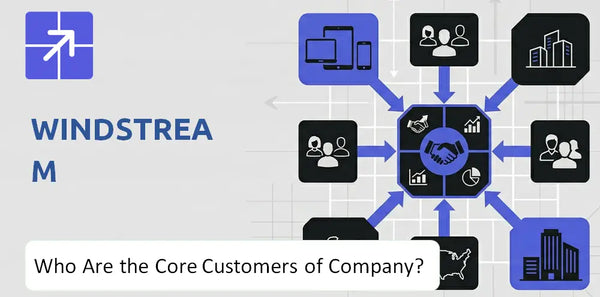
Who are Windstream's core customers in underserved Tier 2 and Tier 3 markets?
Windstream targets residential and SMB customers in semi-urban and rural areas, plus regional enterprises needing high-capacity fiber. This matters because Windstream's 2025 fiber expansion raised FTTP coverage, boosting ARPU and supporting its 2025 debt servicing profile.
Focus on dense small towns and local ISPs; prioritize scalable FTTP packages and service SLAs to drive retention and margin. See Windstream BCG Matrix Analysis for product positioning and portfolio moves.
Who Is Windstream Trying to Win?
Windstream tries to win three tiers: Kinetic residential and small business (SMB) subscribers in rural/suburban areas, Enterprise clients with multi-site networking needs, and Wholesale partners needing backbone transport.
 Main customer group: Kinetic residential and SMB subscribers
Kinetic residential customers and small and medium business customers are the primary Windstream target customers for 2025 – 2026, focused on rural and suburban communities where fiber penetration is lower; Windstream targets households and SMBs that need reliable high-speed fiber and bundled VoIP services.
Secondary groups: Enterprise and Wholesale
Enterprise and wholesale customers are secondary but strategic: Windstream targets mid-to-large organizations in healthcare, retail, and financial services plus hyperscalers and carriers that buy capacity on its 112,000-mile fiber backbone for high-capacity transport.
Customer type and market role: mixed consumer and business operator
Windstream serves a mixed customer base: residential broadband customers and small and medium business customers drive subscriber revenue, while enterprise and data center clients drive higher ARPU via managed network, SD-WAN, and cloud connectivity services.
Most important segment by scale and strategy
The most important segment for revenue and scale in 2025 is the Kinetic residential/SMB base – consumer broadband subscriptions and bundled services – supported by enterprise contracts and wholesale transport that monetize the backbone; see Sales and Marketing Strategy of Windstream Company for tactical detail: Sales and Marketing Strategy of Windstream Company
Windstream SWOT Analysis
- Complete SWOT Breakdown
- Fully Customizable
- Editable in Excel & Word
- Professional Formatting
- Investor-Ready Format

What Do Windstream's Customers Care About Most?
Windstream core customers demand mission-critical symmetrical connectivity, predictable pricing, and managed security. Residential users want reliable, affordable fiber; enterprise buyers prioritize SASE/SD-WAN and consolidated managed contracts to cut operational burden.

Mission-critical symmetrical connectivity
Customers need low-latency, symmetrical upload/download speeds for remote work, streaming, and cloud apps. Windstream target customers value FTTP performance that exceeds legacy cable, which helped stabilize fiber churn at 1.1 percent in early 2026.
Practical buying drivers: price transparency and reliability
Residential broadband customers pick plans based on clear pricing, SLA-backed uptime, and consistent speeds. Small and medium business customers also favor predictable billing and bundled voice/data packages to simplify cash flow and procurement.
Emotional and aspirational appeal: trust and professionalism
Buyers choose providers that signal reliability and operational maturity. For enterprises, choosing a managed provider reduces internal IT stress and signals to stakeholders that networking and security are in expert hands.
What customers value most: managed security and consolidation
Enterprise and wholesale customers prioritize SASE (Secure Access Service Edge), SD-WAN, and the ability to consolidate voice, data, and security under a single managed contract to improve operational efficiency and reduce vendor sprawl.
Loyalty and repeat demand drivers
Retention hinges on consistent uptime, fast issue resolution, and contractual simplicity. Long-term service agreements for enterprise solutions and high Net Promoter Scores among fiber subscribers support repeat demand.
Why customers choose Windstream
Windstream core customers choose the firm for its FTTP performance, managed networking portfolio, and bundled contracts that lower IT overhead. See the Competitive Landscape of Windstream Company for context on market positioning and competitor trade-offs.
Windstream Business Model Canvas
- One-time Payment
- No Research Needed – Save Hours of Work
- Built by Experts, Trusted by Consultants
- Instant Download, Ready to Use
- 100% Editable, Fully Customizable

Where Is Demand Strongest for Windstream?
Demand is strongest in the Southeast and Midwest U.S., where Windstream Company's fiber footprint reached 2.1 million locations by Q1 2026, driven by residential broadband uptake and growing enterprise and wholesale needs.
Main Market: Southeast & Midwest Concentration
Windstream target customers cluster in the Southeast and Midwest where fiber density and population centers align; this concentration supports rapid residential broadband adoption and fiber-to-the-home rollouts that anchor recurring revenue.
Secondary Markets: Enterprise & Wholesale Corridors
Enterprise and wholesale customers drive secondary demand along high-capacity data routes – especially connecting data center hubs in North Carolina, Texas, and Illinois – fueling backhaul and metro connectivity services.
Where Windstream Company Is Strongest
Windstream Company shows strength in reach and revenue mix where fiber passes dense suburbs and midmarket enterprise campuses; enterprise and wholesale contracts now represent a growing share of high-margin capacity sales.
Fastest-Growing Demand: Enterprise Edge & AI Infrastructure
Growth is fastest in the Enterprise segment among decentralized organizations needing secure, high-bandwidth links to cloud cores; wholesale capacity demand is surging for AI-model training and 400G/800G optical services in 2025 – 2026.
See related context in History and Background of Windstream Company
Windstream Marketing Mix
- Complete Marketing Mix Analysis
- Effortlessly Communicate Your Business Strategy
- Investor-Ready Format
- 100% Editable and Customizable
- Clear and Structured Layout

How Does Windstream Keep Its Audience Growing?
Windstream keeps its audience growing by aggressive CAPEX to expand fiber, converting legacy DSL to fiber, and a land-and-expand play in Enterprise to sell adjacent services; bundling managed WiFi and cybersecurity raises ARPU and retention. Focused rural fiber builds and wholesale capacity wins deepen reach across residential broadband customers, SMBs, and enterprise and wholesale customers.
Expanding the Customer Base Through Fiber and Enterprise Expansion
Windstream expands its audience by converting legacy DSL to fiber – over 48 percent converted by March 2026 – raising ARPU and attracting the Windstream target customers in rural communities and suburban areas. Heavy CAPEX into fiber and targeted Enterprise sales enable moves into adjacent segments: SMB telecommunications customers, healthcare organizations, education institutions, and data center and cloud customers seeking wholesale capacity.
Customer Retention Drivers
Retention improves via bundled value-added services – managed WiFi, enhanced cybersecurity, and VoIP – that raise switching costs and increase lifetime value. Enterprise land-and-expand deals lock in multi-year contracts; focusing on service quality in rural fiber markets reduces churn among residential broadband customers and small and medium business customers.
Loyalty, Repeat Demand, and Customer Depth
Windstream deepens customer relationships by upselling managed services and network solutions; renewals and multi-service bundles create ecosystem stickiness. For enterprise and wholesale customers, repeat demand for bandwidth from regionalized data centers drives sustained wholesale revenue growth and higher contract sizes.
Strongest Customer-Base Growth Lever in 2025/2026
The key lever is first-mover rural fiber deployment combined with wholesale capacity sales – this strategy converted 48 percent of DSL to fiber and positions Windstream as a premium infrastructure play, capturing regional data center demand and increasing ARPU across Windstream core customers. For more on ownership and strategy, see Ownership and Control of Windstream Company
Windstream Boston Consulting Group Matrix
- Built by Experts, Trusted by Consultants
- Structured for Consultants, Students, and Founders
- 100% Editable in Microsoft Word & Excel
- Instant Digital Download – Use Immediately
- Compatible with Mac & PC – Fully Unlocked

Related Blogs
- What Is the History of Windstream Company and How Did It Evolve?
- What Is the Competitive Landscape of Windstream Company and How Does It Compete?
- What Is the Growth Outlook of Windstream Company and Where Is It Heading?
- How Does Windstream Company Work and What Drives Its Business Model?
- How Does Windstream Company Reach Customers and Turn Demand into Sales?
- What Do the Mission, Vision, and Core Values of Windstream Company Reveal?
- Who Owns Windstream Company Today and Who Holds Control?
Frequently Asked Questions
Windstream's core target customers are Kinetic residential and small business subscribers, especially in rural and suburban areas. The company also serves enterprise clients with multi-site networking needs and wholesale partners that buy backbone transport on its fiber network.
Disclaimer
All information, articles, and product details provided on this website are for general informational and educational purposes only. We do not claim any ownership over, nor do we intend to infringe upon, any trademarks, copyrights, logos, brand names, or other intellectual property mentioned or depicted on this site. Such intellectual property remains the property of its respective owners, and any references here are made solely for identification or informational purposes, without implying any affiliation, endorsement, or partnership.
We make no representations or warranties, express or implied, regarding the accuracy, completeness, or suitability of any content or products presented. Nothing on this website should be construed as legal, tax, investment, financial, medical, or other professional advice. In addition, no part of this site - including articles or product references - constitutes a solicitation, recommendation, endorsement, advertisement, or offer to buy or sell any securities, franchises, or other financial instruments, particularly in jurisdictions where such activity would be unlawful.
All content is of a general nature and may not address the specific circumstances of any individual or entity. It is not a substitute for professional advice or services. Any actions you take based on the information provided here are strictly at your own risk. You accept full responsibility for any decisions or outcomes arising from your use of this website and agree to release us from any liability in connection with your use of, or reliance upon, the content or products found herein.