
Who are Workday's core customers among Global 2000 CFOs, CHROs, and enterprise IT leaders?
Workday targets large enterprises – especially Global 2000 firms – focused on finance, HR, and planning consolidation. This matters because Workday's FY2026 revenue exceeded 9.6 billion, and generative AI integrations are driving deeper CFO and CHRO adoption.
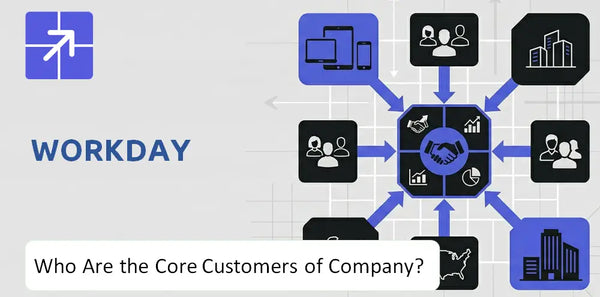
Focus on decision-makers who value data integrity, compliance, and cross-domain analytics; prioritize enterprise deals and renewals. See Workday BCG Matrix Analysis for product positioning and growth signals.
Who Is Workday Trying to Win?
Workday tries to win large global enterprises and mid-market organizations that run complex HR and finance processes, targeting CHROs and CFOs seeking a single source of truth for employee and capital data.
 Main customer group: Fortune-scale enterprises
Workday target customers focus on Fortune 500 and Global 2000 firms; Workday serves over 65 percent of the top 500 companies and wins large accounts for enterprise HR software buyers because of scale, compliance, and global payroll needs.
Secondary customer groups: mid-market and departmental buyers
Workday core customers include mid market companies (roughly 500 – 3,500 employees) reached via Workday Launch for rapid deployment; HR leaders using Workday and finance teams choosing Workday Financial Management drive uptake here.
Customer type and market role: B2B enterprise software
Workday mainly serves businesses and institutions – enterprises, higher education, healthcare, retail, manufacturing, and public sector agencies – selling SaaS HCM (human capital management) and finance systems to institutional decision makers like CHROs, CFOs, and CIOs.
Most important segment by revenue and scale
The most important segment is large enterprises (Fortune/Global 2000): they drive recurring subscription revenue, higher average contract value, and strategic visibility – enterprise customers interested in Workday HCM account for the majority of Workday's ARR and large deal pipeline.
See related context in the company overview: Mission, Vision, and Values of Workday Company
Workday SWOT Analysis
- Complete SWOT Breakdown
- Fully Customizable
- Editable in Excel & Word
- Professional Formatting
- Investor-Ready Format

What Do Workday's Customers Care About Most?
Workday target customers care most about unified data, lower total cost of ownership, and automation that reduces manual work; financial and HR leaders prioritize auditability, faster closes, real-time cash visibility, talent retention, and skills-based planning.

Reduce data fragmentation and TCO
Workday core customers seek a single source of truth across HR and finance to replace on-premise silos and cut hardware and maintenance costs tied to legacy ERP systems.
Practical buying drivers: cost, performance, auditability
Enterprise HR software buyers and CFOs choosing Workday prioritize lower TCO, rapid financial close times, strong audit trails, and predictable uptime tied to SLAs.
Emotional and aspirational appeal: confidence and control
HR leaders using Workday and finance teams choosing Workday Financial Management value the confidence of secure, compliant payroll and the prestige of modern cloud-first operations.
What customers value most: automation and reliability
Clients value automation – Workday Illuminate adoption rose notably in 2025 as firms automated expense reconciliation, job description drafting, and predictive talent analytics – and 99.9 percent uptime and a strong security posture.
Loyalty and repeat demand drivers
Retention stems from integrated data that reduces manual reconciliation, measurable ROI from faster closes and reduced headcount for routine tasks, and ongoing feature releases like Illuminate that increase stickiness.
Why customers choose Workday
Large enterprises adopting Workday software and mid market companies evaluating Workday pick it for combined HR and finance capabilities, demonstrable TCO reductions versus on-premise, and AI-driven productivity gains evidenced in 2025 deployments; see Growth Outlook of Workday Company for context.
Workday Business Model Canvas
- One-time Payment
- No Research Needed – Save Hours of Work
- Built by Experts, Trusted by Consultants
- Instant Download, Ready to Use
- 100% Editable, Fully Customizable

Where Is Demand Strongest for Workday?
Workday finds the most demand in the United States, which drives roughly 75 percent of revenue, while EMEA and APJ show faster growth as multinationals modernize back-office systems.
Primary Market: United States
The United States is the primary concentration for Workday target customers because of scale, high enterprise adoption, and deep penetration among large enterprises adopting Workday software and HR leaders using Workday.
Secondary Markets: EMEA and APJ
EMEA and APJ are secondary demand areas, accelerating faster year-over-year as international multinationals and mid market companies evaluating Workday replace legacy ERP to consolidate HR and finance platforms.
Where Workday Is Strongest
Workday is strongest in HCM footprint and installed base, with large enterprises and enterprise HR software buyers driving recurring revenue and cross-sell into finance; existing HCM customers are the prime cross-sell cohort.
Fastest-Growing Demand: Financial Management and Mid-Market
In early 2026, Financial Management growth outpaces HCM as finance teams choosing Workday replace legacy ERP; new logo acquisitions in the mid-market rose approximately 20 percent year-over-year, driven by SMBs assessing Workday alternatives and private companies migrating to Workday cloud HCM.
Industry pockets with resilient demand include healthcare organizations using Workday, financial services, and public sector agencies considering Workday due to compliance and complex labor rules; this fuels cross-sell to companies that use Workday for HR and finance. Read more on strategy here: Sales and Marketing Strategy of Workday Company
Workday Marketing Mix
- Complete Marketing Mix Analysis
- Effortlessly Communicate Your Business Strategy
- Investor-Ready Format
- 100% Editable and Customizable
- Clear and Structured Layout

How Does Workday Keep Its Audience Growing?
Workday keeps its audience growing through high gross retention near 95 percent, a disciplined land-and-expand play, and AI-driven product depth that embeds the platform into daily workflows, enabling steady upsell and cross-sell across HR and finance.
Expanding into Adjacent Segments and New Buyers
Workday reaches adjacent segments by upselling modules like Workday Adaptive Planning, Strategic Sourcing, and Peakon Employee Voice to existing customers and by targeting CFOs choosing Workday and HR leaders using Workday at large enterprises, higher education, healthcare, and retail. Land-and-expand wins among enterprise customers and mid market companies evaluating Workday drive new account growth, while targeted product bundles attract finance teams choosing Workday Financial Management.
Customer Retention Drivers
High gross retention (~95%) and Net Revenue Retention above 100% come from mission-critical HCM and financial workflows, embedded AI efficiency that raises switching costs, and ongoing product investment; renewals remain strong even during tightening macro cycles as enterprise customers view Workday as essential for long-term cost containment.
Loyalty, Repeat Demand, and Customer Depth
Repeat demand is driven by expansion bookings and module attach rates; upsells to existing customers (companies that use Workday for HR and finance) sustain growth and deepen enterprise adoption. Customer success programs and integrations with daily manager and employee workflows create ecosystem stickiness for HR managers looking for Workday solutions and finance teams choosing Workday Financial Management.
Strongest Growth Lever in 2025/2026
The primary growth lever is land-and-expand combined with AI-driven efficiency: maintaining subscription revenue growth of 15 – 16 percent in 2025/2026 through upsells and high NRR; this keeps large enterprises adopting Workday software and mid market companies evaluating Workday progressively expanding spend. See this concise company history for context: History and Background of Workday Company
Workday Boston Consulting Group Matrix
- Built by Experts, Trusted by Consultants
- Structured for Consultants, Students, and Founders
- 100% Editable in Microsoft Word & Excel
- Instant Digital Download – Use Immediately
- Compatible with Mac & PC – Fully Unlocked

Related Blogs
- What Is the History of Workday Company and How Did It Evolve?
- What Is the Competitive Landscape of Workday Company and How Does It Compete?
- What Is the Growth Outlook of Workday Company and Where Is It Heading?
- How Does Workday Company Work and What Drives Its Business Model?
- How Does Workday Company Reach Customers and Turn Demand into Sales?
- What Do the Mission, Vision, and Core Values of Workday Company Reveal?
- Who Owns Workday Company Today and Who Holds Control?
Frequently Asked Questions
Workday's core customers are large global enterprises and mid-market organizations with complex HR and finance needs. The company focuses on Fortune 500 and Global 2000 firms, while also serving departmental buyers and mid-market companies that want a single source of truth for employee and capital data.
Disclaimer
All information, articles, and product details provided on this website are for general informational and educational purposes only. We do not claim any ownership over, nor do we intend to infringe upon, any trademarks, copyrights, logos, brand names, or other intellectual property mentioned or depicted on this site. Such intellectual property remains the property of its respective owners, and any references here are made solely for identification or informational purposes, without implying any affiliation, endorsement, or partnership.
We make no representations or warranties, express or implied, regarding the accuracy, completeness, or suitability of any content or products presented. Nothing on this website should be construed as legal, tax, investment, financial, medical, or other professional advice. In addition, no part of this site - including articles or product references - constitutes a solicitation, recommendation, endorsement, advertisement, or offer to buy or sell any securities, franchises, or other financial instruments, particularly in jurisdictions where such activity would be unlawful.
All content is of a general nature and may not address the specific circumstances of any individual or entity. It is not a substitute for professional advice or services. Any actions you take based on the information provided here are strictly at your own risk. You accept full responsibility for any decisions or outcomes arising from your use of this website and agree to release us from any liability in connection with your use of, or reliance upon, the content or products found herein.