
How does Aavas Financiers Limited convert informal incomes in semi-urban India into a scalable home-loan business?
Aavas Financiers Limited targets under-banked borrowers in semi-urban and rural India, using localized underwriting and property-backed loans to bridge a large credit gap. This matters as Aavas reported sustained growth through 2025, with mortgage originations rising alongside India's urbanization and housing demand.
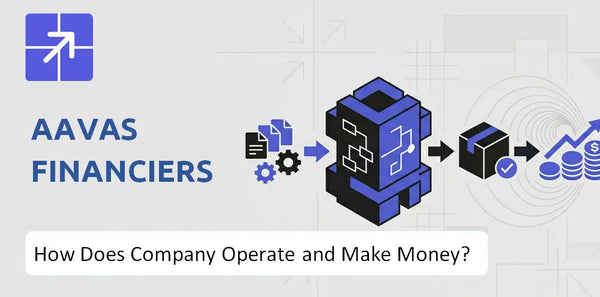
Aavas leans on branch-led sourcing, simplified documentation, and collateral valuation to keep credit costs low and margins healthy; monitor branch expansion and loan book mix for 2026 risk signals. See Aavas Financiers BCG Matrix Analysis
What Does Aavas Financiers Actually Sell?
Aavas Financiers Limited sells long-term, property-secured credit focused on affordable housing. Customers pay for home purchase, construction, home improvement, and loans against property for micro-enterprises, with underwriting tailored to cash-income borrowers.
 Core products: secured home and micro-enterprise loans
Aavas Financiers offers home loans for purchase or construction, home improvement loans, and loans against property to micro-enterprises. Typical tenors run long-term and the average ticket size in 2025 was around ₹1.1 – 1.2 million.
Who buys these loans
Primary buyers are self-employed, cash-income households: small shopkeepers, artisans, transport operators, and rural salaried customers. Aavas Financiers customer segments prioritize borrowers without formal tax returns or regular pay slips.
What customers actually get
Customers receive access to secured capital for asset ownership, predictable EMIs, and long tenors that make housing affordable. The value includes credit for property-backed wealth creation and working-capital support for micro-enterprises.
Why this offering stands out
Aavas Financiers business model differentiates by underwriting cash-income borrowers using field-based assessment and branch-led rural distribution. That Aavas lending process keeps average loan tickets granular and drives scale into underserved markets; see Mission, Vision, and Values of Aavas Financiers Company for context.
Aavas Financiers SWOT Analysis
- Complete SWOT Breakdown
- Fully Customizable
- Editable in Excel & Word
- Professional Formatting
- Investor-Ready Format

How Does Aavas Financiers Run Its Business Day to Day?
Aavas Financiers runs day-to-day via a decentralized, branch-led model where in-house teams handle sourcing, underwriting, and collections across a >380-branch network; credit officers perform field visits while a digital backend tracks portfolio health and keeps loan approval turnaround under 12 days.

Branch-led operating model
Aavas Financiers uses local branches as primary operating units; each branch staffs credit officers who originate loans, perform in-person verification, and manage customer relationships so the company keeps direct control over acquisition and servicing.
Product and service delivery to borrowers
Customers apply at branches or via the digital portal; in-branch credit officers collect documents, run field investigations, and finalize disbursement – typical loan approval timelines average under 12 days, supporting timely access to affordable housing loans.
Origination, underwriting, and credit assessment
Underwriting relies on field-level cash-flow reconstruction and a verified standard-of-living proxy for creditworthiness; decisions combine in-person findings with credit bureau data and analytics-driven scorecards to control asset quality.
Sales channels and distribution network
Distribution is predominantly branch-centric – no third-party agents – so the branch network (expanded to over 380 branches by 2026) drives reach into semi-urban and rural customer segments for affordable housing finance.
Key systems, assets, and partnerships
Core assets include the branch footprint, trained credit officers, and a digital lending platform with real-time portfolio analytics; funding partnerships with banks and bond markets supply lending capital while risk systems monitor NPA and provisioning metrics.
What makes the model work in practice
The high-touch field verification combined with centralized analytics reduces information asymmetry, keeps gross NPA manageable, and sustains scalable growth – this operational mix drives Aavas Financiers business model efficiency and supports competitive turnaround times.
See governance and ownership context here: Ownership and Control of Aavas Financiers Company
Aavas Financiers Business Model Canvas
- One-time Payment
- No Research Needed – Save Hours of Work
- Built by Experts, Trusted by Consultants
- Instant Download, Ready to Use
- 100% Editable, Fully Customizable

How Does Revenue Flow Through Aavas Financiers?
Revenue at Aavas Financiers flows mainly from interest earned on its loan portfolio minus borrowing costs; demand converts to revenue as loan originations expand AUM and generate interest, fees, and insurance commissions.
Net interest margin: core revenue engine
Aavas Financiers earns most revenue from the spread between loan yields and funding costs; in 2025 the company reports loan yields around 13.0% – 13.5% and a net interest margin above 5%, making NIM the primary driver of profitability.
Fees, processing charges and cross-sales
Secondary streams include processing fees and insurance product commissions sold alongside home and affordable-housing loans; these add modest non – interest income that complements interest revenue.
Pricing and monetization model
Aavas monetizes demand via interest on amortizing retail loans plus upfront processing fees and insurance premiums; funding comes from bank term loans, non – convertible debentures and NHB refinancing, so revenue = AUM × loan yield – funding cost.
Key revenue growth levers
Top drivers are AUM expansion, yield maintenance, and low incremental funding costs; Aavas AUM has been scaling at a CAGR of about 20% – 22% into the 2025 fiscal period, so loan book growth directly lifts interest income and overall revenue.
For operational context on distribution, origination and historical context see History and Background of Aavas Financiers Company
Aavas Financiers Marketing Mix
- Complete Marketing Mix Analysis
- Effortlessly Communicate Your Business Strategy
- Investor-Ready Format
- 100% Editable and Customizable
- Clear and Structured Layout

What Makes Aavas Financiers's Model Sustainable or Fragile?
Aavas Financiers' model is sustainable due to low GNPA near 1.0% – 1.1% and a high ROA around 3.2% – 3.4% , but remains fragile to sharp funding-cost rises, regulatory shifts, and discounting by large banks. Strengths include a rural distribution moat and proprietary informal-income data; risks center on competition, concentration of funding sources, and policy changes.
What Supports the Model
Aavas Financiers' disciplined credit culture keeps Gross NPA close to 1.0% – 1.1%, sustaining margins. Its ROA of about 3.2% – 3.4% in 2025 provides capital buffer and supports steady profitability even with modest rate volatility.
Key Assets or Capabilities
Deep branch network in Tier 3 – Tier 4 towns and proprietary underwriting models for informal incomes reduce acquisition and credit costs. Digital loan tracking and a focused affordable housing product suite sustain unit economics and customer retention.
Dependencies or Constraints
Profitability depends on stable wholesale funding; sharp increases in borrowing costs compress net interest margins. Regulatory moves in housing finance or subsidy schemes and rising competition from universal banks offering lower rates are structural constraints.
How Durable the Model Looks
For 2025/2026 the model appears resilient: geographic moat and unique informal-income data give Aavas Financiers a defensive edge that larger banks find costly to replicate. Still, market-share erosion is possible if competitors aggressively price into affordable housing.
See detailed channel and marketing context in Sales and Marketing Strategy of Aavas Financiers Company.
Aavas Financiers Boston Consulting Group Matrix
- Built by Experts, Trusted by Consultants
- Structured for Consultants, Students, and Founders
- 100% Editable in Microsoft Word & Excel
- Instant Digital Download – Use Immediately
- Compatible with Mac & PC – Fully Unlocked

Related Blogs
- What Is the History of Aavas Financiers Company and How Did It Evolve?
- What Is the Competitive Landscape of Aavas Financiers Company and How Does It Compete?
- What Is the Growth Outlook of Aavas Financiers Company and Where Is It Heading?
- How Does Aavas Financiers Company Reach Customers and Turn Demand into Sales?
- What Do the Mission, Vision, and Core Values of Aavas Financiers Company Reveal?
- Who Are the Core Customers in Aavas Financiers Company's Target Market?
- Who Owns Aavas Financiers Company Today and Who Holds Control?
Frequently Asked Questions
Aavas Financiers sells long-term, property-secured credit for affordable housing and related needs. Its products include home loans for purchase or construction, home improvement loans, and loans against property for micro-enterprises. The business focuses on borrowers who often have cash income rather than formal tax returns or regular pay slips.
Disclaimer
All information, articles, and product details provided on this website are for general informational and educational purposes only. We do not claim any ownership over, nor do we intend to infringe upon, any trademarks, copyrights, logos, brand names, or other intellectual property mentioned or depicted on this site. Such intellectual property remains the property of its respective owners, and any references here are made solely for identification or informational purposes, without implying any affiliation, endorsement, or partnership.
We make no representations or warranties, express or implied, regarding the accuracy, completeness, or suitability of any content or products presented. Nothing on this website should be construed as legal, tax, investment, financial, medical, or other professional advice. In addition, no part of this site - including articles or product references - constitutes a solicitation, recommendation, endorsement, advertisement, or offer to buy or sell any securities, franchises, or other financial instruments, particularly in jurisdictions where such activity would be unlawful.
All content is of a general nature and may not address the specific circumstances of any individual or entity. It is not a substitute for professional advice or services. Any actions you take based on the information provided here are strictly at your own risk. You accept full responsibility for any decisions or outcomes arising from your use of this website and agree to release us from any liability in connection with your use of, or reliance upon, the content or products found herein.