
How does Accel Entertainment place machines in local venues to generate recurring cash flow?
Accel Entertainment places video gaming terminals in bars, restaurants, and truck stops, earning revenue from machine play and revenue shares with operators. This matters because in 2025 the distributed gaming channel showed robust unit-level margins versus resort casinos, driven by flexible capex and regulatory growth in key states.
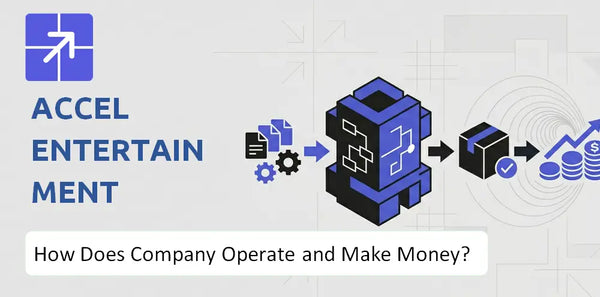
Accel's strengths include low fixed costs and scalable logistics; a practical move is to monitor state regulatory changes and site churn rates for early revenue signals. See Accel Entertainment BCG Matrix Analysis
What Does Accel Entertainment Actually Sell?
Accel Entertainment sells a turnkey revenue platform centered on Video Gaming Terminals (VGTs) plus ancillary amusement devices and ATM solutions; customers pay for installed, managed, and compliant revenue-generating equipment that converts floor space into cash flow.
 Core products: VGTs and managed gaming platform
Accel Entertainment's primary offering is Video Gaming Terminals (VGTs) – electronic gambling machines providing slots, video poker, and similar games – delivered as a turnkey service including equipment, installation, maintenance, and licensing support at no upfront cost to the location partner.
Who buys it: small and mid-sized venue owners
Bars, restaurants, convenience stores, veterans' clubs, and other small-to-mid-sized business owners partner with Accel Entertainment to monetize underutilized floor space through a slot route operator model and gaming technology provider services.
Customer value: passive income and increased dwell time
Operators receive a passive, legally compliant income stream without capital expenditure; locations typically see higher foot traffic and longer patron dwell time, with revenue split arrangements that generate ongoing site-level payouts.
Differentiators: turnkey model and regulated support
Accel Entertainment stands out by offering full-service deployment plus regulatory licensing and compliance support, a combined amusement and ATM portfolio, and a technology platform that simplifies revenue reporting and machine management for partners.
For context on the company's evolution and market placement see History and Background of Accel Entertainment Company.
Accel Entertainment SWOT Analysis
- Complete SWOT Breakdown
- Fully Customizable
- Editable in Excel & Word
- Professional Formatting
- Investor-Ready Format

How Does Accel Entertainment Run Its Business Day to Day?
Accel Entertainment runs daily operations through a centralized software platform that monitors uptime, cash, and compliance across its network, dispatches technicians, and drives game-mix decisions using location-level analytics to maximize revenue.

Operating model: centralized monitoring and field execution
Technicians, relationship managers, and centralized ops use real-time telemetry to manage a fleet of over 25,000 video gaming terminals (VGTs) across ~2,800 locations as of early 2026; the platform routes service, cash replenishment, and compliance tasks to local teams.
Product/service delivery: in-location gaming access
Customers play on site at partner bars, restaurants, and truck stops where Accel Entertainment installs and maintains VGTs; revenue is collected via machine meters and reconciled through the operator's back-office systems.
Production/sourcing: hardware, software, and content
Accel sources gaming cabinets, proprietary software, and third – party game content, updating cabinets and game mixes centrally and locally to match demographics and state regulations.
Sales channels/distribution: route operations and partnerships
Primary distribution is via direct partnerships with venue operators; Accel's slot route operator model places and services machines on site, sharing revenue with location partners and expanding via targeted market entries.
Key assets/systems/partnerships: telemetry and compliance teams
Core assets are the telemetry platform, field service fleet, licensing relationships with state gaming boards, and payment/collection systems; partnerships include hardware vendors and venue networks that enable scale.
What makes the model work: data-driven optimization
Daily analysis of hold and performance metrics lets Accel optimize game mixes and placement, lowering downtime via rapid service dispatch and improving per-location yield – key to the Accel Entertainment business model and revenue model Accel Entertainment.
Daily mechanics: telemetry flags low cash or errors, dispatch teams perform service and cash drops, compliance specialists prepare state filings, and analysts adjust game mixes using hold data to boost revenue per terminal; see Growth Outlook of Accel Entertainment Company for strategic context.
Accel Entertainment Business Model Canvas
- One-time Payment
- No Research Needed – Save Hours of Work
- Built by Experts, Trusted by Consultants
- Instant Download, Ready to Use
- 100% Editable, Fully Customizable

How Does Revenue Flow Through Accel Entertainment?
Revenue flows from player wagers into Net Terminal Income (NTI), then is split per state rules into taxes, operator share, and location partner share; secondary fees add modest revenue. Demand (play volume, location uptime) converts to NTI via Accel Entertainment's slot route and technology operations.
Core revenue: Net Terminal Income (NTI)
NTI is the total wagered minus payouts and is the primary driver of the Accel Entertainment revenue model. In mature markets like Illinois, after an approximate 34 percent gaming tax, the remaining 66 percent of NTI is split equally between Accel Entertainment and the location partner, so Accel Entertainment nets roughly 33 percent of NTI as gross revenue.
Secondary revenue: fees, rake, and services
Accel Entertainment also earns smaller streams from amusement-device rakes, ATM transaction fees, and technology or service fees tied to terminal management. These add diversification but typically represent a single-digit percentage uplift to total revenue in 2025 financial mixes.
Monetization mechanics and pricing
The company monetizes via commission-like revenue shares on NTI, fixed or variable service charges, and per-transaction ATM fees; regulatory schedules dictate timing and flow of funds. Automated cash reconciliation and regulated remittances ensure transparent split among state, Accel Entertainment, and location partners.
Key revenue drivers and sensitivities
Revenue scales with machine install base, daily handle per terminal, and uptime; policy changes (tax rates, licensing) and consumer spend patterns have the biggest impact. For operational detail and go-to-market context see Sales and Marketing Strategy of Accel Entertainment Company.
Accel Entertainment Marketing Mix
- Complete Marketing Mix Analysis
- Effortlessly Communicate Your Business Strategy
- Investor-Ready Format
- 100% Editable and Customizable
- Clear and Structured Layout

What Makes Accel Entertainment's Model Sustainable or Fragile?
Accel Entertainment's model is sustained by long-term exclusivity contracts and geographic expansion, creating a sticky, predictable cash flow while reducing Illinois concentration; however, it is fragile to state-level tax increases, zoning or licensing changes, and sharp declines in local consumer spending at bars and restaurants.
Exclusive, multi-year contracts drive stickiness
Long-term exclusivity agreements – typically five to eight years – lock in placement fees and revenue shares, producing predictable recurring cash flows and high barriers to entry for rival slot route operators.
Geographic diversification and recent market entry
Expansion into Nebraska in 2025 and Georgia in 2026 reduced reliance on Illinois; diversification means less regulatory concentration risk and broader distribution for Accel Entertainment's gaming technology provider offerings.
Concentration on on-premise hospitality venues
Revenue depends heavily on bars and restaurants foot traffic and local consumer spending; a severe downturn in discretionary spending or pandemic-like closures would hit throughput and EBITDA margins fast.
Model durability assessment for 2025 – 2026
As of fiscal 2025 the business is a high-quality cash-flow generator with a defensible market position, yet valuation sensitivity remains tied to the pace of new state gaming legalizations and the stability of state tax structures; legislative shifts could materially compress net margins.
Key vulnerabilities include potential state tax hikes, zoning or licensing reforms, and concentration in certain states; benefits include exclusivity, scale in the slot route business model, and a technology-enabled distribution platform that supports partnerships and steady revenue streams – see Target Customers and Market of Accel Entertainment Company for market context.
Accel Entertainment Boston Consulting Group Matrix
- Built by Experts, Trusted by Consultants
- Structured for Consultants, Students, and Founders
- 100% Editable in Microsoft Word & Excel
- Instant Digital Download – Use Immediately
- Compatible with Mac & PC – Fully Unlocked

Related Blogs
- What Is the History of Accel Entertainment Company and How Did It Evolve?
- What Is the Competitive Landscape of Accel Entertainment Company and How Does It Compete?
- What Is the Growth Outlook of Accel Entertainment Company and Where Is It Heading?
- How Does Accel Entertainment Company Reach Customers and Turn Demand into Sales?
- What Do the Mission, Vision, and Core Values of Accel Entertainment Company Reveal?
- Who Are the Core Customers in Accel Entertainment Company's Target Market?
- Who Owns Accel Entertainment Company Today and Who Holds Control?
Frequently Asked Questions
Accel Entertainment sells a turnkey revenue platform built around Video Gaming Terminals, plus ancillary amusement devices and ATM solutions. The company installs, manages, and supports compliant revenue-generating equipment for venue partners, turning underused floor space into an ongoing cash-flow source without upfront capital costs for the location owner.
Disclaimer
All information, articles, and product details provided on this website are for general informational and educational purposes only. We do not claim any ownership over, nor do we intend to infringe upon, any trademarks, copyrights, logos, brand names, or other intellectual property mentioned or depicted on this site. Such intellectual property remains the property of its respective owners, and any references here are made solely for identification or informational purposes, without implying any affiliation, endorsement, or partnership.
We make no representations or warranties, express or implied, regarding the accuracy, completeness, or suitability of any content or products presented. Nothing on this website should be construed as legal, tax, investment, financial, medical, or other professional advice. In addition, no part of this site - including articles or product references - constitutes a solicitation, recommendation, endorsement, advertisement, or offer to buy or sell any securities, franchises, or other financial instruments, particularly in jurisdictions where such activity would be unlawful.
All content is of a general nature and may not address the specific circumstances of any individual or entity. It is not a substitute for professional advice or services. Any actions you take based on the information provided here are strictly at your own risk. You accept full responsibility for any decisions or outcomes arising from your use of this website and agree to release us from any liability in connection with your use of, or reliance upon, the content or products found herein.