
How does Acer Inc. operate across hardware, software, and services to generate revenue?
Acer Inc. sells high-volume PCs, monitors, and gaming gear while pushing into software, AI-enabled services, and lifestyle devices to lift margins. This matters because Acer's 2025 shift toward AI partnerships and niche subsidiaries signals its move from thin-margin hardware to higher-margin software revenue. Acer BCG Matrix Analysis
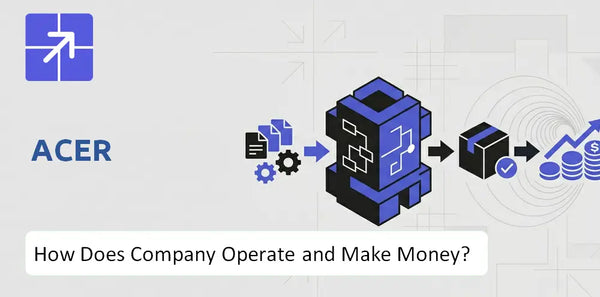
Acer's revenue mix still skews hardware, so profit growth hinges on scaling software subscriptions and AI services launched in 2025; prioritize recurring-revenue conversion to improve margins.
What Does Acer Actually Sell?
Acer Inc. sells computing hardware and related software and services: laptops (Swift, Aspire, Predator, Nitro), Chromebooks, monitors, projectors, servers, AI PCs with NPUs, plus lifestyle products (ebii e-bike), portable power stations, and medical AI diagnostics. Customers pay for devices, platform enablement, aftersales services, and enterprise software and solutions.
 Core hardware lines and new AI PCs
Acer business model centers on volume PC sales: Swift and Aspire ultraportables, Predator and Nitro gaming rigs, and market-leading Chromebooks for education. In 2025 Acer shifted its product strategy toward AI PCs with integrated NPUs; Acer reported that AI-capable devices accounted for about 28% of global notebook shipments in FY2025.
Who buys Acer products
Buyers include consumers, gamers, K – 12 and higher-education institutions, and B2B/enterprise clients purchasing servers and monitors. Channel mix spans retail, ecommerce, and large resellers; enterprise and public-sector contracts grew to ~22% of revenue in FY2025.
Customer value and services
Customers pay for performance, affordability, and ecosystem services: local AI inference on NPUs, gaming optimizations, cloud and warranty services, and medical AI for diagnostics. Aftermarket and services revenue (warranty, software, subscriptions) contributed roughly 12% of total Acer revenue in 2025.
Why Acer's offering stands out
Acer competes on price-performance and channel reach, leveraging OEM/ODM relationships to cut costs and fast time-to-market. Its Predator brand and gaming monitors target enthusiasts while Chromebooks dominate education; Acer's diversified revenue streams reduce cyclicality. See Sales and Marketing Strategy of Acer Company for more on distribution and channel tactics: Sales and Marketing Strategy of Acer Company
Acer SWOT Analysis
- Complete SWOT Breakdown
- Fully Customizable
- Editable in Excel & Word
- Professional Formatting
- Investor-Ready Format

How Does Acer Run Its Business Day to Day?
Acer Inc. runs an asset-light, brand-centric operation focused on R&D, industrial design, and global logistics, outsourcing manufacturing to ODMs and managing inventory across retail, e-commerce, and B2B channels. Day-to-day work centers on supply-chain orchestration, product roadmaps, sales operations, and autonomous internal divisions that act as semi-independent business units.

Operating model: asset-light, brand-led
Acer business model runs on design, engineering, and brand management while outsourcing production to Asian ODMs. Core systems are ERP for supply-chain planning, PLM (product lifecycle management), and CRM for global sales and aftersales.
Product and service delivery: multi-channel access
Customers buy through retail partners, direct e-commerce storefronts, and B2B distributors; channel inventory syncs with real-time demand signals. Aftersales warranty, repair networks, and software updates (firmware, drivers) complete the customer journey.
Production, sourcing, development: ODM partnerships
R&D and industrial design occur in-house while manufacturing and assembly are outsourced to third-party ODMs in Taiwan, China, and Southeast Asia to scale capacity quickly. This reduces capital expenditure and allows rapid product refresh cycles.
Sales channels & distribution: retail, eCommerce, B2B
Distribution mixes big-box retail, online marketplaces, Acer-owned e-storefronts, and enterprise resellers. Commercial sales teams handle contracts for education, government, and corporate clients, driving higher-margin services and solutions revenue.
Key assets, systems & partnerships
Key assets are the brand, IP (design patents), global channel relationships, and ODM contracts; core systems include ERP, PLM, and logistics TMS. Strategic partnerships with chip suppliers, logistics carriers, and reseller networks keep component flow and distribution stable.
What makes the model work in practice
The asset-light approach keeps fixed costs low and allows scaling production to match real-time demand; multigenerational business units (cybersecurity, medical) act as semi-independent engines for innovation and potential IPO spin-offs. Inventory turns and ODM flexibility are critical.
Operational metrics (2025 fiscal year): Acer Inc. reported global revenue of NT$320 billion with hardware (laptops, desktops, monitors) contributing roughly 78% of revenue and services/solutions 22%; gross margin sat near 11.5% while operating margin hovered around 3.2%. Average inventory days were approximately 45, and supply-chain disruptions in 2024 – 25 pushed component cost per unit up 4 – 6% in key segments.
For a focused review of ownership, control, and corporate structure affecting how Acer works at the top level, see Ownership and Control of Acer Company
Acer Business Model Canvas
- One-time Payment
- No Research Needed – Save Hours of Work
- Built by Experts, Trusted by Consultants
- Instant Download, Ready to Use
- 100% Editable, Fully Customizable

How Does Revenue Flow Through Acer?
Revenue at Acer Inc. flows mainly from high-volume hardware sales and wholesale distributor contracts, turning global demand into cash via retail, B2B channels, and direct online sales.
Main revenue driver: Laptops and commercial PCs
Laptop sales account for over 60 percent of turnover, with fiscal 2025 consolidated revenues exceeding TWD 280 billion. The commercial PC refresh cycle in 2025 restored volume demand, converting orders into wholesale and retail revenue quickly.
Additional revenue: Gaming, peripherals, and services
High-margin gaming and AI PCs, monitors, peripherals, and warranty/aftersales lift revenues; Acer pushed gaming and AI segments in 2026 to capture a 15 – 20 percent price premium over standard models, increasing per-unit revenue.
Pricing and monetization model
Money enters via wholesale transactions with global distributors and direct sales on the Acer Store; monetization depends on balancing Average Selling Prices (ASPs) against component costs (CPUs, memory) and capturing premium pricing for specialized SKUs.
What drives revenue most
Volume of laptop shipments, ASP management, and component cost swings drive top line and margins; gross margins averaged around 10 – 12 percent historically, and 2026 focus on gaming/AI aims to raise overall profitability. See Mission, Vision, and Values of Acer Company for corporate context: Mission, Vision, and Values of Acer Company
Acer Marketing Mix
- Complete Marketing Mix Analysis
- Effortlessly Communicate Your Business Strategy
- Investor-Ready Format
- 100% Editable and Customizable
- Clear and Structured Layout

What Makes Acer's Model Sustainable or Fragile?
Acer Inc.'s model is sustained by strong brand equity in gaming and education, plus diversification into medical tech and green energy via Dual Transformation; however, thin operating margins and reliance on chipmakers create fragility. Structural strengths include spin-off ability and channel reach; key risks are supply shocks, margin compression, and concentrated component cycles.
Brand-led diversification supports resilience
Acer business model benefits from the Predator gaming brand and strong education discounts, which drive stable demand in premium gaming monitors and school laptops; diversified revenue from medical technology and green energy reduces pure-PC cyclicality.
Scale, channel reach, and spin-off capital
Acer company overview shows global retail, eCommerce, and B2B distribution plus OEM/ODM sourcing that keep unit costs low; the ability to spin off subsidiaries acts as a unique capital-raising lever versus pure-play PC makers.
High supplier concentration and margin pressure
Acer supply chain depends heavily on Intel, AMD, and Nvidia for CPU/GPU cycles, and on contract manufacturers for assembly; operating margins historically sit between 3% and 5%, leaving limited buffer against component shortages or price wars.
Durability outlook for 2025 – 2026
Professional judgment for 2025 and 2026: Acer is stable if it captures the AI PC upgrade cycle and scales services revenue; otherwise, margin volatility and supply disruptions could make the model exposed. See History and Background of Acer Company for context: History and Background of Acer Company
Acer Boston Consulting Group Matrix
- Built by Experts, Trusted by Consultants
- Structured for Consultants, Students, and Founders
- 100% Editable in Microsoft Word & Excel
- Instant Digital Download – Use Immediately
- Compatible with Mac & PC – Fully Unlocked

Related Blogs
- What Is the History of Acer Company and How Did It Evolve?
- What Is the Competitive Landscape of Acer Company and How Does It Compete?
- What Is the Growth Outlook of Acer Company and Where Is It Heading?
- How Does Acer Company Reach Customers and Turn Demand into Sales?
- What Do the Mission, Vision, and Core Values of Acer Company Reveal?
- Who Are the Core Customers in Acer Company's Target Market?
- Who Owns Acer Company Today and Who Holds Control?
Frequently Asked Questions
Acer sells laptops, Chromebooks, monitors, projectors, servers, AI PCs with NPUs, and related software and services. It also offers lifestyle and specialized products like the ebii e-bike, portable power stations, and medical AI diagnostics. Customers pay for hardware, platform enablement, aftersales support, and enterprise solutions.
Disclaimer
All information, articles, and product details provided on this website are for general informational and educational purposes only. We do not claim any ownership over, nor do we intend to infringe upon, any trademarks, copyrights, logos, brand names, or other intellectual property mentioned or depicted on this site. Such intellectual property remains the property of its respective owners, and any references here are made solely for identification or informational purposes, without implying any affiliation, endorsement, or partnership.
We make no representations or warranties, express or implied, regarding the accuracy, completeness, or suitability of any content or products presented. Nothing on this website should be construed as legal, tax, investment, financial, medical, or other professional advice. In addition, no part of this site - including articles or product references - constitutes a solicitation, recommendation, endorsement, advertisement, or offer to buy or sell any securities, franchises, or other financial instruments, particularly in jurisdictions where such activity would be unlawful.
All content is of a general nature and may not address the specific circumstances of any individual or entity. It is not a substitute for professional advice or services. Any actions you take based on the information provided here are strictly at your own risk. You accept full responsibility for any decisions or outcomes arising from your use of this website and agree to release us from any liability in connection with your use of, or reliance upon, the content or products found herein.