
How does Appen work as a human-in-the-loop service provider and what drives its revenue?
Appen supplies human annotation, validation, and alignment services that train and improve generative AI models. This matters because Appen flags industry reliance on paid human labor for model safety; in 2025 it pivoted toward higher-margin alignment work amid falling low-complexity tagging demand. Appen BCG Matrix Analysis
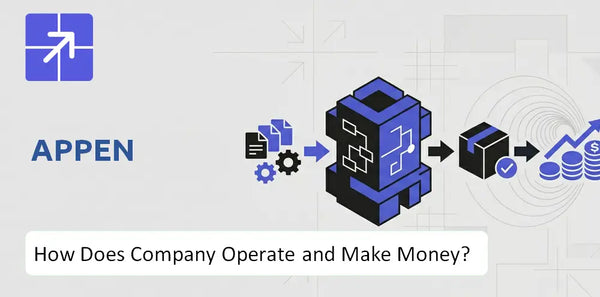
Focus on scaling specialized alignment teams and automation to protect margins; rising client demand for model safety in 2025 makes this the key revenue lever.
What Does Appen Actually Sell?
Appen sells human-verified AI training data and model evaluation services – not raw data alone but labeled ground truth, RLHF annotations, and accuracy/helpfulness scores that make models reliable. By 2025 Appen also offers Sovereign AI datasets tailored for localized, culturally aware models.
 Core Products: Ground Truth, RLHF, Multi-modal Annotation
Appen provides data annotation services across text, image, audio, and video, plus Reinforcement Learning from Human Feedback (RLHF) and model evaluation. Customers pay for labeled datasets, quality scores (accuracy, helpfulness), and curated corpora that reduce hallucinations and bias in AI systems.
Who Buys It: AI Teams, Tech Firms, Governments
Buyers include hyperscalers, enterprise AI teams, robotics and autonomous-vehicle developers, and national authorities building Sovereign AI. Procurement is often enterprise contracts for ongoing data pipelines and one-off evaluation projects.
Customer Value: Better Model Behavior and Faster Time-to-Deployment
Clients receive higher model accuracy, fewer safety incidents, and locale-specific coverage; this drives reduced fine-tuning cycles and lower downstream remediation costs. Appen reports serving hundreds of enterprise customers and scaling projects with a crowdsourced workforce to meet volume peaks.
Differentiators: Quality Controls, Scale, and Sovereign AI Catalog
Appen combines a large global crowd of contractors, layered quality control, and metric-driven validation (accuracy/helpfulness scores) to ensure usable training sets. By 2025 the catalog expanded to include Sovereign AI datasets for localized models, positioning Appen as an AI training data provider with enterprise-grade compliance and cultural nuance coverage. See Mission, Vision, and Values of Appen Company
Appen SWOT Analysis
- Complete SWOT Breakdown
- Fully Customizable
- Editable in Excel & Word
- Professional Formatting
- Investor-Ready Format

How Does Appen Run Its Business Day to Day?
Appen runs day-to-day as a real-time data-labeling service: clients submit projects, Appen's solution architects slice requirements into micro-tasks in the Appen Data Annotation Platform (ADAP), and a global crowd of ~1.3 million contractors across 170 countries executes and validates labels with automated quality controls and model-assisted workflows.

Operating Model: centralized platform, distributed workforce
Appen operates ADAP as the central orchestration layer: solution architects map client specs to millions of micro-tasks, ADAP routes tasks to workers by language, location, and demographic filters, and continuous quality gates enforce accuracy in real time.
Product or Service Delivery: project-based, API-enabled access
Clients – search engines, LLM developers, enterprises – order services via account teams or APIs; Appen delivers datasets, annotation batches, or managed-labeling projects on SLAs, with bulk delivery, secure transfers, and versioned datasets.
Production, Sourcing, or Development: crowd-sourced labeling plus model-assisted prep
Data is sourced through the crowd and partner channels, preprocessed by ADAP and increasingly by AI (Model-Assisted Labeling). Humans resolve edge cases and provide final validation; Appen maintains linguistic and demographic panels to meet client requirements.
Sales Channels or Distribution: enterprise sales, platform API, channel partners
Revenue comes from direct enterprise contracts, recurring managed-service deals, and platform/API consumption. Global account teams, partnerships, and case-based proposals connect Appen to major AI labs and tech buyers.
Key Assets, Systems, or Partnerships: ADAP, crowd, and security controls
Critical assets are the ADAP software stack, the global crowd (~1.3 million contractors), labeled dataset libraries, and security/compliance frameworks; strategic partnerships with cloud and ML tool vendors accelerate integrations.
What Makes the Model Work in Practice: scale, microtasking, and QC loops
Efficiency comes from micro-task parallelism, demographic targeting for high-fidelity labels, automated gold-set checks that reject low-quality work in real time, and model-assisted labeling that lowers cost per label while keeping humans as final arbiters.
Daily KPIs tracked include throughput (tasks/hour), accuracy vs gold-set (target >95% for many projects), contractor active count, and model-assist adoption; in 2025 Appen reported increasing share of annotation using model-assisted workflows and continued reliance on a global crowdsourced workforce to handle language and edge-case diversity – see the Sales and Marketing Strategy of Appen Company for related context.
Appen Business Model Canvas
- One-time Payment
- No Research Needed – Save Hours of Work
- Built by Experts, Trusted by Consultants
- Instant Download, Ready to Use
- 100% Editable, Fully Customizable

How Does Revenue Flow Through Appen ?
Revenue flows from volume-based service contracts, project statements of work, and growing Platform-as-a-Service subscriptions; demand converts to cash via per-task billing, hourly professional fees, and recurring platform access. For 2025, Appen stabilized revenue near $260 million to $280 million, shifting away from low-margin labeling toward higher-margin PaaS and enterprise engagements.
Core revenue: Volume service contracts
Most revenue comes from high-volume contracts with global tech customers and large enterprises supplying steady demand for data annotation services. Historically over 70 percent of revenue came from a few Global technology giants, but diversification reduced that concentration by 2025.
Secondary revenue: Enterprise, Government, and PaaS
Appen expanded into Enterprise and Government sectors and grew Platform-as-a-Service licensing where customers pay to use Appen's annotation and management tools, moving revenue toward recurring streams and away from commodity labeling.
Pricing and monetization model
Demand converts to revenue via per-task pricing for crowdsourced workforce outputs, hourly professional services for custom projects, and subscription or usage-based fees for PaaS access – creating a mix of variable and predictable income.
What drives revenue most
Volume and client concentration drive top-line swings, while contract mix (project versus PaaS), pricing per task/hour, and growth in enterprise/government accounts determine margin recovery and revenue stability.
History and Background of Appen Company
Appen Marketing Mix
- Complete Marketing Mix Analysis
- Effortlessly Communicate Your Business Strategy
- Investor-Ready Format
- 100% Editable and Customizable
- Clear and Structured Layout

What Makes Appen 's Model Sustainable or Fragile?
Appen's model is sustainable while human-level reasoning gaps persist, relying on crowdsourced workforce and quality IP, but fragile due to customer concentration, synthetic data threats, and margin sensitivity to labor rules and Big Tech pricing power.
Human-in-the-Loop Advantage
Appen remains essential where models hallucinate or misinterpret context; human annotation reduces error rates and supports model evaluation, keeping demand for data annotation services from enterprises focused on LLM safety and accuracy.
Scale, Diversity, and QA IP
Global crowdsourced workforce and curated datasets provide linguistic and cultural coverage hard to replicate; proprietary quality-control processes and tooling underpin repeatable annotation accuracy and certification for complex speech and language projects.
Customer Concentration & Pricing Pressure
Appen faces extreme customer concentration – historically >50% revenue from top clients at points – and gross margins track client pricing power and global labor cost trends, exposing earnings to contract renewals and Big Tech negotiation leverage.
Durability Assessment for 2025/2026
After 2023 – 2024 restructuring, Appen appears to have right-sized costs and stabilized cash flow; still, the business is a high-beta play on continued human oversight need, with synthetic data and model-generated labeling as the largest medium-term fragility.
For detailed context and recent metrics see Growth Outlook of Appen Company.
Appen Boston Consulting Group Matrix
- Built by Experts, Trusted by Consultants
- Structured for Consultants, Students, and Founders
- 100% Editable in Microsoft Word & Excel
- Instant Digital Download – Use Immediately
- Compatible with Mac & PC – Fully Unlocked

Related Blogs
- What Is the History of Appen Company and How Did It Evolve?
- What Is the Competitive Landscape of Appen Company and How Does It Compete?
- What Is the Growth Outlook of Appen Company and Where Is It Heading?
- How Does Appen Company Reach Customers and Turn Demand into Sales?
- What Do the Mission, Vision, and Core Values of Appen Company Reveal?
- Who Are the Core Customers in Appen Company's Target Market?
- Who Owns Appen Company Today and Who Holds Control?
Frequently Asked Questions
Appen sells human-verified AI training data and model evaluation services. Its offerings include labeled ground truth, RLHF annotations, multi-modal annotation, and accuracy or helpfulness scores that help make AI models more reliable and less biased.
Disclaimer
All information, articles, and product details provided on this website are for general informational and educational purposes only. We do not claim any ownership over, nor do we intend to infringe upon, any trademarks, copyrights, logos, brand names, or other intellectual property mentioned or depicted on this site. Such intellectual property remains the property of its respective owners, and any references here are made solely for identification or informational purposes, without implying any affiliation, endorsement, or partnership.
We make no representations or warranties, express or implied, regarding the accuracy, completeness, or suitability of any content or products presented. Nothing on this website should be construed as legal, tax, investment, financial, medical, or other professional advice. In addition, no part of this site - including articles or product references - constitutes a solicitation, recommendation, endorsement, advertisement, or offer to buy or sell any securities, franchises, or other financial instruments, particularly in jurisdictions where such activity would be unlawful.
All content is of a general nature and may not address the specific circumstances of any individual or entity. It is not a substitute for professional advice or services. Any actions you take based on the information provided here are strictly at your own risk. You accept full responsibility for any decisions or outcomes arising from your use of this website and agree to release us from any liability in connection with your use of, or reliance upon, the content or products found herein.