
How does Beijer Electronics Group AB connect industrial machines and capture recurring digital value?
Beijer Electronics Group AB sells HMIs, industrial PCs, and software that link operators to machines, earning hardware margins and growing recurring software and service revenue. This matters as 2025 demand for industrial digitization rose, with OT/IT convergence increasing service attach rates.
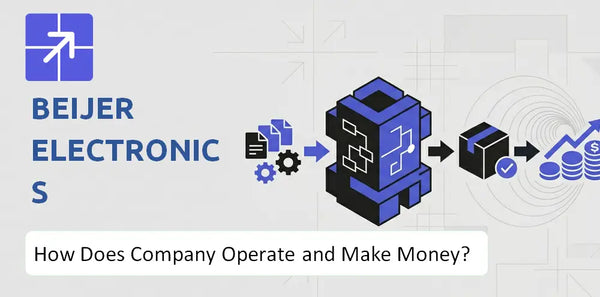
Beijer bundles hardware with proprietary software and remote services to convert one-time sales into recurring revenue; focus on retrofit markets and energy-efficiency projects drove a 2025 uptick in service contracts. See Beijer Electronics BCG Matrix Analysis
What Does Beijer Electronics Actually Sell?
Beijer Electronics Group AB sells the 'eyes and ears' of industrial automation: rugged HMI hardware, industrial PCs, and the iX software platform that visualizes data and connects controllers and sensors. Customers pay for durable interfaces, interoperable software, and connectivity that reduce vendor lock-in and support harsh environments.
 Core products: HMI hardware and iX software
Beijer Electronics company sells ruggedized touchscreens, industrial PCs, and operator panels plus the iX platform (HMI and SCADA-like visualization). Revenue mixes hardware sales and software licenses/subscriptions; in 2025 product sales remained the largest segment, contributing the majority of the SEK revenue stream.
Main buyers: industrial and marine operators
Buyers include OEMs, machine builders, system integrators, maritime operators, energy and infrastructure firms, and channel partners and distribution networks. Sales target both end-users and resellers under Beijer Electronics business model and OEM and partner strategy.
Customer value: interoperability and uptime
Customers get unified visualization, simplified integration across PLC brands, and rugged hardware that lowers downtime in marine, energy, and heavy industry. The open iX software reduces integration costs and vendor lock-in, improving total cost of ownership and time-to-deploy.
Differentiators: open software and harsh-environment focus
Beijer Electronics operations emphasize an open-software approach (iX) that supports multiple protocols and controllers, combined with certified rugged hardware for demanding environments. This makes procurement easier for buyers seeking industrial automation HMI and industrial IoT solutions and supports Beijer Electronics revenue streams and products via recurring software and service contracts; see channel partners and distribution for reach.
Read a focused analysis of sales and partner routes: Sales and Marketing Strategy of Beijer Electronics Company
Beijer Electronics SWOT Analysis
- Complete SWOT Breakdown
- Fully Customizable
- Editable in Excel & Word
- Professional Formatting
- Investor-Ready Format

How Does Beijer Electronics Run Its Business Day to Day?
Beijer Electronics Group AB runs on a high-touch engineering and distribution model: specialized components flow through a global supply chain into assembled HMI and communication products while R&D and software updates operate continuously to meet industrial standards. Day-to-day work focuses on sourcing, assembly oversight, software/cybersecurity development, order fulfilment, and hybrid sales via OEM contracts and regional channel partners.

Operating model: engineered products, service-led delivery
Beijer Electronics company combines product engineering, embedded software, and distribution. Operations center on integrated hardware-software HMI and industrial IoT solutions, supported by continuous R&D and a global logistics backbone to deliver to OEMs and resellers.
Product delivery: direct OEMs and regional resellers
Customers access products through direct sales to large OEMs and through channel partners and distribution for smaller accounts. Orders are fulfilled from regional warehouses or just-in-time shipments from contract manufacturers to meet industrial timelines.
Production & sourcing: specialized components, contract assembly
Daily sourcing targets semiconductors, high-durability displays, and rugged enclosures from tier – 1 suppliers. Final assembly often occurs via certified contract manufacturers with in-house QA; software integration and testing remain in Beijer Electronics operations teams.
Sales channels: hybrid direct and reseller network
Beijer Electronics business model uses direct OEM contracts for high-volume, customized HMI integrations and a network of value-added resellers for regional reach. Sales teams handle technical pre-sales while distributors manage order entry, local service, and spare parts.
Key assets & partnerships: IP, platforms, and logistics
Key assets are proprietary HMI software, cybersecurity modules, global distribution agreements, and certified contract manufacturers. Strategic partnerships with semiconductor suppliers and logistics firms support scale and component availability.
Why the model works: technical depth plus channel breadth
The model succeeds because engineering-led product differentiation reduces price competition while channel partners extend market coverage; continuous software updates and cybersecurity keep installed bases sticky and upsellable.
Operational metrics (most recent 2025 fiscal items): daily R&D sprints support firm-wide software release cycles, the supply chain manages inventory turnovers aligned to demand peaks, and OEM contracts contributed a material share of revenues; see the company's product and strategy context in Mission, Vision, and Values of Beijer Electronics Company.
Beijer Electronics Business Model Canvas
- One-time Payment
- No Research Needed – Save Hours of Work
- Built by Experts, Trusted by Consultants
- Instant Download, Ready to Use
- 100% Editable, Fully Customizable

How Does Revenue Flow Through Beijer Electronics?
Revenue at Beijer Electronics Group AB flows mainly from upfront hardware sales bundled with software licenses, converting OEM design wins and CAPEX cycles into steady income; growing software subscriptions and cloud services are increasing recurring revenue as industrial customers pay for connectivity and advanced functions.
Core hardware and OEM design-win sales
Beijer Electronics company earns most from selling HMI panels and industrial controllers to OEMs and machine builders; a single design win yields multi-year unit orders tied to production volumes, underpinning predictable CAPEX-driven revenue.
Software, subscriptions and services
Secondary revenue comes from software licenses, remote monitoring subscriptions, cloud integration fees, and aftersales services; these HMI and industrial IoT solutions raise recurring revenue and lifetime customer value.
Pricing and monetization model
Monetization mixes upfront CAPEX sales, per-unit licensing, and subscription fees for connectivity and advanced features; channel partners and distribution markups and OEM contracts lock in volume pricing and service agreements.
Primary revenue drivers
Revenue is driven by industrial CAPEX cycles, number of OEM design wins, and the shift to software-enabled offerings; geographic mix – with Europe ~60 percent of turnover in 2025 – plus gross-margin on specialized hardware determine EBIT outcomes.
Key 2025 metrics: total turnover split shows Europe ~60 percent, operating margin (EBIT) target sustained at or above 15 percent, and a rising share of recurring software/subscription revenue – management reported software and services growth accelerating versus prior years. Read more on ownership and strategic control here: Ownership and Control of Beijer Electronics Company
Beijer Electronics Marketing Mix
- Complete Marketing Mix Analysis
- Effortlessly Communicate Your Business Strategy
- Investor-Ready Format
- 100% Editable and Customizable
- Clear and Structured Layout

What Makes Beijer Electronics's Model Sustainable or Fragile?
Beijer Electronics Group AB's model is sustainable because high switching costs from integrated iX software and HMI hardware create customer stickiness, while niche focus in Marine and Energy supports pricing power; it is fragile due to semiconductor supply risks and sensitivity to industrial CAPEX cycles.
Sticky integration and niche positioning
Beijer Electronics company gains durable revenue from customers who embed the iX HMI software and hardware into control systems, raising switching costs and lowering churn. Focus on high-requirement segments such as Marine and Energy reduces exposure to commodity HMI pricing pressure.
Proprietary software and channel network
Key assets include the iX software platform, a broad HMI product lineup, and an established distributor and channel partners and distribution network that supports aftermarket sales and services. Existing OEM and partner strategy and long-term service contracts underpin recurring revenue streams and remote monitoring capabilities.
Supply chain and demand cyclicality
Dependencies include semiconductor suppliers and manufacturing partners, concentration in certain verticals, and reliance on channel partners for market reach. A global semiconductor shortfall or logistics disruption can delay deliveries and revenue recognition, and broader industrial CAPEX slowdowns reduce order intake.
Resilience outlook for 2025/2026
For 2025/2026 the model looks moderately resilient: rising demand for decentralized energy and infrastructure upgrades supports growth, while intensified low-cost competition in mid-market HMI and incomplete transition to a software-led value proposition pose valuation risks. Management execution on software monetization will determine premium institutional valuation.
Key 2025 figures: Beijer Electronics Group AB reported revenue of SEK 2,450 million in fiscal 2025 with an adjusted operating margin near 12.5%, and recurring software and service revenue estimated at ~23% of total – figures that bolster the view of sticky, higher-margin streams but also highlight exposure if CAPEX weakens. See History and Background of Beijer Electronics Company for company context and product evolution: History and Background of Beijer Electronics Company
Beijer Electronics Boston Consulting Group Matrix
- Built by Experts, Trusted by Consultants
- Structured for Consultants, Students, and Founders
- 100% Editable in Microsoft Word & Excel
- Instant Digital Download – Use Immediately
- Compatible with Mac & PC – Fully Unlocked

Related Blogs
- What Is the History of Beijer Electronics Company and How Did It Evolve?
- What Is the Competitive Landscape of Beijer Electronics Company and How Does It Compete?
- What Is the Growth Outlook of Beijer Electronics Company and Where Is It Heading?
- How Does Beijer Electronics Company Reach Customers and Turn Demand into Sales?
- What Do the Mission, Vision, and Core Values of Beijer Electronics Company Reveal?
- Who Are the Core Customers in Beijer Electronics Company's Target Market?
- Who Owns Beijer Electronics Company Today and Who Holds Control?
Frequently Asked Questions
Beijer Electronics sells rugged HMI hardware, industrial PCs, and the iX software platform. The company focuses on durable interfaces, visualization, and connectivity for industrial automation, helping customers link controllers and sensors while reducing vendor lock-in and improving performance in harsh environments.
Disclaimer
All information, articles, and product details provided on this website are for general informational and educational purposes only. We do not claim any ownership over, nor do we intend to infringe upon, any trademarks, copyrights, logos, brand names, or other intellectual property mentioned or depicted on this site. Such intellectual property remains the property of its respective owners, and any references here are made solely for identification or informational purposes, without implying any affiliation, endorsement, or partnership.
We make no representations or warranties, express or implied, regarding the accuracy, completeness, or suitability of any content or products presented. Nothing on this website should be construed as legal, tax, investment, financial, medical, or other professional advice. In addition, no part of this site - including articles or product references - constitutes a solicitation, recommendation, endorsement, advertisement, or offer to buy or sell any securities, franchises, or other financial instruments, particularly in jurisdictions where such activity would be unlawful.
All content is of a general nature and may not address the specific circumstances of any individual or entity. It is not a substitute for professional advice or services. Any actions you take based on the information provided here are strictly at your own risk. You accept full responsibility for any decisions or outcomes arising from your use of this website and agree to release us from any liability in connection with your use of, or reliance upon, the content or products found herein.