
How does CalAmp convert hardware into recurring SaaS revenue and what drives CalAmp as a telematics and IoT services business?
CalAmp sells telematics devices and subscription software that turns vehicle and asset signals into analytics and workflows. This matters because by 2025 CalAmp shifted focus to subscription services to stabilize margins amid declining hardware sales, supported by growing fleet telematics demand.
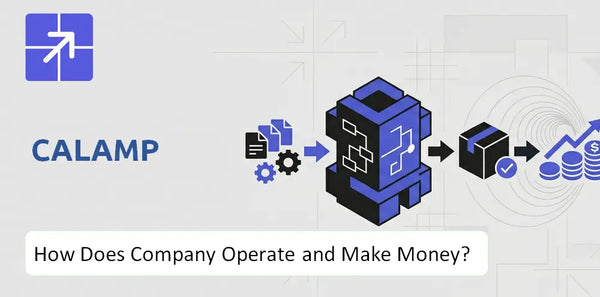
CalAmp monetizes devices, connectivity, and data platforms, upselling analytics and fleet-management features to drive recurring revenue. See product detail: CalAmp BCG Matrix Analysis
What Does CalAmp Actually Sell?
CalAmp sells a connected intelligence ecosystem: rugged edge GPS/diagnostic devices plus the CalAmp Telematics Cloud and software suites (iOn, CrashBoxx) that turn sensor streams into fleet, safety, and asset-recovery actions. Customers pay for real-time visibility, predictive maintenance, and automated safety alerts delivered as a hardware-plus-subscription service.
 Core product mix: devices, cloud, apps
CalAmp sells telematics hardware (OBD-II dongles, rugged trackers, asset and trailer sensors), the CalAmp Telematics Cloud platform, and vertical software suites such as iOn for fleet operations and CrashBoxx for automated crash detection and claims workflow.
Main buyers and procurement models
Buyers include trucking and logistics fleets, equipment rental and construction firms, municipal and federal government fleets, and insurance carriers. Procurement mixes capital hardware purchases with recurring SaaS/subscription contracts and managed-service agreements.
Customer value: operational and financial impact
Customers gain lower fuel spend, improved driver safety, faster theft recovery, and reduced downtime through predictive maintenance alerts. Public filings show CalAmp's subscription and recurring revenue has been the primary growth driver, representing a growing share of total revenue in 2025.
Differentiators and go – to – market
CalAmp differentiates via integrated hardware-to-cloud stack, industry-specific apps, telematics API integrations for partners, and a mixed sales motion (direct, channel, OEM). That blend supports a subscription revenue model while preserving hardware unit sales and services upsells – key to how CalAmp makes money.
For context on market positioning and competitors, see Competitive Landscape of CalAmp Company.
CalAmp SWOT Analysis
- Complete SWOT Breakdown
- Fully Customizable
- Editable in Excel & Word
- Professional Formatting
- Investor-Ready Format

How Does CalAmp Run Its Business Day to Day?
CalAmp runs daily by managing the telematics data lifecycle: sourcing hardware from contract manufacturers, deploying devices, ingesting and processing telemetry on its cloud platform, and selling subscriptions and services through direct and reseller channels.

Operational backbone: cloud-first telematics delivery
CalAmp business model centers on a cloud platform that ingests device telemetry, provides real-time analytics, and bills recurring subscriptions. Day-to-day ops prioritize platform reliability, low-latency data flow, and uptime SLAs for thousands of global endpoints.
Product and service delivery to customers
Customers access CalAmp IoT telematics solutions via SaaS subscriptions and managed services; hardware is often bundled with service plans. Sales teams activate accounts, provision devices, and integrate APIs so fleets and enterprise clients consume telematics in dashboards and mobile apps.
Production, sourcing, and R&D workflow
CalAmp is effectively fabless: contract manufacturers produce GPS tracking devices and modules. Engineering focuses on firmware, cloud features, and API stability; supply-chain teams manage component lead times and inventory to avoid field shortages.
Sales channels and distribution model
Revenue comes through a direct enterprise sales force, government contracting, and a network of value-added resellers. Field sales drive large accounts while channel partners and SMB-focused resellers handle volume distribution and installation.
Key assets, systems, and partnerships
Core assets include the cloud platform, device firmware, telematics APIs, and partnerships with contract manufacturers and carriers. Platform uptime and API throughput are critical; partnerships with carriers and VARs widen geographic reach and compliance for government work.
What drives day-to-day effectiveness
After the 2024 restructuring, daily focus shifted to customer success and software integration, boosting recurring revenue versus hardware margins. Monitoring data ingestion rates, reducing mean time to repair, and increasing subscription renewals keep gross margin and ARR growth visible.
Relevant metrics: in fiscal 2025 CalAmp reported $299.1 million in revenue and $111.5 million in subscription and services revenue (recurring), reflecting the shift away from high-volume hardware; daily ops concentrate on maintaining 99.9% platform availability and scaling ingestion for over 1.2 million connected endpoints.
Read a deeper take on sales and customer motion in the Sales and Marketing Strategy of CalAmp Company
CalAmp Business Model Canvas
- One-time Payment
- No Research Needed – Save Hours of Work
- Built by Experts, Trusted by Consultants
- Instant Download, Ready to Use
- 100% Editable, Fully Customizable

How Does Revenue Flow Through CalAmp?
Revenue flows into CalAmp through hardware sales and recurring software subscriptions, with demand from fleets converted into predictable monthly fees and one-time device purchases. The company seeds software adoption by pricing hardware aggressively to grow its installed base and recurring subscription revenue.
Subscription-first Telematics-as-a-Service
CalAmp's primary revenue stream is recurring subscriptions for telematics, fleet management, and analytics; in fiscal 2025 subscriptions represent approximately 65 percent of total revenue, giving steady monthly cash flow tied to active connected assets.
Hardware sales and professional services
Secondary revenue comes from GPS tracking devices and gateways sold at lower margins to acquire customers, plus professional services, custom integrations, and data licensing that add one-time and recurring fees.
Pricing and monetization mix
CalAmp monetizes via upfront hardware sales, per-asset monthly subscription fees, tiered software packages, and add-on modules (safety, compliance); enterprise deals include integration fees and volume-based discounts.
Key revenue drivers
The main drivers are growth in connected assets, subscription ARPU, and retention (stickiness from integrations); in 2025 focus on Telematics-as-a-Service raised recurring revenue share and improved visibility into cash flows. See Ownership and Control of CalAmp Company for related corporate context.
CalAmp Marketing Mix
- Complete Marketing Mix Analysis
- Effortlessly Communicate Your Business Strategy
- Investor-Ready Format
- 100% Editable and Customizable
- Clear and Structured Layout

What Makes CalAmp's Model Sustainable or Fragile?
CalAmp's model is sustainable where long-term government and enterprise telematics contracts create recurring subscription revenue and a defensive moat, but fragile due to legacy hardware exposure, chip supply risks, and intense SaaS competition that pressures margins and renewal rates.
Structural Strength: Embedded, Recurring Revenue
CalAmp business model benefits from enterprise and government fleet contracts that convert device sales into ongoing subscription and service revenue; by 2025 recurring revenue mix is a higher share of total revenue, improving cash predictability.
Key Assets or Capabilities: Platform Integration and Contracts
CalAmp how it works centers on its telematics cloud platform, API integration, and installed base of endpoints that provide up-sell paths; deep government and enterprise relationships act as switching-cost anchors for fleet management solutions.
Dependencies or Constraints: Supply, R&D, and Competition
CalAmp IoT telematics solutions remain exposed to global chip shortages that can delay device deployment, and the business needs sustained R&D spending to keep its software competitive against specialized SaaS players and incumbents like Geotab or Verizon Connect.
Durability in 2025/2026: Cautiously Optimistic but Conditional
Post-restructuring, the leaner balance sheet reduced debt service and improved profitability focus; however, long-term viability requires maintaining software renewal rates above 90 percent and protecting subscription gross margins against SaaS rivals and price pressure.
Key metrics investors should watch: 2025 subscription revenue growth, subscription as percent of total revenue, renewal rate (target > 90 percent), R&D spend as percent of revenue, and net leverage after private restructuring; see Growth Outlook of CalAmp Company for context: Growth Outlook of CalAmp Company
CalAmp Boston Consulting Group Matrix
- Built by Experts, Trusted by Consultants
- Structured for Consultants, Students, and Founders
- 100% Editable in Microsoft Word & Excel
- Instant Digital Download – Use Immediately
- Compatible with Mac & PC – Fully Unlocked

Related Blogs
- What Is the History of CalAmp Company and How Did It Evolve?
- What Is the Competitive Landscape of CalAmp Company and How Does It Compete?
- What Is the Growth Outlook of CalAmp Company and Where Is It Heading?
- How Does CalAmp Company Reach Customers and Turn Demand into Sales?
- What Do the Mission, Vision, and Core Values of CalAmp Company Reveal?
- Who Are the Core Customers in CalAmp Company's Target Market?
- Who Owns CalAmp Company Today and Who Holds Control?
Frequently Asked Questions
CalAmp sells connected telematics hardware, cloud software, and subscription services. Its products include GPS and diagnostic devices, the CalAmp Telematics Cloud, and software suites like iOn and CrashBoxx that help customers track fleets, improve safety, and recover assets.
Disclaimer
All information, articles, and product details provided on this website are for general informational and educational purposes only. We do not claim any ownership over, nor do we intend to infringe upon, any trademarks, copyrights, logos, brand names, or other intellectual property mentioned or depicted on this site. Such intellectual property remains the property of its respective owners, and any references here are made solely for identification or informational purposes, without implying any affiliation, endorsement, or partnership.
We make no representations or warranties, express or implied, regarding the accuracy, completeness, or suitability of any content or products presented. Nothing on this website should be construed as legal, tax, investment, financial, medical, or other professional advice. In addition, no part of this site - including articles or product references - constitutes a solicitation, recommendation, endorsement, advertisement, or offer to buy or sell any securities, franchises, or other financial instruments, particularly in jurisdictions where such activity would be unlawful.
All content is of a general nature and may not address the specific circumstances of any individual or entity. It is not a substitute for professional advice or services. Any actions you take based on the information provided here are strictly at your own risk. You accept full responsibility for any decisions or outcomes arising from your use of this website and agree to release us from any liability in connection with your use of, or reliance upon, the content or products found herein.