
How does Dell Technologies connect semiconductor innovation to enterprise IT and monetize full-stack infrastructure?
Dell Technologies sells servers, storage, networking and services, scaling supply chains and channel partners to convert chip advances into customer-ready systems. This matters as Dell reported strong 2025 server demand tied to AI workloads, signaling durable infrastructure revenue shifts. Dell BCG Matrix Analysis
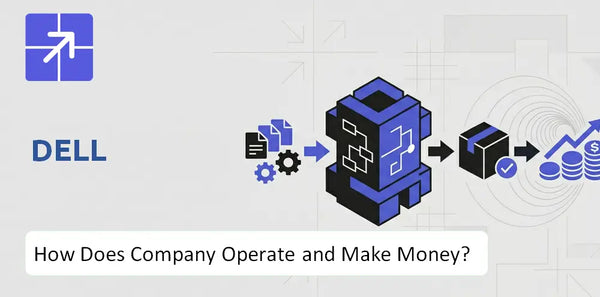
Dell captures higher-margin services and systems integration as customers buy AI-optimized racks; focus on channel efficiency and OEM partnerships drives recurring revenue and aftermarket sales.
What Does Dell Actually Sell?
Dell Technologies sells PCs, workstations, servers, storage, networking, software and services; customers pay for integrated hardware, AI-enabled platforms, and professional services that run and secure IT and private AI environments.
 Core product lines and platforms
The Client Solutions Group offers Latitude, Precision, and XPS PCs and workstations redefined in 2025 – 2026 with integrated AI neural processing units (NPUs). The Infrastructure Solutions Group sells PowerEdge servers and PowerScale storage as the data-center backbone, plus networking, VMware-based software stacks, and converged systems.
Who buys these products
Buyers include enterprises (IT, data centers, AI/ML teams), public-sector organizations, SMBs, and individual consumers seeking premium XPS laptops. Channel partners and large cloud/service providers also purchase at scale for resale or infrastructure buildouts.
Customer value and outcomes
Customers get performance-optimized hardware plus deployment, lifecycle and support services that reduce time-to-production for workloads and private AI. In fiscal 2025 Dell reported that services and infrastructure contributed materially to recurring revenue growth, with Solutions & Services driving higher gross margins than pure hardware sales.
Why Dell's offering stands out
Dell combines direct-sales scale, global supply-chain management, and integrated offerings such as Dell AI Factory – hardware, proprietary software, and professional services for private AI – to win enterprise contracts. This mix supports diversified Dell revenue streams and improves profitability versus standalone PC sales; see Mission, Vision, and Values of Dell Company for deeper context.
Dell SWOT Analysis
- Complete SWOT Breakdown
- Fully Customizable
- Editable in Excel & Word
- Professional Formatting
- Investor-Ready Format

How Does Dell Run Its Business Day to Day?
Dell Technologies runs day-to-day on a build-to-order manufacturing logic and an aggressive direct-to-enterprise sales strategy, coordinating global logistics and 24/7 services to deliver customized hardware and lifecycle support. Key systems include order-to-manufacture platforms, global distribution hubs, and a large field-services organization that links sales, supply chain, and support.

Operating model: Build-to-order plus direct enterprise sales
Dell business model centers on configure-to-order production and direct sales to enterprises and consumers. Daily operations prioritize rapid configuration, order routing to regional factories, and tight coordination with sales and services for delivery and installation.
Product and service delivery: Customized hardware to global customers
Customers order via direct sales teams, e-commerce, or channel partners; orders flow into manufacturing lines and regional distribution centers. For 2025 the services segment supports >24/7 technical support and on-site maintenance, retaining customers across device lifecycles.
Production, sourcing, and development: Strategic supplier alliances
Dell secures priority silicon and networking components through partnerships with suppliers such as Nvidia and Broadcom, enabling consistent supply for servers and PCs. R&D and product engineering focus on modular designs so factories assemble customer-specific SKUs quickly.
Sales channels and distribution: Direct-first with partner reach
Primary go-to-market strategy: direct enterprise sales and e-commerce; channel partners and resellers extend reach for SMBs and retail. In 2025 direct enterprise contracts accounted for a material share of revenue, supported by deal teams, systems integration, and OEM relationships.
Key assets, systems, and partnerships: Supply chain and services scale
Core assets include regional manufacturing hubs, global distribution network, and a services organization. Strategic partnerships with silicon providers secure components; enterprise sales CRM, order-to-cash systems, and logistics platforms keep lead times low.
What makes the model work: Customization, scale, and integrated services
The model succeeds because build-to-order reduces inventory and enables pricing flexibility while large-scale services lock in recurring revenue. For 2025, services and solutions continued to be a key profit driver, complementing PC and infrastructure hardware sales and improving lifetime value.
Relevant context: read more on the company history in History and Background of Dell Company.
Dell Business Model Canvas
- One-time Payment
- No Research Needed – Save Hours of Work
- Built by Experts, Trusted by Consultants
- Instant Download, Ready to Use
- 100% Editable, Fully Customizable

How Does Revenue Flow Through Dell?
Dell Technologies turns customer demand into revenue mainly via hardware sales and growing subscription services; transactional PC and server shipments convert quickly, while long-term contracts and financing smooth and extend cash flows.
Core revenue: Hardware sales (PCs and servers)
In fiscal 2025 Dell Technologies reported revenue of approximately 94,000,000,000 dollars, with the bulk from PC and server hardware. Servers gained momentum from AI demand, pushing fiscal 2026 projections toward 102,000,000,000 dollars.
Recurring revenue: Services and APEX
Dell APEX converts capital expenditure into subscription billing, increasing recurring revenue and gross margin stability. Professional services, infrastructure support, and software add predictable, higher-margin income streams.
Monetization: Sales, subscriptions, and financing
Dell monetizes through direct transactional sales, multi-year APEX subscriptions, software licensing, and service fees. Dell Financial Services finances purchases, shortening sales cycles and converting pipeline demand into realized revenue.
Primary revenue drivers
Key drivers are PC refresh cycles, enterprise server upgrades for AI, APEX subscription growth, and financing uptake via Dell Financial Services. Supply chain efficiency and direct sales pricing also materially affect margins and conversion speed.
See additional context on corporate structure and control in this article: Ownership and Control of Dell Company
Dell Marketing Mix
- Complete Marketing Mix Analysis
- Effortlessly Communicate Your Business Strategy
- Investor-Ready Format
- 100% Editable and Customizable
- Clear and Structured Layout

What Makes Dell's Model Sustainable or Fragile?
Dell Technologies' model is sustainable due to scale, a massive AI server backlog, and a PC refresh cycle, but fragile from component-cost swings, GPU shortages, and PC cyclicality that can compress margins and revenue timing.
Scale and AI backlog drive revenue visibility
Dell's massive scale and diversified revenue streams give pricing power and negotiating leverage with suppliers. Entering 2026 Dell had a record AI server backlog exceeding 4,000,000,000 dollars, supporting near-term infrastructure revenue and cash generation.
Integrated go-to-market and services attach
Dell's direct-sales model plus channel partners and a growing services business increase lifetime customer value and recurring revenue. Services and solutions now materially boost margins versus raw PC hardware sales.
High dependence on components and GPUs
Dell's cost base is sensitive to semiconductor and high-end GPU pricing and availability; supply-chain disruption or GPU scarcity can compress gross margins quickly. The PC segment remains cyclical and exposed to OEM competition and price pressure.
Overall durability in 2025 – 2026: resilient but exposed
Professional judgment for 2025 and 2026: Dell Technologies is a robust, cash-generative leader in enterprise AI infrastructure, with strong near-term visibility from the > 4 billion AI server backlog and PC refresh demand, yet performance is tightly linked to enterprise AI adoption rates and global semiconductor supply stability. See Competitive Landscape of Dell Company for context: Competitive Landscape of Dell Company
Dell Boston Consulting Group Matrix
- Built by Experts, Trusted by Consultants
- Structured for Consultants, Students, and Founders
- 100% Editable in Microsoft Word & Excel
- Instant Digital Download – Use Immediately
- Compatible with Mac & PC – Fully Unlocked

Related Blogs
- What Is the History of Dell Company and How Did It Evolve?
- What Is the Competitive Landscape of Dell Company and How Does It Compete?
- What Is the Growth Outlook of Dell Company and Where Is It Heading?
- How Does Dell Company Reach Customers and Turn Demand into Sales?
- What Do the Mission, Vision, and Core Values of Dell Company Reveal?
- Who Are the Core Customers in Dell Company's Target Market?
- Who Owns Dell Company Today and Who Holds Control?
Frequently Asked Questions
Dell sells PCs, workstations, servers, storage, networking, software, and services. Its offerings combine integrated hardware with AI-enabled platforms and professional services that help customers run and secure IT and private AI environments. The product mix spans consumer devices, enterprise infrastructure, and support services.
Disclaimer
All information, articles, and product details provided on this website are for general informational and educational purposes only. We do not claim any ownership over, nor do we intend to infringe upon, any trademarks, copyrights, logos, brand names, or other intellectual property mentioned or depicted on this site. Such intellectual property remains the property of its respective owners, and any references here are made solely for identification or informational purposes, without implying any affiliation, endorsement, or partnership.
We make no representations or warranties, express or implied, regarding the accuracy, completeness, or suitability of any content or products presented. Nothing on this website should be construed as legal, tax, investment, financial, medical, or other professional advice. In addition, no part of this site - including articles or product references - constitutes a solicitation, recommendation, endorsement, advertisement, or offer to buy or sell any securities, franchises, or other financial instruments, particularly in jurisdictions where such activity would be unlawful.
All content is of a general nature and may not address the specific circumstances of any individual or entity. It is not a substitute for professional advice or services. Any actions you take based on the information provided here are strictly at your own risk. You accept full responsibility for any decisions or outcomes arising from your use of this website and agree to release us from any liability in connection with your use of, or reliance upon, the content or products found herein.