
How does Dürr AG combine engineering and digital automation to drive revenue across automotive and woodworking clients?
Dürr AG sells advanced painting, assembly, and woodworking systems and recurring services; its order book signals OEM capex trends. In 2025 Dürr reported growing aftermarket service margins as clients pursued electrification and factory decarbonization.
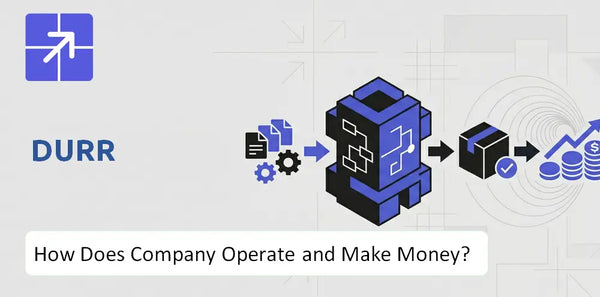
Dürr monetizes through equipment sales, installation, digital subscriptions, and spare parts; services now represent an expanding share of revenue. See product context in Durr BCG Matrix Analysis.
What Does Durr Actually Sell?
Dürr AG sells integrated production ecosystems: automated paint shops, robotics-led application lines, final assembly systems, HOMAG woodworking machinery, and environmental technology. Customers pay for end-to-end solutions – hardware, software, and services – that cut material use, energy, and provide continuous digital monitoring.
 Integrated production ecosystems and core products
Dürr Company offers automated paint shop systems, application robotics, final assembly lines, HOMAG woodworking machines (saws to CNC centers), and exhaust-air purification plus energy-optimization systems. Revenue stems from equipment sales, digital platforms, and long-term service and maintenance contracts.
Primary buyers and customer segments
Automotive OEMs and tier-1 suppliers buy paint shops, robots, and assembly lines; furniture and timber manufacturers purchase HOMAG equipment; industrial players and municipalities buy environmental technology. Aftermarket services and digital subscriptions attract existing factory operators and fleet owners.
Customer value and measurable outcomes
Clients gain lower variable costs and higher uptime: Dürr solutions claim up to 30% lower paint consumption, up to 50% lower production energy costs in optimized lines, and component-level digital monitoring that reduces downtime and quality defects. Service contracts provide predictable OPEX and uptime SLAs.
Differentiators and why customers choose Dürr
Dürr works as an ecosystem provider combining hardware, software (Industry 4.0 digitalization), and environmental tech – so buyers get turnkey, scalable systems rather than standalone machines. HOMAG gives market-leading woodworking reach; aftermarket contracts and digital services create recurring Durr revenue streams and lock-in.
Sales and Marketing Strategy of Durr Company
Durr SWOT Analysis
- Complete SWOT Breakdown
- Fully Customizable
- Editable in Excel & Word
- Professional Formatting
- Investor-Ready Format

How Does Durr Run Its Business Day to Day?
Dürr AG runs daily as a project-led engineering contractor, coordinating multi-year, turnkey deliveries across five divisions with heavy emphasis on Paint and Final Assembly Systems; workstreams blend site installation, systems integration, and digital commissioning using digital twins and software-first controls to meet OEM production schedules.

Operating model: integrated project leadership
Dürr Company operates as lead contractor on large capital projects: program managers run cross-functional teams for engineering, procurement, and construction (EPC) across multi-year lifecycles. Daily work centers on milestone tracking, risk controls, and coordinating thousands of suppliers to deliver turnkey paint shops and assembly lines.
Product and service delivery: turnkey systems plus software
Customers procure integrated systems – paint shop equipment, robotics, and software – through direct contracts and long-term service agreements; delivery includes engineering design, factory acceptance tests, on-site installation, and commissioning with digital verification to shorten ramp-up.
Production, sourcing, development: global supply networks
Manufacturing combines in-house production of core modules and outsourced components from global suppliers; R&D centers in Germany and abroad develop automation, coating technology, and Industry 4.0 software – digital twin models reduce physical prototyping and on-site adjustments.
Sales channels and distribution: direct B2B and aftermarket
Sales are primarily direct to OEMs and large contract manufacturers via tendering and framework agreements; aftermarket services and maintenance contracts generate recurring revenue and ensure long-term customer lock-in.
Key assets, systems, partnerships: software, robots, and alliances
Core assets include paint shop technology, robotic platforms, digital-twin software, and global service centers. Strategic partnerships with carmakers and component suppliers secure large orders and joint development for EV production lines; see further market context in Target Customers and Market of Durr Company.
What makes the model work in practice: digital-first, project discipline
Digital twins and pre-commissioning cut on-site hours and lower integration risk, which is critical when coordinating thousands of supplier parts and meeting OEM cycle times. Strong project governance, service contracts, and diversified divisions stabilize cash flow; in FY 2025 paint and final assembly remained the largest revenue drivers.
Durr Business Model Canvas
- One-time Payment
- No Research Needed – Save Hours of Work
- Built by Experts, Trusted by Consultants
- Instant Download, Ready to Use
- 100% Editable, Fully Customizable

How Does Revenue Flow Through Durr?
Revenue at Durr Company flows from large capital equipment projects and growing high-margin services; demand becomes revenue via milestone payments on projects and recurring service contracts that convert installed base into steady cash.
Main revenue from new equipment sales
New equipment – paint shop systems, automation cells, and emissions-control plants – generated about 70 percent of Durr AG business model revenue in fiscal 2025, with total sales approaching 4.7 billion euros. Large automotive capital projects are booked as orders and converted to cash through staged milestone payments tied to delivery and commissioning.
Growing service and aftermarket income
The Service segment accounted for nearly 30 percent of 2025 revenue, driven by spare parts, upgrades, digital maintenance contracts, and remote diagnostics. These Durr aftermarket services and maintenance contracts carry higher gross margins and smooth volatility when manufacturers delay capital expenditures.
Pricing and monetization model
Durr Company monetizes via milestone-based equipment sales, time-and-materials or fixed-price installation fees, and subscription or pay-per-use models for digital services (Industry 4.0 offerings). Service pricing blends one-off parts sales with recurring contracts for predictive maintenance and software licensing.
What most drives revenue
Revenue is driven by automotive OEM investment cycles, electrification and sustainability upgrades (paint shop and emissions tech), and expansion of digital services that raise lifetime value of installed equipment. See Growth Outlook of Durr Company for context on order trends and strategic priorities.
Durr Marketing Mix
- Complete Marketing Mix Analysis
- Effortlessly Communicate Your Business Strategy
- Investor-Ready Format
- 100% Editable and Customizable
- Clear and Structured Layout

What Makes Durr's Model Sustainable or Fragile?
Dürr AG's model rests on structural demand from mandatory industrial decarbonization and automation trends, giving steady project pipelines and aftermarket service revenue; key dependencies – automotive exposure and ~20 – 25% China sales – create fragility if EV adoption slows or trade tensions spike.
Green transformation creates structural demand
Regulatory pressure and corporate net-zero targets drive plant modernizations, supporting sustained orders for Dürr AG's energy-efficient systems through 2030. Mandatory upgrades of carbon-heavy facilities produce multi-year retrofit and new – build projects that underpin Durr Company revenue streams.
HOMAG and timber automation add a long tail
Automated timber construction and woodworking equipment from the HOMAG division provide diversification and secular growth beyond autos, supporting recurring aftermarket services and maintenance contracts tied to Durr products and services.
Concentration on automotive and China sales
Dürr AG derives a large share of orders from the automotive sector and is exposed to China for roughly 20 – 25% of sales, creating concentration risk. Any sharp downturn in global EV adoption or increased trade friction risks rapid order cancellations and margin pressure.
Resilience vs. interest – rate sensitivity
Professional judgment for 2025 – 2026 is that Dürr AG is a resilient industrial leader with strong aftermarket and service cashflows, but valuation and project timing are sensitive to high interest rates that can delay capital projects and capex cycles.
Key financial context: backlog, orders, and service revenue matter most; in 2025 prioritize monitoring order intake, gross margin on large paint – shop systems, and service recurring revenue as indicators of how Durr works and how durable the Durr AG business model is – see Mission, Vision, and Values of Durr Company for corporate orientation.
Durr Boston Consulting Group Matrix
- Built by Experts, Trusted by Consultants
- Structured for Consultants, Students, and Founders
- 100% Editable in Microsoft Word & Excel
- Instant Digital Download – Use Immediately
- Compatible with Mac & PC – Fully Unlocked

Related Blogs
- What Is the History of Durr Company and How Did It Evolve?
- What Is the Competitive Landscape of Durr Company and How Does It Compete?
- What Is the Growth Outlook of Durr Company and Where Is It Heading?
- How Does Durr Company Reach Customers and Turn Demand into Sales?
- What Do the Mission, Vision, and Core Values of Durr Company Reveal?
- Who Are the Core Customers in Durr Company's Target Market?
- Who Owns Durr Company Today and Who Holds Control?
Frequently Asked Questions
Durr sells integrated production ecosystems, not just standalone machines. Its offerings include automated paint shops, robotics-led application lines, final assembly systems, HOMAG woodworking machinery, and environmental technology. Customers buy hardware, software, and services together to improve material use, energy efficiency, and digital monitoring.
Disclaimer
All information, articles, and product details provided on this website are for general informational and educational purposes only. We do not claim any ownership over, nor do we intend to infringe upon, any trademarks, copyrights, logos, brand names, or other intellectual property mentioned or depicted on this site. Such intellectual property remains the property of its respective owners, and any references here are made solely for identification or informational purposes, without implying any affiliation, endorsement, or partnership.
We make no representations or warranties, express or implied, regarding the accuracy, completeness, or suitability of any content or products presented. Nothing on this website should be construed as legal, tax, investment, financial, medical, or other professional advice. In addition, no part of this site - including articles or product references - constitutes a solicitation, recommendation, endorsement, advertisement, or offer to buy or sell any securities, franchises, or other financial instruments, particularly in jurisdictions where such activity would be unlawful.
All content is of a general nature and may not address the specific circumstances of any individual or entity. It is not a substitute for professional advice or services. Any actions you take based on the information provided here are strictly at your own risk. You accept full responsibility for any decisions or outcomes arising from your use of this website and agree to release us from any liability in connection with your use of, or reliance upon, the content or products found herein.