
How does Emeco Holdings Limited operate as an asset-light heavy-equipment provider to miners?
Emeco Holdings Limited rents and services heavy mining equipment, letting miners boost output without large capital purchases. This reduces miners' balance-sheet pressure and shortens fleet lead times. In 2025 Emeco reported stronger rental utilization, signaling recovering mining capex.
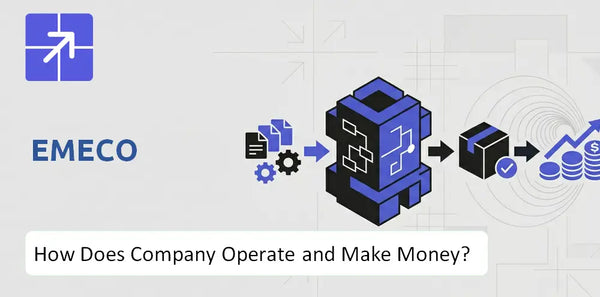
Focus on utilization and fleet age: higher use raises margins and delays replacement capex risk. See Emeco BCG Matrix Analysis for product-position insight.
What Does Emeco Actually Sell?
Emeco Holdings Limited rents heavy excavators, dump trucks, and dozers and sells guaranteed uptime via maintenance and rebuild services; customers pay for equipment capacity and dependable availability in remote mining sites rather than outright ownership.
 Core fleet rental and uptime services
Emeco company supplies industrial-scale earthmoving machines on a rental and contract basis, plus workshop rebuilds and parts through its Force maintenance network. Revenue mixes rental day rates, long-term contracts, and refurbishment fees – customers effectively buy operating hours and reliability.
Primary buyers and contract clients
Mining operators, large-scale contractors, and commodity producers in iron ore, copper, and coal are main buyers. Contracts skew to large open-cut mines in Australia and internationally, where scale, remote logistics, and uptime commitments matter most.
Practical customer value
Customers convert fixed capital into variable operating expense, cut fleet downtime risk, and gain scalability tied to commodity cycles. Emeco's Force rebuilds extend machine life – industry reports show component remanufacturing can reduce lifecycle cost by up to 20 – 30%.
Differentiators and ease of procurement
Emeco stands out by guaranteeing uptime in harsh settings via on-site service teams, predictive maintenance, and refurbished components, enabling faster scaling of projects. Contracts and leasing options simplify procurement versus CAPEX purchases and align incentives around availability.
See the company mission and values for strategic context: Mission, Vision, and Values of Emeco Company
Emeco SWOT Analysis
- Complete SWOT Breakdown
- Fully Customizable
- Editable in Excel & Word
- Professional Formatting
- Investor-Ready Format

How Does Emeco Run Its Business Day to Day?
Emeco Holdings Limited runs day-to-day by optimizing a fleet of roughly 850 heavy assets across major mining regions, using real-time telematics to prioritize uptime and schedule preventative maintenance; workshops refurbish machines to as-new condition, extending asset life and lowering capex needs.

Operating model: asset-light rental plus full-life stewardship
Emeco company leases heavy equipment as a service while owning and managing the fleet end-to-end. Daily ops focus on utilization, dispatch, telemetry-driven maintenance, and diesel/parts logistics to keep machines working at remote mining sites.
Product or service delivery: on-site rental with service wrap
Customers access equipment through medium-to-long term contracts; Emeco handles mobilization, operator support when required, maintenance, and refurbishing, shifting purchase capex to predictable operating expense for miners.
Production, sourcing, and remanufacturing: in-house workshops
Workshops act as internal factories that remanufacture used machines to as-new standards, cutting replacement costs versus OEM purchases and enabling a circular approach similar to sustainable furniture manufacturer models.
Sales channels and distribution: direct B2B contracts
Sales happen via direct commercial teams selling multi-year fleet contracts to mining operators and contractors; logistics teams manage delivery, on-site servicing, and redeployment across regions.
Key assets, systems, and partnerships: telemetry and workshops
Emeco Operating System telematics is central for real-time health monitoring; combined with 850-unit fleet scale, regional workshops, and supplier partnerships, this infrastructure sustains high utilization and cost-efficient remanufacturing.
What makes the model work in practice: lifecycle economics
Preventative maintenance reduces unscheduled downtime and repair costs, while in-house refurbishing maximizes useful life – lowering total cost of ownership and enabling predictable revenue from product-as-a-service arrangements; see Sales and Marketing Strategy of Emeco Company for related go-to-market details.
Emeco Business Model Canvas
- One-time Payment
- No Research Needed – Save Hours of Work
- Built by Experts, Trusted by Consultants
- Instant Download, Ready to Use
- 100% Editable, Fully Customizable

How Does Revenue Flow Through Emeco?
Revenue flows mainly from renting and maintaining furniture and equipment, plus workshop services and parts sales; demand converts to revenue via utilization and contract terms. Monetization rests on the spread between acquisition/maintenance cost and cumulative rental income over an asset's lifecycle.
Primary revenue: rental and maintenance services
Hourly rental rates and long-term service contracts generate the bulk of revenue; entering 2026 about 65 percent of revenue comes from rental and maintenance services, reflecting Emeco company's product-as-a-service furniture model.
Additional revenue: internal workshop and parts sales
Internal workshop capabilities and parts sales supply the remaining 35 percent, with high-margin workshop services also servicing third-party fleets to diversify income beyond the rental pool.
Pricing and monetization model: utilization-driven spread
Demand monetizes through hourly fees and contract fees tied to utilization; the company targets machine utilization around 88 percent, and profitability relies on the lifecycle spread between asset cost plus maintenance and cumulative rental income.
What drives revenue most: utilization and lifecycle economics
Revenue is most sensitive to utilization rates and asset lifecycle economics; higher utilization and longer productive life improve the rental income-to-capex ratio and boost margins, while workshop margins provide stable, higher-margin income.
History and Background of Emeco Company
Emeco Marketing Mix
- Complete Marketing Mix Analysis
- Effortlessly Communicate Your Business Strategy
- Investor-Ready Format
- 100% Editable and Customizable
- Clear and Structured Layout

What Makes Emeco's Model Sustainable or Fragile?
Emeco Holdings Limited's model is sustainable because of high barriers to entry and rising miner demand for outsourced fleet management, but it is fragile to sharp commodity price falls and skilled-labour shortages that can create idle assets and canceled projects.
High barriers and outsourced fleet demand support the model
Emeco company benefits from specialized heavy-equipment fleets and long-term contracts that deter new entrants; miners increasingly outsource fleet management to preserve cash, supporting recurring revenue and asset utilization.
Key assets and operational capabilities
Emeco's fleet scale, maintenance workshops, and in-house refurbishment capability create a product-as-a-service furniture-style analogy for mining fleets; these assets enable cash generation and extend equipment life, similar to sustainable furniture manufacturer remanufacturing practices.
Dependencies and concentration risks
The business depends on metallurgical coal and gold capital cycles, availability of skilled technicians for maintenance workshops, and a concentrated client base; steep commodity price drops can trigger project cancellations and idle equipment.
Durability assessment for 2025/2026
As of March 2026 professional judgment indicates Emeco Holdings Limited is a disciplined, cash-generative operator with a strengthened balance sheet and a net debt to EBITDA below 1.0x in 2026, providing a buffer against volatility; still, performance remains closely tied to Australian mining capex cycles and vulnerable to sharp commodity downturns.
See detailed financial and strategic context in this analysis: Growth Outlook of Emeco Company
Emeco Boston Consulting Group Matrix
- Built by Experts, Trusted by Consultants
- Structured for Consultants, Students, and Founders
- 100% Editable in Microsoft Word & Excel
- Instant Digital Download – Use Immediately
- Compatible with Mac & PC – Fully Unlocked

Related Blogs
- What Is the History of Emeco Company and How Did It Evolve?
- What Is the Competitive Landscape of Emeco Company and How Does It Compete?
- What Is the Growth Outlook of Emeco Company and Where Is It Heading?
- How Does Emeco Company Reach Customers and Turn Demand into Sales?
- What Do the Mission, Vision, and Core Values of Emeco Company Reveal?
- Who Are the Core Customers in Emeco Company's Target Market?
- Who Owns Emeco Company Today and Who Holds Control?
Frequently Asked Questions
Emeco sells heavy equipment rental and uptime services. It provides excavators, dump trucks, and dozers on contract, plus maintenance, rebuilds, and parts through its Force network. Customers pay for dependable equipment availability and operating hours rather than buying the machines outright.
Disclaimer
All information, articles, and product details provided on this website are for general informational and educational purposes only. We do not claim any ownership over, nor do we intend to infringe upon, any trademarks, copyrights, logos, brand names, or other intellectual property mentioned or depicted on this site. Such intellectual property remains the property of its respective owners, and any references here are made solely for identification or informational purposes, without implying any affiliation, endorsement, or partnership.
We make no representations or warranties, express or implied, regarding the accuracy, completeness, or suitability of any content or products presented. Nothing on this website should be construed as legal, tax, investment, financial, medical, or other professional advice. In addition, no part of this site - including articles or product references - constitutes a solicitation, recommendation, endorsement, advertisement, or offer to buy or sell any securities, franchises, or other financial instruments, particularly in jurisdictions where such activity would be unlawful.
All content is of a general nature and may not address the specific circumstances of any individual or entity. It is not a substitute for professional advice or services. Any actions you take based on the information provided here are strictly at your own risk. You accept full responsibility for any decisions or outcomes arising from your use of this website and agree to release us from any liability in connection with your use of, or reliance upon, the content or products found herein.