
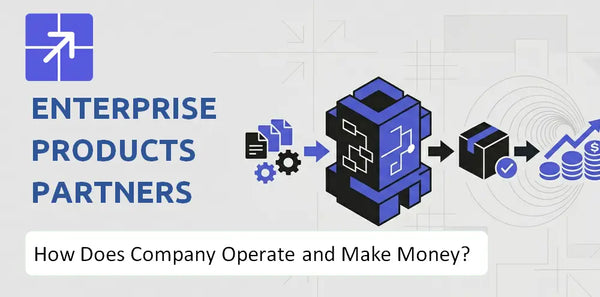
How does Enterprise Products Partners L.P. operate its midstream network to earn fee-based revenue?
Enterprise Products Partners L.P. runs pipelines, storage, and terminals that charge fees per volume moved, insulating cash flow from commodity-price swings. This matters as its 2025 volumes rose in the Permian, signaling resilient fee income amid midstream consolidation.
Focus on throughput growth and contract tenure; long-term ship-or-pay deals and export capacity expansions drove a 2025 uptick in utilization. See Enterprise Products Partners BCG Matrix Analysis
What Does Enterprise Products Partners Actually Sell?
Enterprise Products Partners L.P. sells midstream infrastructure services: reliable movement, storage, and transformation of energy molecules. Customers pay for transportation, gathering, processing, fractionation, storage, and export access for natural gas, natural gas liquids (NGLs), crude oil, and refined products.
 Core offerings: midstream infrastructure and services
Enterprise Products Partners operates pipelines and storage services, NGL processing and fractionation facilities, gas processing plants, and marine export terminals. Its platforms include long-haul pipelines, gathering systems, storage caverns, and fractionators that separate mixed NGL streams into ethane, propane, and butane; in 2025 it reported throughput and fee-based volumes that underpin cash distributions.
Main buyers: industrial, petrochemical, and export markets
Buyers include petrochemical companies, refiners, LNG and NGL exporters, crude oil marketers, and upstream producers needing gathering and processing. Enterprise Products Partners business model serves customers seeking reliable access to premium markets via the Houston Ship Channel and other hubs.
Customer value: market access and logistical optionality
Customers get guaranteed access to domestic petrochemical plants and international buyers, flexibility to route molecules to highest-value destinations, and storage to manage seasonal supply. Fee-based contracts and take-or-pay arrangements reduce exposure to commodity price swings and preserve predictable cash flow.
Differentiators: scale, connectivity, and commercial contracts
Enterprise Products Partners stands out for scale of pipeline assets, joint ventures that expand reach, and integrated fractionation plus export terminals enabling direct access to global markets. Its fee-based contracts and diversified revenue streams support stable distributions; see Mission, Vision, and Values of Enterprise Products Partners Company for company context.
Enterprise Products Partners SWOT Analysis
- Complete SWOT Breakdown
- Fully Customizable
- Editable in Excel & Word
- Professional Formatting
- Investor-Ready Format

How Does Enterprise Products Partners Run Its Business Day to Day?
Enterprise Products Partners L.P. runs daily as an integrated midstream services operator: it gathers hydrocarbons, moves them through its 50,000+ mile pipeline network, stores them in >300 million barrels of capacity, processes and fractionates NGLs at hubs like Mont Belvieu, then ships finished products to domestic and global markets while capturing fee-based revenue at each step.

Operating model: integrated midstream throughput
Enterprise Products Partners centers on continuous flow: gather in basins, move via pipelines, process at hubs, and deliver to end markets. That operating loop lets the company earn multiple fees as a single molecule traverses gathering, transportation, processing, storage, and export stages.
Product and service delivery: fee-based access
Customers access services via long-term contracts, take-or-pay and interruptible tariffs, and throughput agreements for pipelines, storage leases, and NGL fractionation. Enterprise Products Partners business model emphasizes predictable, fee-based cash flows rather than commodity price exposure.
Production, sourcing, and development: asset-led expansion
The firm sources volumes from producers in plays like the Permian Basin, adds capacity through targeted capex and joint ventures, and develops bottleneck relief projects. Management allocates capital daily toward high-growth corridors and constrained takeaway points to maximize utilization.
Sales channels and distribution: pipeline and marine networks
Distribution uses pipelines, marine terminals, rail and truck connections, and export facilities tied into global LNG and petrochemical markets. Sales are executed through contract billing, nominations, and shipper scheduling systems that coordinate daily nominations and flows.
Key assets, systems, and partnerships: scale and integration
Core assets include 50,000+ miles of pipelines, terminals, fractionators at Mont Belvieu, and 300+ million barrels of storage; technology stacks handle SCADA monitoring, nominations, and maintenance planning. Strategic joint ventures expand footprint and share capex and off-take commitments.
What makes the model work: throughput, contracts, and execution
Efficiency comes from aligning capacity with producer growth, contract structures that de-risk volume variability, and strict maintenance and safety programs to minimize downtime. Daily priorities: maximize throughput, relieve bottlenecks, and preserve environmental compliance to protect steady fee income.
See operational and historical context in History and Background of Enterprise Products Partners Company
Enterprise Products Partners Business Model Canvas
- One-time Payment
- No Research Needed – Save Hours of Work
- Built by Experts, Trusted by Consultants
- Instant Download, Ready to Use
- 100% Editable, Fully Customizable

How Does Revenue Flow Through Enterprise Products Partners?
Enterprise Products Partners collects fees for transporting, storing, and handling hydrocarbons; demand converts to revenue via contracted volumes and throughput charges. Most cash comes from long-term, fixed-fee agreements with take-or-pay protections, and retained distributable cash funds growth projects.
Main revenue: fee-based pipeline and storage tolls
Enterprise Products Partners earns the bulk of its income by charging fixed fees to move and store crude oil, natural gas, and natural gas liquids (NGLs). These toll-like charges, under long-term contracts, produce predictable gross operating margin and protect cash flow from commodity price swings.
Additional revenue: NGL processing, fractionation, and services
Secondary streams include NGL processing and fractionation fees, marine terminal services, and midstream fee-for-service operations. Joint ventures and third-party service agreements add incremental cash without proportionate capital exposure.
Pricing and monetization: long-term contracts with take-or-pay
Pricing is predominantly fixed-fee or cost-plus under multi-year contracts; roughly 75 to 80 percent of gross operating margin comes from these fixed agreements as of early 2026. Customers pay per barrel or per MMBtu of capacity reserved, converting volume demand into stable cash receipts.
What drives revenue most: contracted capacity and throughput volumes
Revenue is driven by contracted capacity utilization, new capacity additions, and throughput growth from producers, refiners, and industrial users. Enterprise Products Partners manages commodity-price risk via fee-based contracts and reinvests distributable cash flow to fund expansions, lowering dilution and sustaining dividend distributions; see Growth Outlook of Enterprise Products Partners Company for context: Growth Outlook of Enterprise Products Partners Company
Enterprise Products Partners Marketing Mix
- Complete Marketing Mix Analysis
- Effortlessly Communicate Your Business Strategy
- Investor-Ready Format
- 100% Editable and Customizable
- Clear and Structured Layout

What Makes Enterprise Products Partners's Model Sustainable or Fragile?
Enterprise Products Partners L.P. combines hard-to-replicate pipelines and storage with fee-based, long-term contracts, creating durable cash flow; key dependencies on NGL exports and petrochemical demand expose it to energy transition risks and permitting/regulatory shifts.
Wide-moat physical network supports cash flow
Enterprise Products Partners benefits from an integrated midstream energy company network of pipelines and storage services that is costly and slow to replicate, creating steady fee-based revenue and steady distributions. In 2025 the partnership reported consolidated adjusted EBITDA near $9.8 billion, reflecting resilient throughput and fee margins.
Processing and export capabilities are key assets
The company's NGL processing and fractionation facilities plus access to export terminals anchor its role in global petrochemicals and LNG value chains; NGL exports served as a massive tailwind through 2025 – 2026. Joint ventures and pipeline assets map across Gulf Coast basins secure volume commitments and long-term contracts.
Concentration on hydrocarbons and regulatory constraints
Enterprise Products Partners business model depends heavily on natural gas liquids transportation and petrochemical demand; permitting hurdles and environmental regulation can limit new pipelines and growth. Commodity exposure remains through throughput-linked fees despite predominantly fee-based contracts.
Resilience outlook for 2025 – 2026
Professional judgment for 2026 views Enterprise Products Partners as a premier defensive infrastructure play with a top-tier credit profile and over 27 consecutive years of distribution increases; management projects ~5 percent distribution growth and a multi-billion dollar capital backlog that supports volume growth even if upstream production is moderate. See sales strategy link for commercial context: Sales and Marketing Strategy of Enterprise Products Partners Company
Enterprise Products Partners Boston Consulting Group Matrix
- Built by Experts, Trusted by Consultants
- Structured for Consultants, Students, and Founders
- 100% Editable in Microsoft Word & Excel
- Instant Digital Download – Use Immediately
- Compatible with Mac & PC – Fully Unlocked

Related Blogs
- What Is the History of Enterprise Products Partners Company and How Did It Evolve?
- What Is the Competitive Landscape of Enterprise Products Partners Company and How Does It Compete?
- What Is the Growth Outlook of Enterprise Products Partners Company and Where Is It Heading?
- How Does Enterprise Products Partners Company Reach Customers and Turn Demand into Sales?
- What Do the Mission, Vision, and Core Values of Enterprise Products Partners Company Reveal?
- Who Are the Core Customers in Enterprise Products Partners Company's Target Market?
- Who Owns Enterprise Products Partners Company Today and Who Holds Control?
Frequently Asked Questions
Enterprise Products Partners sells midstream infrastructure services. Its business centers on moving, storing, processing, fractionating, and exporting energy molecules such as natural gas, NGLs, crude oil, and refined products. Customers pay for transportation, gathering, storage, and access to premium domestic and global markets.
Disclaimer
All information, articles, and product details provided on this website are for general informational and educational purposes only. We do not claim any ownership over, nor do we intend to infringe upon, any trademarks, copyrights, logos, brand names, or other intellectual property mentioned or depicted on this site. Such intellectual property remains the property of its respective owners, and any references here are made solely for identification or informational purposes, without implying any affiliation, endorsement, or partnership.
We make no representations or warranties, express or implied, regarding the accuracy, completeness, or suitability of any content or products presented. Nothing on this website should be construed as legal, tax, investment, financial, medical, or other professional advice. In addition, no part of this site - including articles or product references - constitutes a solicitation, recommendation, endorsement, advertisement, or offer to buy or sell any securities, franchises, or other financial instruments, particularly in jurisdictions where such activity would be unlawful.
All content is of a general nature and may not address the specific circumstances of any individual or entity. It is not a substitute for professional advice or services. Any actions you take based on the information provided here are strictly at your own risk. You accept full responsibility for any decisions or outcomes arising from your use of this website and agree to release us from any liability in connection with your use of, or reliance upon, the content or products found herein.