
How does Esker turn manual invoice and order processing into a recurring SaaS business?
Esker automates back-office document flows for mid-to-large firms, replacing manual AR/AP with cloud workflows that reduce cycle times and errors. This matters as Esker reported strong 2025 subscription renewals and rising ARR, signaling resilient demand amid inflationary pressure.
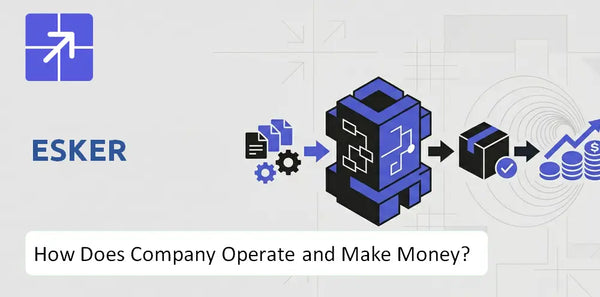
Esker's platform bundles OCR, AI routing, and analytics to lock customers into sticky, high-margin subscriptions; consider its Esker BCG Matrix Analysis for product-level positioning.
What Does Esker Actually Sell?
Esker sells a cloud-based AI document process automation platform for Order-to-Cash (O2C) and Procure-to-Pay (P2P) workflows that extracts, validates, and syncs transaction data with ERPs; customers pay for automated document processing, reduced manual entry, and integrated payment and financing capabilities.
 Core platform: automated document lifecycle
Esker software delivers a SaaS cloud platform that uses machine learning and OCR (optical character recognition) to capture invoices, purchase orders, and remittances, validate data against ERP records (SAP, Oracle, Microsoft Dynamics), and post transactions automatically.
Who buys Esker automation
Buyers are mid-market and enterprise finance and procurement teams across manufacturing, distribution, retail, and services that need accounts payable automation, accounts receivable automation, and scalable cloud document processing.
Practical value customers receive
Customers get faster cash conversion, fewer posting errors, and lower processing costs; Esker reports deployments reduce invoice processing time by up to 70% and manual touches by as much as 80% in validated case studies.
Why Esker business model stands out
The Esker business model bundles subscription-based Esker cloud platform access with integrated B2B payment processing and supply chain financing launched by early 2026, so customers manage documents and money flow in one workflow; tight ERP integrations and continuous ML training drive higher straight-through processing rates.
For a data-driven outlook on growth and recent product additions, see Growth Outlook of Esker Company
Esker SWOT Analysis
- Complete SWOT Breakdown
- Fully Customizable
- Editable in Excel & Word
- Professional Formatting
- Investor-Ready Format

How Does Esker Run Its Business Day to Day?
Esker company runs daily as a multitenant SaaS operation that processes high volumes of invoices and documents through a global cloud platform; teams focus on transaction routing, model training, and customer expansion while integrations with ERPs keep workflows synchronized.

Operating model: centralized multitenant SaaS
Esker business model relies on a single, standardized cloud instance that serves all clients, enabling continuous deployment, centralized monitoring, and shared improvements across tenants while preserving data segregation and compliance.
Product delivery: subscription access to automation tools
Customers subscribe to Esker software via annual or multi – year SaaS contracts; users access modules for accounts payable, accounts receivable, and purchase-to-pay through the Esker cloud platform with role-based portals and API connectors to ERPs.
Development: ML, OCR, and continuous model refinement
Daily R&D work iterates proprietary machine learning and OCR pipelines that process over 1.6 billion document pages annually, improving extraction accuracy, auto-coding, and exception handling across languages and document types.
Sales channels: land-and-expand plus partner ecosystem
Sales teams typically land with a pilot in accounts payable then expand across finance; distribution is amplified through partnerships with ERP vendors and global consulting firms to embed Esker accounts payable automation into clients' stacks.
Key assets: cloud infra, ML models, ERP connectors
Core assets include the Esker cloud platform, trained machine – learning models, secure data centers/CDNs, certified ERP integrations, and channel partnerships; these enable scalable processing and rapid customer onboarding.
Why it works: scale, feedback loops, and embedded workflows
Multitenancy drives low marginal cost per customer, model training benefits from aggregated document volume, and ERP/consulting partnerships create high switching costs – so land – and – expand sales and continuous ML improvements sustain growth.
Daily KPIs tracked include processed documents per hour, ML extraction accuracy, straight – through processing rate, and time – to – value for AP pilots; public filings show revenue growth driven by subscription ARR and expansion bookings in fiscal 2025, while implementation teams manage integrations and change management to hit ROI targets for customers. Read a market analysis here: Competitive Landscape of Esker Company
Esker Business Model Canvas
- One-time Payment
- No Research Needed – Save Hours of Work
- Built by Experts, Trusted by Consultants
- Instant Download, Ready to Use
- 100% Editable, Fully Customizable

How Does Revenue Flow Through Esker?
Revenue flows mainly through a SaaS-led model with fixed subscriptions and variable transaction fees; demand converts to revenue via multi-year ERP-integrated contracts and low churn driven by high switching costs.
Primary revenue: SaaS subscriptions and transaction fees
Esker company earns about 85% of turnover from its SaaS offerings in the 2025 fiscal year, combining fixed subscription fees with volume-linked transaction fees so revenue scales as customers process more invoices and purchase orders.
Additional revenue: services and legacy maintenance
The remaining 15% of 2025 revenue comes from professional services – implementation, training – and legacy maintenance contracts that support migrations and customization for ERP integrations.
Pricing and monetization model
Esker business model uses multi-year subscription contracts with tiered pricing plus per-transaction surcharges; upsells for AI/OCR modules and premium SLAs drive average contract value increases and recurring revenue growth.
What most strongly drives revenue
Recurring revenue growth of 15% in 2025 reflects successful upsell of AI-driven Esker software features; low churn from ERP integration stickiness and rising transaction volumes are the main revenue engines.
For customer segments, integrations, and market fit see Target Customers and Market of Esker Company.
Esker Marketing Mix
- Complete Marketing Mix Analysis
- Effortlessly Communicate Your Business Strategy
- Investor-Ready Format
- 100% Editable and Customizable
- Clear and Structured Layout

What Makes Esker's Model Sustainable or Fragile?
The Esker company model is sustained by mission-critical financial automation and high switching costs, but it is fragile to AI competition from ERP vendors and to cyclical declines in B2B transaction volumes. Structural strengths include sticky recurring revenue and regulatory tailwinds; key risks include competitive feature convergence and dependency on global trade activity.
High switching costs and mission-critical positioning
Esker software embeds into customers' AP/AR workflows and ERPs, creating operational friction for replacement and driving a net revenue retention rate consistently above 92%. That stickiness converts into predictable subscription and transaction cash flow, supporting reinvestment in ML/OCR and platform improvements.
Platform reach and regulatory tailwinds
Esker cloud platform benefits from expansion of mandatory e-invoicing across Europe and parts of North America, increasing demand for compliant automation; in 2025 this dynamic helped sustain transaction volumes and recurring subscription upsell opportunities.
Reliance on integrations and ecosystem partners
Esker accounts payable automation depends on deep ERP integrations (SAP, Oracle, Microsoft) and partner channels for scale; concentration in a few large ERP ecosystems is a constraint if those vendors build equivalent native automation.
Resilience outlook for 2025 – 2026
Professional judgment: Esker remains a resilient, cash-generative leader in 2025 and into 2026, supported by recurring SaaS revenue, transaction fees, and regulatory-driven demand; however, AI competition from ERP giants and a potential slump in B2B trade volumes are material downside scenarios to monitor.
For implementation and adoption context see the company background: History and Background of Esker Company
Esker Boston Consulting Group Matrix
- Built by Experts, Trusted by Consultants
- Structured for Consultants, Students, and Founders
- 100% Editable in Microsoft Word & Excel
- Instant Digital Download – Use Immediately
- Compatible with Mac & PC – Fully Unlocked

Related Blogs
- What Is the History of Esker Company and How Did It Evolve?
- What Is the Competitive Landscape of Esker Company and How Does It Compete?
- What Is the Growth Outlook of Esker Company and Where Is It Heading?
- How Does Esker Company Reach Customers and Turn Demand into Sales?
- What Do the Mission, Vision, and Core Values of Esker Company Reveal?
- Who Are the Core Customers in Esker Company's Target Market?
- Who Owns Esker Company Today and Who Holds Control?
Frequently Asked Questions
Esker sells a cloud-based AI document process automation platform for Order-to-Cash and Procure-to-Pay workflows. The platform extracts, validates, and syncs transaction data with ERPs, helping customers automate document processing, reduce manual entry, and connect payment and financing capabilities in one workflow.
Disclaimer
All information, articles, and product details provided on this website are for general informational and educational purposes only. We do not claim any ownership over, nor do we intend to infringe upon, any trademarks, copyrights, logos, brand names, or other intellectual property mentioned or depicted on this site. Such intellectual property remains the property of its respective owners, and any references here are made solely for identification or informational purposes, without implying any affiliation, endorsement, or partnership.
We make no representations or warranties, express or implied, regarding the accuracy, completeness, or suitability of any content or products presented. Nothing on this website should be construed as legal, tax, investment, financial, medical, or other professional advice. In addition, no part of this site - including articles or product references - constitutes a solicitation, recommendation, endorsement, advertisement, or offer to buy or sell any securities, franchises, or other financial instruments, particularly in jurisdictions where such activity would be unlawful.
All content is of a general nature and may not address the specific circumstances of any individual or entity. It is not a substitute for professional advice or services. Any actions you take based on the information provided here are strictly at your own risk. You accept full responsibility for any decisions or outcomes arising from your use of this website and agree to release us from any liability in connection with your use of, or reliance upon, the content or products found herein.