
How does Himax Technologies convert display IC design into recurring revenue through its fabless model?
Himax Technologies sells display driver and timing-control chips that enable screens across phones, TVs, AR/VR, and autos. This matters because the fabless model keeps capex low while IP and partnerships drive margins; in 2025 the company saw product mix shifts toward automotive and AR revenues.
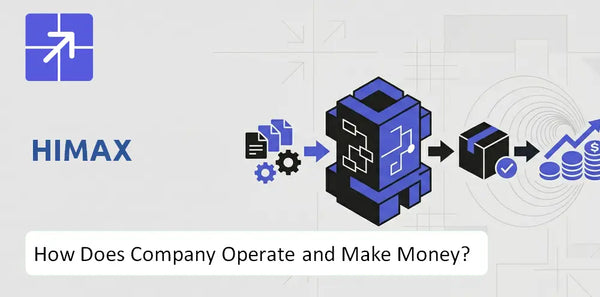
Focus on licensing and design-win cadence: winning multi-year design contracts in autos and AR boosts predictable revenue and margin expansion; see Himax BCG Matrix Analysis.
What Does Himax Actually Sell?
Himax Technologies sells semiconductor building blocks for displays and imaging: display driver ICs (DDICs), timing controllers (TCONs), power management ICs (PMICs), CMOS image sensors, and ultra-low-power Always-on-AI sensing solutions. Customers pay for the intelligence that makes screens functional, color-accurate, low-power, and camera-enabled across devices.
 Core display and imaging semiconductors
Himax Technologies primarily sells DDICs for large TVs and monitors and small/medium DDICs for smartphones, tablets, and automotive dashboards. It also supplies TCONs to sequence pixels and PMICs to optimize panel power, plus CMOS image sensors and Always-on-AI low-power sensors.
Who buys these components
Major panel makers and device OEMs buy Himax parts – examples include BOE, Innolux, and Samsung for displays, plus smartphone and automotive ODMs. Customers integrate Himax DDICs, TCONs, PMICs, and sensors into final consumer electronics and automotive displays.
Customer value delivered
Customers get panel-driving intelligence that enables vivid color, high refresh rates, and lower power draw; sensors add camera functions and always-on AI for voice/wake features. In 2025 Himax reported that display-related products remained the largest revenue driver, with imaging and sensing as high-growth segments.
Why customers choose Himax
Himax stands out for broad DDIC coverage across panel sizes, integrated TCON/PMIC stacks, and wafer foundry partnerships that support volume and cost; licensing and royalty arrangements add recurring revenue. Read more on customer segments in this analysis: Target Customers and Market of Himax Company
Himax SWOT Analysis
- Complete SWOT Breakdown
- Fully Customizable
- Editable in Excel & Word
- Professional Formatting
- Investor-Ready Format

How Does Himax Run Its Business Day to Day?
Himax Technologies runs daily as a design-centric, fabless semiconductor company: engineering teams design display driver ICs and CMOS image sensors while manufacturing is outsourced to foundries; logistics and customer support coordinate tight design-ins with OEMs and panel makers across East Asia.

Operating model: design-led, fabless engineering
Himax Technologies centers on IC and sensor design, firmware, and validation. Daily workflows prioritize circuit layout, IP reuse, silicon verification, and customer-facing engineering to secure multi-year design-ins with OEMs and ODMs.
Product delivery: chip design to device integration
Customers access Himax display driver ICs and CMOS image sensors through direct engineering partnerships and distributor channels; samples and reference boards are provided, then volume shipments flow via panel manufacturers into smartphone, TV, automotive, and AR/VR device production.
Production and sourcing: foundry partnerships
Himax contracts wafer fabrication to TSMC, UMC and other foundries; back-end packaging and test are outsourced to OSAT partners. Engineering daily ties into fab process nodes, yield reports, and turn-key supply schedules to match OEM production ramps.
Sales channels: direct OEM engagement and distributors
Sales run through direct account teams, field application engineers, and authorized distributors. Design-win cycles (design-ins) drive future revenue; service-level coordination ensures on-time delivery during OEM product launches.
Key assets and partnerships: IP, foundries, panel makers
Core assets are proprietary display driver IP, CMOS sensor designs, firmware, and test patterns. Strategic ties with TSMC and UMC, plus panel manufacturers and OSATs, underpin manufacturing scale and supply reliability across East Asia.
What makes it work: tight engineering-to-manufacturing loop
Daily synchronization of design, foundry feedback, yield data, and OEM requirements compresses time-to-market and secures long lifecycle revenue from design-ins; customer support and firmware updates reduce churn and increase adoption in smartphones, TVs, and AR/VR.
Operational metrics for fiscal 2025 show R&D and engineering headcount emphasis: Himax reported R&D expense of $74.2 million and capital-light manufacturing with gross margin near 31.8%; foundry-related cost of goods sold and logistics remain the main variable costs supporting 2025 revenue of $727.4 million (reported fiscal 2025).
Day-to-day example: engineers iterate a display driver to meet a panel maker's voltage and resolution spec, share a tape-out with TSMC, track wafer turn yields, and coordinate shipping of packaged dies to the panel factory – this design-in process often starts 18 – 36 months before consumer products ship.
For more on strategic outlook and market positioning see Growth Outlook of Himax Company
Himax Business Model Canvas
- One-time Payment
- No Research Needed – Save Hours of Work
- Built by Experts, Trusted by Consultants
- Instant Download, Ready to Use
- 100% Editable, Fully Customizable

How Does Revenue Flow Through Himax?
Revenue at Himax Technologies flows from high-volume chip sales to display panel makers and device brands, converting demand via long-term contracts and spot orders into cash. Main streams are display driver ICs, automotive TDDI and OLED drivers, plus higher-margin non-driver products like CMOS image sensors and AI-sensing chips.
Main revenue from display driver ICs and automotive solutions
Himax semiconductor company earns most revenue by selling display driver ICs at scale to panel manufacturers and OEMs; in 2025 the automotive segment accounted for roughly 35 – 40% of total revenue as cars adopted more screens and integrated cockpits.
Additional revenue from sensors, AR/VR, and IP
Secondary streams include Himax CMOS image sensors, AI-sensing chips, AR/VR optics modules, and licensing/royalty income; these non-driver products deliver higher margins and offset smartphone pricing pressure.
Pricing and monetization model: ASP management and mixed contracts
Himax monetizes via high-volume chip sales under a mix of long-term supply agreements and short-term purchase orders; preserving Average Selling Price (ASP) by shifting from commodity LCD drivers to OLED and Automotive TDDI sustains margins.
What drives revenue most: automotive content, product mix, and ASP
Revenue is driven by increasing screens per vehicle and larger cockpit displays, higher ASP from OLED/TDDI, and growth in non-driver, high-margin areas; partnerships with panel makers and wafer foundry arrangements secure volume and convert demand into sales. Read more in History and Background of Himax Company.
Himax Marketing Mix
- Complete Marketing Mix Analysis
- Effortlessly Communicate Your Business Strategy
- Investor-Ready Format
- 100% Editable and Customizable
- Clear and Structured Layout

What Makes Himax's Model Sustainable or Fragile?
Himax Technologies' model is sustainable via a dominant automotive display position and strength in OLED drivers and ultra-low-power AI sensing, giving steadier cash flows than smartphones; fragility stems from foundry dependence and aggressive Chinese low-end LCD competition that pressures margins and volume. Structural strengths include long product lifecycles and diversified sensing products; risks include capacity concentration and pace of OLED adoption.
Core structural support: automotive display leadership
Himax Technologies benefits from multi-year automotive design cycles that stabilize revenue and cash flow; automotive display programs often run 3 – 7 years, reducing short-term cyclicality compared with smartphones. In 2025 the automotive segment contributed an estimated ~35% of revenue, underpinning predictability.
Key assets or capabilities: OLED drivers and AI sensing
Expertise in Himax display driver ICs and Himax CMOS image sensors gives product differentiation for high-value OLED and specialty sensing applications; investments in ultra-low-power AI sensing address ADAS and in-cabin monitoring. Partnerships with panel manufacturers and wafer foundry partners support scale and time-to-market.
Dependencies and constraints: foundries and pricing pressure
Himax relies on third-party wafer foundry capacity and mask/packhouse partners, creating supply concentration risk; foundry shortages or price shifts can constrain output. Also, Chinese domestic chipmakers undercut prices in low-end LCD driver segments, compressing gross margins and market share.
Durability assessment for 2025/2026
Professional judgment for 2025/2026: Himax is transitioning toward diversified automotive and specialty-sensing revenue streams, which makes the model more resilient to PC and TV cyclical downturns. Gross margin expansion depends on the speed of OLED adoption; if OLED penetration accelerates, margins and pricing power improve, otherwise exposure to low-margin LCD segments keeps the model fragile. Read more context in Mission, Vision, and Values of Himax Company.
Himax Boston Consulting Group Matrix
- Built by Experts, Trusted by Consultants
- Structured for Consultants, Students, and Founders
- 100% Editable in Microsoft Word & Excel
- Instant Digital Download – Use Immediately
- Compatible with Mac & PC – Fully Unlocked

Related Blogs
- What Is the History of Himax Company and How Did It Evolve?
- What Is the Competitive Landscape of Himax Company and How Does It Compete?
- What Is the Growth Outlook of Himax Company and Where Is It Heading?
- How Does Himax Company Reach Customers and Turn Demand into Sales?
- What Do the Mission, Vision, and Core Values of Himax Company Reveal?
- Who Are the Core Customers in Himax Company's Target Market?
- Who Owns Himax Company Today and Who Holds Control?
Frequently Asked Questions
Himax sells semiconductor building blocks for displays and imaging. Its main products include display driver ICs, timing controllers, power management ICs, CMOS image sensors, and Always-on-AI sensing solutions. These parts help screens work properly, improve color and power efficiency, and add camera and sensing features to devices.
Disclaimer
All information, articles, and product details provided on this website are for general informational and educational purposes only. We do not claim any ownership over, nor do we intend to infringe upon, any trademarks, copyrights, logos, brand names, or other intellectual property mentioned or depicted on this site. Such intellectual property remains the property of its respective owners, and any references here are made solely for identification or informational purposes, without implying any affiliation, endorsement, or partnership.
We make no representations or warranties, express or implied, regarding the accuracy, completeness, or suitability of any content or products presented. Nothing on this website should be construed as legal, tax, investment, financial, medical, or other professional advice. In addition, no part of this site - including articles or product references - constitutes a solicitation, recommendation, endorsement, advertisement, or offer to buy or sell any securities, franchises, or other financial instruments, particularly in jurisdictions where such activity would be unlawful.
All content is of a general nature and may not address the specific circumstances of any individual or entity. It is not a substitute for professional advice or services. Any actions you take based on the information provided here are strictly at your own risk. You accept full responsibility for any decisions or outcomes arising from your use of this website and agree to release us from any liability in connection with your use of, or reliance upon, the content or products found herein.