
How does Hitachi combine industrial hardware and Lumada data services to generate recurring revenue?
Hitachi shifted from selling equipment to selling outcomes by embedding its Lumada platform into infrastructure assets, boosting service-led margins and lowering cyclicality. In 2025 Hitachi reported stronger services growth as utilities and rail operators pay for uptime and analytics.
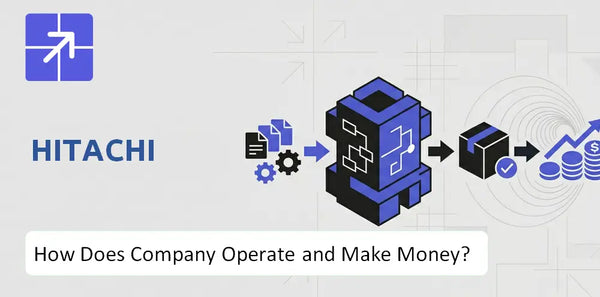
Focus on contracts that convert installations into multi-year service agreements; this drives predictable cash flow and higher lifetime value. See product context in Hitachi BCG Matrix Analysis.
What Does Hitachi Actually Sell?
Hitachi sells integrated industrial and IT solutions combining heavy equipment with digital intelligence; customers pay for physical systems plus embedded software and analytics that deliver measurable outcomes. Core offerings include rail and power infrastructure, Lumada IoT/AI services, and automated logistics and building systems under a Social Innovation business model.
 Core portfolio: hardware plus software
Hitachi business model centers on three pillars: Digital Systems and Services with IT consulting, cloud integration, and the Lumada platform; Green Energy and Mobility with power grids, nuclear systems, and high-speed rail including Rail-as-a-Service; Connective Industries with automated logistics, elevators, and digitalized manufacturing equipment.
Main buyers and channels
Buyers include utilities, transport operators, large manufacturers, real-estate owners, and governments; procurement mixes project-based CAPEX contracts, long-term service agreements, and subscription or outcome-based models for Lumada and Rail-as-a-Service.
Customer value and measurable outcomes
Customers receive reduced carbon emissions and grid losses for utilities, increased factory uptime via predictive maintenance, and lower TCO for mobility through asset-as-a-service models; Hitachi reported ¥8.9 trillion consolidated revenue in fiscal 2025 with strong growth in digital services and energy solutions driving recurring service income.
Differentiators: Social Innovation and systems integration
Hitachi stands out by integrating heavy hardware, software (Lumada IoT), and consulting to deliver outcome-based contracts; its scale in infrastructure and partnerships enables faster deployment than pure-play software vendors and rivals like Siemens and GE in end-to-end solutions. See authoritative context in this company profile: History and Background of Hitachi Company
Hitachi SWOT Analysis
- Complete SWOT Breakdown
- Fully Customizable
- Editable in Excel & Word
- Professional Formatting
- Investor-Ready Format

How Does Hitachi Run Its Business Day to Day?
Hitachi runs day-to-day through a digital-first operating model centered on the Lumada ecosystem, combining field engineering, on-site co-creation, and fast software delivery to turn equipment into data-driven services.

Operating model: platform-led, decentralized delivery
Operations are organized around Lumada as the connective tissue across Hitachi business segments; teams use data from sensors to run analytics, support remote operations, and feed product roadmaps. After divesting non-core units, Hitachi adopted a more agile, decentralized structure to speed decision-making and localize solutions.
Product and service delivery: co-creation and managed services
Customers access solutions via on-site consulting, systems integration, and cloud-enabled subscriptions; engineers deploy hardware plus sensors that stream into Lumada for monitoring and optimization. The sales-to-service flow typically includes pilot, scale-up, and managed operations contracts that blend CapEx equipment sales with recurring software and services revenue.
Production, sourcing, and development: hardware plus software engineering
Manufacturing focuses on critical energy and industrial hardware while software development is concentrated in GlobalLogic and in-house digital teams; suppliers provide transformers, semiconductors, and optics, and engineering labs validate integrations before field rollout.
Sales channels and distribution: direct, partners, and platforms
Hitachi sells direct to utilities, industrials, and governments, and routes digital offerings through partners and system integrators; GlobalLogic accelerates time-to-market for software-defined products, while channel partners handle local commissioning and aftermarket services.
Key assets, systems, and partnerships: Lumada and GlobalLogic
The company's scale rests on Lumada (IoT platform), GlobalLogic (digital engineering), manufacturing plants, and partnerships with utilities and semiconductor suppliers; these assets let Hitachi bundle hardware, software, and services into integrated offerings.
What makes the model work in practice: data-driven co-creation
Practical efficiency comes from sensor-to-analytics loops: engineers deploy sensors, analytics optimize load or uptime, and consultants iterate with clients on-site, reducing commissioning cycles and increasing recurring revenue. This model shifts revenue mix toward recurring digital services; Hitachi reported 2025 revenue by segment growth in social infrastructure and digital solutions, supporting higher-margin services.
For deeper context on market positioning and financial trends see Growth Outlook of Hitachi Company
Hitachi Business Model Canvas
- One-time Payment
- No Research Needed – Save Hours of Work
- Built by Experts, Trusted by Consultants
- Instant Download, Ready to Use
- 100% Editable, Fully Customizable

How Does Revenue Flow Through Hitachi?
Revenue flows through a blend of large capital projects and margin-rich recurring services; demand for infrastructure and decarbonization becomes immediate sales and long-term service income via multi-year contracts and digital subscriptions. Lumada-driven software and Energy orders convert global demand into higher-margin, predictable revenue streams.
Main revenue engine: Lumada and solutions-led sales
Lumada-related business accounted for roughly 30% of total revenue in fiscal 2025 and now anchors the Hitachi business model by boosting software and services margins above the group average. Large infrastructure sales (power grids, rail fleets) seed long-term digital and services contracts tied to Lumada deployments.
Additional revenue streams: Energy orders and recurring services
Hitachi converts decarbonization demand through its Energy segment, which held a record order backlog above 35 billion dollars in 2025, while multi-year service level agreements, maintenance, and digital subscriptions deliver high-margin recurring revenue.
Pricing and monetization: upfront capex plus subscription services
Initial monetization comes from one-time capital sales and project revenue; ongoing monetization uses subscriptions, service fees, licensing of Lumada software, and performance-based contracts that shift revenue mix toward software-heavy, higher-margin streams.
What drives revenue most: software mix and decarbonization projects
The strongest drivers are the growth of Lumada (digital transformation services for enterprises) and Energy project demand; management targets a consolidated adjusted EBITA margin of 12% by 2026 as the mix shifts to higher-margin software and recurring services. See Mission, Vision, and Values of Hitachi Company for context on strategic direction.
Hitachi Marketing Mix
- Complete Marketing Mix Analysis
- Effortlessly Communicate Your Business Strategy
- Investor-Ready Format
- 100% Editable and Customizable
- Clear and Structured Layout

What Makes Hitachi's Model Sustainable or Fragile?
Hitachi's model is sustainable due to dominant positions in grid modernization and sticky software platforms, but fragile from interest-rate sensitivity and large acquisition execution risk. Structural strengths include scale and recurring services; dependencies include capital-project cycles and integration of Thales signaling assets.
Market leadership in grid modernization
Hitachi Energy holds a leading share in transmission and distribution upgrades, driving steady demand for high-voltage equipment and digital grid controls; this supports recurring revenue from long project lifecycles and service contracts.
Sticky digital ecosystem (Lumada)
The Lumada IoT platform and systems-integration services create high switching costs: clients embed analytics, asset management, and operations, producing recurring software and services revenue that reduces commoditization.
Concentration on capital-intensive customers
Revenue depends on utilities, rail, and industry capex cycles; rising global interest rates can delay projects and compress near-term orders, creating cash-flow and backlog volatility for 2025/2026.
Resilience assessment for 2025/2026
As of fiscal – 2025, professional judgment is that Hitachi is well-positioned: management tightened focus on Return on Invested Capital (ROIC) and shifted away from low-margin hardware toward services, reducing cyclicality and improving margins, but integration risk for large M&A – notably the Thales signaling transaction – remains material.
Competitive Landscape of Hitachi Company
Hitachi Boston Consulting Group Matrix
- Built by Experts, Trusted by Consultants
- Structured for Consultants, Students, and Founders
- 100% Editable in Microsoft Word & Excel
- Instant Digital Download – Use Immediately
- Compatible with Mac & PC – Fully Unlocked

Related Blogs
- What Is the History of Hitachi Company and How Did It Evolve?
- What Is the Competitive Landscape of Hitachi Company and How Does It Compete?
- What Is the Growth Outlook of Hitachi Company and Where Is It Heading?
- How Does Hitachi Company Reach Customers and Turn Demand into Sales?
- What Do the Mission, Vision, and Core Values of Hitachi Company Reveal?
- Who Are the Core Customers in Hitachi Company's Target Market?
- Who Owns Hitachi Company Today and Who Holds Control?
Frequently Asked Questions
Hitachi sells integrated industrial and IT solutions that combine heavy equipment with software and analytics. Its core offerings include rail and power infrastructure, Lumada IoT/AI services, and automated logistics and building systems under a Social Innovation business model. Customers buy physical systems plus embedded digital services that deliver measurable outcomes.
Disclaimer
All information, articles, and product details provided on this website are for general informational and educational purposes only. We do not claim any ownership over, nor do we intend to infringe upon, any trademarks, copyrights, logos, brand names, or other intellectual property mentioned or depicted on this site. Such intellectual property remains the property of its respective owners, and any references here are made solely for identification or informational purposes, without implying any affiliation, endorsement, or partnership.
We make no representations or warranties, express or implied, regarding the accuracy, completeness, or suitability of any content or products presented. Nothing on this website should be construed as legal, tax, investment, financial, medical, or other professional advice. In addition, no part of this site - including articles or product references - constitutes a solicitation, recommendation, endorsement, advertisement, or offer to buy or sell any securities, franchises, or other financial instruments, particularly in jurisdictions where such activity would be unlawful.
All content is of a general nature and may not address the specific circumstances of any individual or entity. It is not a substitute for professional advice or services. Any actions you take based on the information provided here are strictly at your own risk. You accept full responsibility for any decisions or outcomes arising from your use of this website and agree to release us from any liability in connection with your use of, or reliance upon, the content or products found herein.