
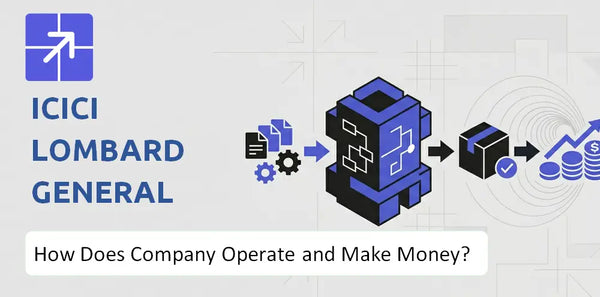
How does ICICI Lombard General Insurance Company generate revenue and manage risks across its non-life insurance products?
ICICI Lombard General Insurance Company sells motor, health, and commercial insurance through bancassurance, agents, and digital channels, using data-driven underwriting to price risk. This matters because in 2025 it remained India's largest private non-life insurer by gross written premium, showing scale and digital traction.
Focus on cross-sell: integrate telematics for motor and preventive care for health to reduce claims and boost retention. See product strategy: ICICI Lombard General Insurance BCG Matrix Analysis
What Does ICICI Lombard General Insurance Actually Sell?
ICICI Lombard General Insurance Company Limited sells non-life insurance: motor, health, travel, home for individuals, and fire, marine, engineering, liability for corporates. Customers pay premiums to transfer financial risk in exchange for a contractually backed promise to pay on covered losses.
 Product mix and channels
ICICI Lombard's product portfolio is led by motor insurance, which contributed nearly 48% of gross written premium (GWP) in FY2025, followed by health, travel, and retail property coverages; corporate lines include fire, marine, engineering, and liability. Revenue sources are premiums, investment income, and fee-based services delivered via bancassurance, agents, brokers, and direct digital platforms.
Who buys it
Individual buyers: private vehicle owners, families buying health and home policies, and retail travelers. Corporate buyers: SMEs and large firms needing property, marine, construction (engineering), and liability coverage; distribution heavily leverages bancassurance partnerships with banks and corporate tie-ups.
Customer value delivered
Customers get guaranteed claim payouts (the promise to pay), loss mitigation services, cashless hospital networks for health, roadside assistance for motor, and risk engineering for corporates. In FY2025 ICICI Lombard reported a claims settlement ratio above 92% on notified claims and emphasized faster digital-first claim processing times.
Why this offering stands out
The firm differentiates via usage-based motor insurance (telematics), wellness-integrated health plans that add preventive care, and strong digital platforms for buying and claims management, reducing lead times and admin costs. Its underwriting and claims management framework, plus reinsurance strategy, support profitable underwriting – FY2025 combined ratio targets aimed near 100%.
Read more about the insurer's guiding principles in this article: Mission, Vision, and Values of ICICI Lombard General Insurance Company
ICICI Lombard General Insurance SWOT Analysis
- Complete SWOT Breakdown
- Fully Customizable
- Editable in Excel & Word
- Professional Formatting
- Investor-Ready Format

How Does ICICI Lombard General Insurance Run Its Business Day to Day?
ICICI Lombard runs daily as a high-volume insurer using a phygital operating model: front-line sales across 300+ branches and 135,000 agents feed a digital-first processing stack where 99 percent of policies issue electronically and claims flow through AI-enabled real-time systems.

Phygital operating model and processing hub
ICICI Lombard combines branch networks and digital platforms to run underwriting, policy issuance, and billing on a central policy administration system; daily operations focus on transaction throughput, automated underwriting rules, and payment reconciliation.
Customer access and product delivery
Customers buy online, via bancassurance with ICICI Bank, agents, or aggregators; e-policy issuance, digital premium collection, and mobile servicing deliver fast fulfilment for motor, health, travel, and corporate lines.
Product development and risk sourcing
Underwriting guidelines, actuarial pricing models, and partner data (telematics, hospital networks) drive product design; reinsurance treaties and portfolio segmentation source capacity and control tail risk.
Distribution ecosystem and sales mechanics
Main channels are bancassurance, agency, brokers, and digital; over 135,000 agents plus ICICI Bank deliver sustained new business while digital brokers and direct web channels scale low-cost acquisition.
Key assets, systems, and partnerships
Core assets include a central policy admin, AI claims platform with computer vision for motor assessment, a network of >13,000 cashless hospitals and >12,000 preferred garages, and bancassurance ties that fuel premium inflows.
Operational levers that make it work
High electronic issuance (99 percent), automated claims triage, preferred provider networks, and scale in distribution compress costs and stabilize loss ratios; efficient cashflow from premium collection drives investment income.
Daily KPIs tracked include policies issued per day, claim closure time, motor TP repair approvals, cashless hospital admissions, combined ratio movements, and collections versus receivables; these feed underwriting adjustments and pricing cadence.
For context on competitive positioning and market structure see Competitive Landscape of ICICI Lombard General Insurance Company
ICICI Lombard General Insurance Business Model Canvas
- One-time Payment
- No Research Needed – Save Hours of Work
- Built by Experts, Trusted by Consultants
- Instant Download, Ready to Use
- 100% Editable, Fully Customizable

How Does Revenue Flow Through ICICI Lombard General Insurance?
Revenue at ICICI Lombard flows from two core streams: premium income from policies and returns on invested float. Demand in motor and health converts into Gross Direct Premium Income, then claims and expenses determine the investible surplus.
Main revenue: Gross Direct Premium Income
Gross Direct Premium Income is the primary engine, which for FY2025 approached INR 290,000,000,000, driven mainly by motor and health product sales and high-volume renewals.
Additional revenue: investment income and fee services
After claims and operating costs, the float is invested – investment income, interest and dividends from an investment book that grew to over INR 580,000,000,000 by early 2026 augment underwriting margins.
Pricing and monetization model
ICICI Lombard monetizes via premium pricing based on actuarial underwriting, distribution commissions (bancassurance, agents), service fees for corporate products and add-ons, and investment yields on float.
Primary revenue drivers
Revenue is most influenced by premium growth in motor and health, combined ratio management (target ~101.5% – 102.5%), investment yield on the large reserve pool, and distribution effectiveness via bancassurance and digital channels. See Sales and Marketing Strategy of ICICI Lombard General Insurance Company for distribution detail: Sales and Marketing Strategy of ICICI Lombard General Insurance Company
ICICI Lombard General Insurance Marketing Mix
- Complete Marketing Mix Analysis
- Effortlessly Communicate Your Business Strategy
- Investor-Ready Format
- 100% Editable and Customizable
- Clear and Structured Layout

What Makes ICICI Lombard General Insurance's Model Sustainable or Fragile?
ICICI Lombard's model rests on scale, data-led underwriting, and diversified distribution, which lower unit acquisition costs and improve pricing accuracy; key risks include medical inflation, regulatory pressure on third-party motor tariffs, and insurtech competition that compresses retail margins.
Scale and Data Advantage Support Underwriting
ICICI Lombard's large retail and corporate book yields superior loss experience data, enabling tighter pricing and segmentation in the underwriting process for policies; this reduces adverse selection and improves combined ratio management. The scale also drives lower customer acquisition cost per policy versus smaller general insurance company India peers.
Technology, Distribution, and Cross – sell Reach
The company's omni – channel distribution – bancassurance, agents, brokers, and direct digital – diversifies revenue streams and limits dependency on any single channel; its tech stack enables streamlined insurance underwriting and claims management and supports cross-sell of health products into an established motor insured base.
Exposure to Medical Inflation and Motor Regulation
Persistent medical inflation at around 12% annually inflates health claim frequency and severity, pressuring loss ratios and pricing; simultaneous regulatory volatility in third-party motor pricing constrains premium increases and can widen underwriting losses. Reinsurance costs also rise when claim severity trends climb.
Resilience in 2025/2026: Strong but Not Immune
For fiscal 2025 ICICI Lombard shows an enviable solvency buffer with a solvency ratio near 2.55, well above the 1.50 regulatory minimum, indicating capital strength to absorb shocks. Market leadership, broad product portfolio (motor health travel), and effective reinsurance and risk management keep it resilient, though retail margins face pressure from digital-only competitors.
Read more on history and strategic context at History and Background of ICICI Lombard General Insurance Company
ICICI Lombard General Insurance Boston Consulting Group Matrix
- Built by Experts, Trusted by Consultants
- Structured for Consultants, Students, and Founders
- 100% Editable in Microsoft Word & Excel
- Instant Digital Download – Use Immediately
- Compatible with Mac & PC – Fully Unlocked

Related Blogs
- What Is the History of ICICI Lombard General Insurance Company and How Did It Evolve?
- What Is the Competitive Landscape of ICICI Lombard General Insurance Company and How Does It Compete?
- What Is the Growth Outlook of ICICI Lombard General Insurance Company and Where Is It Heading?
- How Does ICICI Lombard General Insurance Company Reach Customers and Turn Demand into Sales?
- What Do the Mission, Vision, and Core Values of ICICI Lombard General Insurance Company Reveal?
- Who Are the Core Customers in ICICI Lombard General Insurance Company's Target Market?
- Who Owns ICICI Lombard General Insurance Company Today and Who Holds Control?
Frequently Asked Questions
ICICI Lombard General Insurance sells non-life insurance products for individuals and businesses. Its portfolio includes motor, health, travel, and home policies, along with fire, marine, engineering, and liability cover for corporates. Customers pay premiums to transfer financial risk in return for a contractually backed promise to pay covered losses.
Disclaimer
All information, articles, and product details provided on this website are for general informational and educational purposes only. We do not claim any ownership over, nor do we intend to infringe upon, any trademarks, copyrights, logos, brand names, or other intellectual property mentioned or depicted on this site. Such intellectual property remains the property of its respective owners, and any references here are made solely for identification or informational purposes, without implying any affiliation, endorsement, or partnership.
We make no representations or warranties, express or implied, regarding the accuracy, completeness, or suitability of any content or products presented. Nothing on this website should be construed as legal, tax, investment, financial, medical, or other professional advice. In addition, no part of this site - including articles or product references - constitutes a solicitation, recommendation, endorsement, advertisement, or offer to buy or sell any securities, franchises, or other financial instruments, particularly in jurisdictions where such activity would be unlawful.
All content is of a general nature and may not address the specific circumstances of any individual or entity. It is not a substitute for professional advice or services. Any actions you take based on the information provided here are strictly at your own risk. You accept full responsibility for any decisions or outcomes arising from your use of this website and agree to release us from any liability in connection with your use of, or reliance upon, the content or products found herein.