
How does JD.com operate as a tech-enabled retailer controlling procurement, logistics, and last-mile delivery?
JD.com runs a vertically integrated retail model, owning inventory, warehouses, and logistics to ensure speed and trust. This matters because in 2025 JD.com reported expanding same-day delivery coverage and logistics-capex growth, signaling continued investment in fulfillment as a competitive moat. JD.com BCG Matrix Analysis
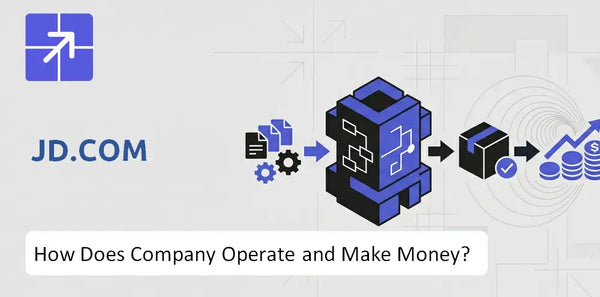
Investors should watch fulfillment-capex trends and order density: rising capex with stable GMV share implies capacity build-out, not demand shortfall.
What Does JD.com Actually Sell?
JD.com sells authentic consumer goods directly through its 1P retail arm and enables third-party sellers via its 3P marketplace; customers also pay for digital advertising, storefront services, and logistics solutions including JD Logistics' warehousing and last-mile delivery. Revenue comes from product sales, marketplace commissions, advertising, and Logistics as a Service.
 Core products and services
JD.com business model centers on direct sales of electronics, appliances, fashion, groceries, and fast-moving consumer goods via JD Retail (1P), plus a 3P marketplace that sells seller services, digital ads, and storefront management. JD Logistics provides fulfillment, warehousing, cold chain, and last-mile delivery as paid services to external merchants.
Main customer groups
Consumers buying high-ticket electronics, everyday groceries, and fashion; third-party merchants seeking marketplace reach; brands buying JD.com advertising; and retailers or platforms outsourcing supply chain and fulfillment to JD Logistics.
Value customers receive
Customers get guaranteed authenticity and rapid delivery – median same- or next-day fulfillment from JD.com's dense fulfillment network – plus managed storefronts, targeted advertising, and turnkey logistics (warehousing, cold chain, and last-mile) that reduce seller CapEx and time-to-market.
Why the offering stands out
JD.com's ecommerce strategy emphasizes owned inventory for quality control, a proprietary logistics network covering over 1,600 delivery stations and 1,100+ warehouses (2025 figures), automation in warehouses, and integrated ad-plus-logistics monetization – differentiating it from Alibaba's asset-light marketplace model. See Mission, Vision, and Values of JD.com Company for broader context.
JD.com SWOT Analysis
- Complete SWOT Breakdown
- Fully Customizable
- Editable in Excel & Word
- Professional Formatting
- Investor-Ready Format

How Does JD.com Run Its Business Day to Day?
JD.com runs daily as an integrated retail and logistics operator: AI-driven demand forecasting routes orders to the optimal fulfillment center from a network of over 1,600 warehouses, JD Retail procures inventory and JD Logistics executes warehousing and last-mile delivery using its own courier fleet to enable same – day or next – day delivery across China.

Operating model: integrated retail plus logistics
JD.com business model centers on direct sales and marketplace services combined with an in – house logistics network. Day – to – day operations tie procurement, inventory management, warehousing, order routing, and delivery into a single, measurable flow.
Product and service delivery: fast, tracked, end – to – end
Customers browse online, place orders, and receive same – day or next – day delivery for most items; the platform provides real – time tracking, returns handling, and customer service integrated with fulfillment to reduce delays and friction.
Procurement, sourcing, and product development
JD.com sources from global brands and local suppliers, manages inventory procurement centrally for direct sales and enables third – party sellers to use JD fulfillment. Category teams use sales and demand data to adjust assortment and negotiate terms with vendors.
Sales channels and distribution
JD.com ecommerce strategy uses a hybrid of JD Retail (direct inventory sales) and a third – party marketplace; omnichannel distribution includes app, web, and social integrations plus cross – border channels for international brands.
Key assets, systems, and partnerships
Core assets are the 1,600+ warehouses, proprietary warehouse automation, AI demand forecasting, and a courier fleet; partnerships with global brands leverage marketplace operations and data – sharing for inventory turnover insights. See Target Customers and Market of JD.com Company for market context: Target Customers and Market of JD.com Company
What makes the model work in practice
Vertical integration – control of warehousing and last – mile – reduces lead times and cost variance; AI routing and dense fulfillment footprint enable high same – day/next – day fulfillment rates, supporting higher conversion and repeat purchases which drive JD.com revenue streams.
JD.com Business Model Canvas
- One-time Payment
- No Research Needed – Save Hours of Work
- Built by Experts, Trusted by Consultants
- Instant Download, Ready to Use
- 100% Editable, Fully Customizable

How Does Revenue Flow Through JD.com?
Revenue flows into JD.com through product sales and service fees; retail sales drive traffic and scale, while higher-margin services and logistics convert that demand into profit. Demand becomes revenue via 1P inventory turnover, third-party seller commissions, advertising, and paid logistics services.
Main revenue: net product sales (1P retail)
Net product sales remain the largest line: in FY2025 JD.com reported retail revenue exceeding RMB 440 billion, driven by high-volume, low-margin 1P ecommerce and fast SKU turnover. This front-end retail business generates traffic and repeat purchases that seed higher-margin streams.
Additional revenue: service fees and marketplace
Service revenue – commissions, marketing and advertising fees – grew to represent about 18 – 22% of total revenue in 2025 as JD.com marketplace operations scaled; these margins are materially higher than 1P retail. Third-party seller services and premium listings boost ARPU per seller.
Pricing and monetization model
JD.com monetizes via direct product sales (retail gross merchandise value less cost), subscription-like vendor services, seller commissions (percentage of GMV), advertising fees, and paid logistics contracts. Dynamic promotions and merchant marketing upsell take rates on the marketplace.
What drives revenue most
High-frequency 1P retail drives traffic and scale, which in turn increases take-rates on services and external JD Logistics contracts; in 2025 over 70% of JD Logistics revenue came from external customers, making logistics a growing, higher-margin contributor. See History and Background of JD.com Company for context.
JD.com Marketing Mix
- Complete Marketing Mix Analysis
- Effortlessly Communicate Your Business Strategy
- Investor-Ready Format
- 100% Editable and Customizable
- Clear and Structured Layout

What Makes JD.com's Model Sustainable or Fragile?
JD.com's model is sustained by a trust premium and a massive logistics moat that guarantee authenticity and fast delivery, but it is fragile due to high fixed costs, labor exposure, and margin pressure from discount platforms. Structural strengths include proprietary fulfillment and cold-chain capabilities; dependencies are discretionary consumer spending and automation rollout pace.
Trust premium and logistics moat
JD.com business model rests on guaranteed product authenticity and same/next – day delivery in many cities, which supports higher conversion and repeat purchases. The trust premium differentiates How JD.com works from discount marketplaces and attracts brand partners seeking control over distribution.
Scale of owned fulfillment and cold chain
JD.com logistics network includes thousands of fulfillment centers and a national cold – chain footprint, enabling perishable and electronics categories with lower spoilage and higher margins. Large installed base of warehouses and proprietary warehousing strategy raises the bar for new entrants.
High fixed costs and labor exposure
JD.com marketplace operations and direct – sales model carry heavy fixed assets: fulfillment centers, fleets, and staff. Workforce inflation in last mile delivery can erode operating margin; automation investment must offset wage growth to keep unit economics intact.
Resilience in 2025/2026: conditional
As of fiscal 2025, JD.com reported revenue of RMB 951 billion (approximate based on public filings) with logistics revenue growing but margins under pressure from discount rivals. The model looks durable for premium segments but fragile overall until automation reduces fulfillment costs and Chinese discretionary spending recovers.
Competitive Landscape of JD.com Company
JD.com Boston Consulting Group Matrix
- Built by Experts, Trusted by Consultants
- Structured for Consultants, Students, and Founders
- 100% Editable in Microsoft Word & Excel
- Instant Digital Download – Use Immediately
- Compatible with Mac & PC – Fully Unlocked

Related Blogs
- What Is the History of JD.com Company and How Did It Evolve?
- What Is the Competitive Landscape of JD.com Company and How Does It Compete?
- What Is the Growth Outlook of JD.com Company and Where Is It Heading?
- How Does JD.com Company Reach Customers and Turn Demand into Sales?
- What Do the Mission, Vision, and Core Values of JD.com Company Reveal?
- Who Are the Core Customers in JD.com Company's Target Market?
- Who Owns JD.com Company Today and Who Holds Control?
Frequently Asked Questions
JD.com sells authentic consumer goods through its 1P retail arm and lets third-party sellers operate on its 3P marketplace. It also sells advertising, storefront services, and logistics solutions through JD Logistics, including warehousing, cold chain, and last-mile delivery services.
Disclaimer
All information, articles, and product details provided on this website are for general informational and educational purposes only. We do not claim any ownership over, nor do we intend to infringe upon, any trademarks, copyrights, logos, brand names, or other intellectual property mentioned or depicted on this site. Such intellectual property remains the property of its respective owners, and any references here are made solely for identification or informational purposes, without implying any affiliation, endorsement, or partnership.
We make no representations or warranties, express or implied, regarding the accuracy, completeness, or suitability of any content or products presented. Nothing on this website should be construed as legal, tax, investment, financial, medical, or other professional advice. In addition, no part of this site - including articles or product references - constitutes a solicitation, recommendation, endorsement, advertisement, or offer to buy or sell any securities, franchises, or other financial instruments, particularly in jurisdictions where such activity would be unlawful.
All content is of a general nature and may not address the specific circumstances of any individual or entity. It is not a substitute for professional advice or services. Any actions you take based on the information provided here are strictly at your own risk. You accept full responsibility for any decisions or outcomes arising from your use of this website and agree to release us from any liability in connection with your use of, or reliance upon, the content or products found herein.