
How does Mansfield Energy Corp. connect refineries to end-users and monetize logistics and risk management?
Mansfield Energy Corp. trades and delivers fuel, blending procurement, transport, and risk hedging to large fleets and industrial clients. This matters because fuel is a top-three cost for transport firms, and Mansfield's 2025 emphasis on tech-enabled logistics cut delivery time and dispute rates, improving margins.
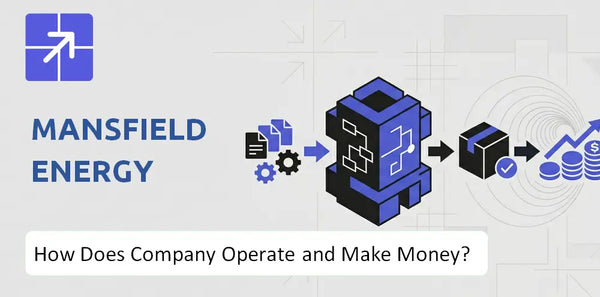
Mansfield scales by bundling procurement, storage, and hedging; clients outsource fuel ops to reduce volatility exposure. See product analysis: Mansfield Energy BCG Matrix Analysis
What Does Mansfield Energy Actually Sell?
Mansfield Energy Company sells fuel products and energy management: conventional gasoline, ultra-low sulfur diesel, lubricants, DEF, Renewable Diesel (RD), and Sustainable Aviation Fuel (SAF), plus fixed-price programs, price caps, and fuel-management hardware/software. Customers pay for fuel supply, price certainty, logistics, and managed utility services that reduce operational and carbon risk.
 Core product and services mix
Mansfield Energy Company sells physical fuels (gasoline, ultra-low sulfur diesel, lubricants, DEF), high volumes of Renewable Diesel and SAF as of 2025, and energy management services including fixed-price contracts and price caps that lock volatility for customers.
Primary buyers
Buyers are marine operators and ports (bunker customers), commercial fleets, aviation fuel purchasers, large industrial users, and supply-chain resellers seeking fuel procurement services and energy trading and logistics support.
Customer value delivered
Customers get price certainty via fixed-price programs and caps, reliable delivery through logistics and international operations, emissions reduction via RD and SAF, and operational visibility from remote tank monitoring and automated dispensing systems.
Differentiators and ease of purchase
Mansfield Energy business model combines commodity supply with energy management and tech-enabled services, making fuel a managed utility; this differentiates it from a pure marine fuel supplier and simplifies contracting, credit terms, and booking bunker fuel transactions. See Sales and Marketing Strategy of Mansfield Energy Company for related detail: Sales and Marketing Strategy of Mansfield Energy Company
Mansfield Energy SWOT Analysis
- Complete SWOT Breakdown
- Fully Customizable
- Editable in Excel & Word
- Professional Formatting
- Investor-Ready Format

How Does Mansfield Energy Run Its Business Day to Day?
Mansfield Energy Company runs as an asset-light logistics operator that schedules and executes thousands of fuel deliveries daily across the U.S. and Canada, using real-time tank telemetry, spot terminal pricing, and a large carrier network to match supply to demand efficiently.

Operating model: centralized orchestration, local execution
The Mansfield Energy business model centers on centralized planning and decentralized delivery: a small owned-asset footprint supported by over 900 terminal supply points and thousands of third-party carriers. Daily operations marry dispatch teams with the Mansfield Entrust platform to convert customer tank reads into optimized pick-ups and deliveries.
Product and service delivery: on-demand, scheduled, and emergency fills
Customers access fuel procurement services via digital ordering, API integrations, or account reps; orders become scheduled deliveries or same-day emergency dispatches. Mansfield Energy manages deliveries for clients from school districts to data centers, ensuring uptime for critical loads.
Production, sourcing, and vendor network
Mansfield sources product from refined product terminals and wholesale markets, using spot and contract purchases to balance cost and availability. For marine and bunker needs it aggregates terminal allocations and third-party supplier offers to fulfill port calls and long-haul requirements.
Sales channels and distribution: multi-channel reach
Revenue comes through direct sales teams, regional account managers, reseller partners, and digital booking tools. Distribution relies on terminal-to-customer logistics via contracted carriers and third-party trucking fleets across North America.
Key assets, systems, and partnerships
Core assets are the proprietary Mansfield Entrust platform, terminal supply agreements at over 900 points, and carrier partner networks. Strategic partnerships include terminal operators, refiners, and financial counterparties for energy trading and credit services.
What makes the model work: data, network scale, and short-cycle procurement
The model succeeds because real-time tank telemetry feeds a dispatch engine that pairs the cheapest terminal price with available carriers, minimizing holding costs and fuel price exposure. High delivery frequency and broad terminal access create resilience against pipeline outages and weather-driven spikes.
Operational metrics: Mansfield manages thousands of deliveries per day, serves customers across both road diesel and marine fuel supplier segments, and maintains working capital via negotiated credit terms and short invoice cycles; the Entrust platform reduces emergency fills and average days-to-delivery by measurable amounts in client case studies – see the Growth Outlook of Mansfield Energy Company.
Mansfield Energy Business Model Canvas
- One-time Payment
- No Research Needed – Save Hours of Work
- Built by Experts, Trusted by Consultants
- Instant Download, Ready to Use
- 100% Editable, Fully Customizable

How Does Revenue Flow Through Mansfield Energy?
Revenue at Mansfield Energy Company is driven by volumes moved and service spreads, converting demand for marine and industrial fuel into predictable cash flows through procurement margins, service fees, and risk-management premiums. High-volume movement turns wholesale buys into multi-billion dollar 2025 revenues via contracts, logistics, and hedging.
Procurement spread: bulk buying and delivery margin
Mansfield Energy Company captures its largest revenue slice by buying fuel at wholesale bulk rates and adding a margin for handling and delivery; in fiscal 2025 the firm processed roughly 3.5 to 4 billion gallons, translating into multi – billion dollar top-line sales driven primarily by gallons moved rather than commodity speculation. This procurement spread is central to how Mansfield Energy works as a marine fuel supplier and fuel procurement services provider.
Service fees: fuel management, compliance, logistics
Clients pay recurring and transaction fees for fuel management, environmental compliance reporting, bunkering coordination, and on – port logistics; these service fees stabilise margins and increase lifetime value per customer, making Mansfield Energy business model less exposed to spot price swings.
Pricing and monetization model: spreads, contracts, hedges
The company monetises demand via transaction margins, fixed-price and volume contracts, and negotiated commissions; it also earns a risk management premium by structuring hedges and fixed-rate agreements for clients seeking budget certainty – a key part of Mansfield Energy pricing and contract terms.
Primary revenue driver: gallons moved and contract mix
Volume (gallons moved) combined with the share of fixed contracts versus spot sales drives revenue most strongly; in 2025 operational scale across ports, plus energy trading and logistics capabilities, allowed stable margins even when oil prices were weak. See History and Background of Mansfield Energy Company for context on scale and operations.
Mansfield Energy Marketing Mix
- Complete Marketing Mix Analysis
- Effortlessly Communicate Your Business Strategy
- Investor-Ready Format
- 100% Editable and Customizable
- Clear and Structured Layout

What Makes Mansfield Energy's Model Sustainable or Fragile?
Mansfield Energy Company's model is sustainable through deep North American supply-chain integration and early moves into low – carbon fuels, yet fragile due to high credit exposure and commodity-price swings. Structural strengths include logistics scale and renewable diesel positions; risks center on customer defaults, thin margins, and long-term electrification of transport.
Supply – chain integration and low – carbon pivot support the model
Mansfield Energy Company leverages integrated energy trading and logistics to move large volumes across North America, enabling competitive procurement and spot sourcing. Its early entry into Renewable Diesel and low – sulfur products by 2025 gives a pricing and regulatory edge as industrial clients face rising Scope 3 emissions requirements.
Key assets and capabilities
The company operates a national logistics network, freight and storage agreements, and an energy trading desk that supports fuel procurement services and marine fuel supplier roles. Strategic partnerships and reseller networks broaden market access and improve margin capture in both bunker fuel procurement and Renewable Diesel supply.
Dependencies and concentration risks
Revenue hinges on high-dollar, thin – margin transactions that amplify credit risk: a single major customer default can stress liquidity and working capital lines. The model also depends on volatile commodity markets, access to third – party storage, and continued demand for liquid fuels amid gradual electrification.
How durable the model looks in 2025/2026
Professional judgment for 2025 – 2026 points to a stable outlook: expansion into Renewable Diesel and consolidation of fragmented fleet logistics create a defensive moat, while energy trading and logistics expertise partially hedge commodity moves. Still, credit exposure and demand shift remain material fragilities that require tighter counterparty limits and liquidity buffers.
Ownership and Control of Mansfield Energy Company
Mansfield Energy Boston Consulting Group Matrix
- Built by Experts, Trusted by Consultants
- Structured for Consultants, Students, and Founders
- 100% Editable in Microsoft Word & Excel
- Instant Digital Download – Use Immediately
- Compatible with Mac & PC – Fully Unlocked

Related Blogs
- What Is the History of Mansfield Energy Company and How Did It Evolve?
- What Is the Competitive Landscape of Mansfield Energy Company and How Does It Compete?
- What Is the Growth Outlook of Mansfield Energy Company and Where Is It Heading?
- How Does Mansfield Energy Company Reach Customers and Turn Demand into Sales?
- What Do the Mission, Vision, and Core Values of Mansfield Energy Company Reveal?
- Who Are the Core Customers in Mansfield Energy Company's Target Market?
- Who Owns Mansfield Energy Company Today and Who Holds Control?
Frequently Asked Questions
Mansfield Energy sells fuel products and energy management services. Its mix includes gasoline, ultra-low sulfur diesel, lubricants, DEF, Renewable Diesel, and Sustainable Aviation Fuel, along with fixed-price programs, price caps, and fuel-management hardware and software. Customers buy supply, price certainty, logistics, and managed services that reduce operational and carbon risk.
Disclaimer
All information, articles, and product details provided on this website are for general informational and educational purposes only. We do not claim any ownership over, nor do we intend to infringe upon, any trademarks, copyrights, logos, brand names, or other intellectual property mentioned or depicted on this site. Such intellectual property remains the property of its respective owners, and any references here are made solely for identification or informational purposes, without implying any affiliation, endorsement, or partnership.
We make no representations or warranties, express or implied, regarding the accuracy, completeness, or suitability of any content or products presented. Nothing on this website should be construed as legal, tax, investment, financial, medical, or other professional advice. In addition, no part of this site - including articles or product references - constitutes a solicitation, recommendation, endorsement, advertisement, or offer to buy or sell any securities, franchises, or other financial instruments, particularly in jurisdictions where such activity would be unlawful.
All content is of a general nature and may not address the specific circumstances of any individual or entity. It is not a substitute for professional advice or services. Any actions you take based on the information provided here are strictly at your own risk. You accept full responsibility for any decisions or outcomes arising from your use of this website and agree to release us from any liability in connection with your use of, or reliance upon, the content or products found herein.