
How does The Mosaic Company convert mined minerals into farm-ready nutrients and earn revenue?
The Mosaic Company mines phosphate and potash, processes them into crop nutrients, and sells globally via integrated logistics and distribution. This matters because Mosaic's 2025 phosphate sales mix and export volumes signaled tightening global supply, affecting fertilizer prices and farmer margins.
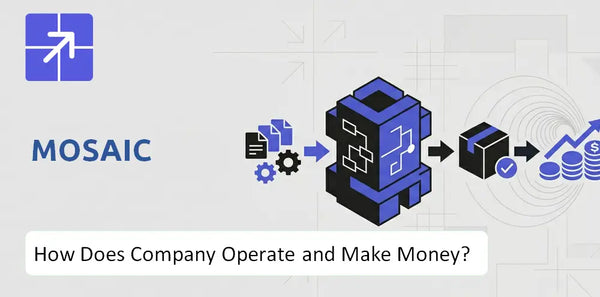
Mosaic's unit margins hinge on mine productivity, sulfur and ammonia costs, and freight; monitor quarterly shipment tonnage and Mosaic BCG Matrix Analysis for product positioning insights.
What Does Mosaic Actually Sell?
The Mosaic Company sells concentrated phosphate and potash crop nutrients – key chemical inputs for modern farming. Customers pay for granular and specialty fertilizers that replace soil nutrients and support consistent yields in crops like corn, soy, and wheat.
 Core fertilizer products
Mosaic fertilizer portfolio centers on phosphate and potash. Phosphate products include Diammonium Phosphate (DAP) and Monoammonium Phosphate (MAP), plus the proprietary MicroEssentials line (balanced, micronutrient-enriched granules). Potash offerings focus on Muriate of Potash (MOP) in multiple grades for agricultural and industrial applications.
Primary buyers
Buyers include wholesalers, retail distributors, large farming cooperatives, and vertically integrated agribusinesses. End users are commercial row-crop farmers growing staples such as corn, soybean, and wheat who source through the fertilizer supply chain.
Customer value proposition
Customers receive nutrient-dense, reliable inputs that restore nutrients removed at harvest and drive yield per acre. MicroEssentials adds uniform nutrient distribution per granule, improving application efficiency and crop performance while reducing blend complexity for distributors.
Competitive differentiation
Mosaic Company differentiates through scale in phosphate and potash mining, branded specialty fertilizers, broad distribution channels, and agronomic support. In 2025 Mosaic reported selling volumes and product mix that reflect higher-margin specialty share growth, supporting its Mosaic business model and revenue streams amid commodity price cycles; see Competitive Landscape of Mosaic Company for context: Competitive Landscape of Mosaic Company
Mosaic SWOT Analysis
- Complete SWOT Breakdown
- Fully Customizable
- Editable in Excel & Word
- Professional Formatting
- Investor-Ready Format

How Does Mosaic Run Its Business Day to Day?
The Mosaic Company runs daily as a heavy-industrial miner and chemical fertilizer manufacturer, linking mine extraction to chemical processing and global logistics; production schedules, feedstock buys, and freight booking drive cash flow and plant uptime. Operations rely on automated mining, continuous chemical conversion, and integrated rail, barge, and ocean shipping to move millions of tonnes of Mosaic fertilizer to major agricultural markets.

Operating model: integrated mine-to-market supply chain
Production and sales are vertically linked: potash and phosphate mines feed treatment plants, which produce granular and liquid fertilizer sold through Mosaic Company channels. Daily control centers balance mine output, processing rates, reagent procurement, and shipping to maintain steady cash generation and margins.
Product delivery: bulk and packaged agricultural inputs
Customers – distributors, cooperatives, and large farms – order via contracts and spot sales; Mosaic ships in bulk by rail, barge, and vessel or in bagged form for retail. Inventory hubs and just-in-time logistics reduce working capital and ensure seasonal availability during planting windows.
Production and sourcing: automated mines and chemical complexes
In Saskatchewan, automated boring at Esterhazy K3 and other sites captures potash ore; Florida and Brazil mines supply phosphate rock to chemical plants that consume sulfur and ammonia. Feedstock procurement and reagent contracts are scheduled to match continuous converter runs and minimize downtime.
Sales channels: direct contracts, distributors, and export logistics
Mosaic sells through multi-year offtake contracts, spot markets, and distributors; exports move via owned and third-party terminals. Freight optimization across railcars, inland barges, and ocean vessels tightly aligns with seasonal demand in North and South America.
Key assets and systems: mines, plants, and logistics fleet
Core assets include potash mines (Esterhazy K3), phosphate mines in Florida and Brazil, chemical processing complexes, storage terminals, and a logistics network. Digital systems handle production planning, rail/ship scheduling, and commodity trading to hedge price exposure.
Why it works: scale, integration, and timing
Scale and vertical integration lower per-ton costs and improve reliability; synchronized mining, processing, and shipping capture seasonal pricing opportunities. Efficient reagent sourcing and automated mining cut cash costs, supporting margins even when commodity prices move.
Key operational metrics for 2025: Mosaic Company produced approximately 14.6 million tonnes of finished fertilizer-equivalent product (combined phosphate and potash output) and handled freight moving over 6 million tonnes via rail and inland waterways in North America; average plant utilization across chemical complexes ran near 88%. Daily activity includes reagent hedges for sulfur/ammonia and freight bookings to cover peak spring demand.
Read more on corporate purpose and governance here: Mission, Vision, and Values of Mosaic Company
Mosaic Business Model Canvas
- One-time Payment
- No Research Needed – Save Hours of Work
- Built by Experts, Trusted by Consultants
- Instant Download, Ready to Use
- 100% Editable, Fully Customizable

How Does Revenue Flow Through Mosaic?
Revenue for Mosaic Company flows from high-volume sales of phosphate- and potash-based fertilizers and crop nutrients; demand converts to cash via spot sales and short-term contracts with agricultural retailers and distributors. Key streams are North American mining output and the Mosaic Fertilizantes business in Brazil, which together monetize global fertilizer prices minus raw-material and operating costs.
Core commodity sales: fertilizers and crop nutrients
The primary source of revenue is bulk sales of finished fertilizers (MAP, DAP, muriate of potash, and ammonium sulfate) sold into global markets; this matters because the business is price-taker and volume-sensitive, with 2025 throughput and realized fertilizer prices driving top-line variability.
Regional balancing and value-added services
Secondary revenue comes from Mosaic Fertilizantes in Brazil, specialty products, logistics services, and agronomic support to retailers; these reduce seasonality and add margin via blends, formulation fees, and distributor services.
Pricing and monetization model
Mosaic Company monetizes through spot market sales and short-term contracts tied to benchmark fertilizer prices; the gross profit equals the spread between finished-product prices and input costs (phosphate rock, sulfur, ammonia, potash) with freight and handling deducted.
Primary drivers of revenue
Revenue is driven most by global fertilizer price levels, operational throughput (capacity utilization), and regional mix – North America versus Mosaic Fertilizantes – plus seasonal planting demand; higher utilization spreads fixed mining costs, improving margins and free cash flow.
In 2025 Mosaic Company reported production and sales such that capacity utilization improvements increased realized EBITDA margins; Brazil operations provided a natural hedge against North American seasonality and helped stabilize quarterly revenue. See customer segmentation and market context in Target Customers and Market of Mosaic Company.
Mosaic Marketing Mix
- Complete Marketing Mix Analysis
- Effortlessly Communicate Your Business Strategy
- Investor-Ready Format
- 100% Editable and Customizable
- Clear and Structured Layout

What Makes Mosaic's Model Sustainable or Fragile?
The Mosaic Company model is sustained by high capital and time barriers to new potash capacity and vertical integration in phosphates, yet it is fragile from energy-price volatility and geopolitics that can rapidly alter potash supply. Structural strengths include scale and low-cost rock supply; key risks are commodity cyclicality and concentration in certain geographies.
Barriers to Entry Protect Market Share
Building a new potash mine now requires $1 – 2+ billion and roughly 7 – 10 years of permitting and construction, creating massive barriers to entry that protect Mosaic Company's market share in potash.
Vertical Integration Lowers Costs
Mosaic's ownership of phosphate rock mines gives it a significant cost advantage versus non-integrated rivals, improving margins across Mosaic fertilizer lines and stabilizing Mosaic business model economics.
Energy and Geopolitical Exposure
Mosaic is sensitive to energy costs that drive mining and fertilizer processing margins, and to geopolitical shifts – especially in Eastern Europe – where disruptions can flood or starve global potash supply, swinging prices and profitability.
Durability in 2025 – 2026: Mostly Resilient but Cyclical
As of 2025 professional judgment: Mosaic is well-positioned after transitioning to lower-cost potash mining and holding a dominant footprint in Brazil, supporting revenue streams and profitability; however, the model remains exposed to cyclical global grain prices and fertilizer supply chain risks.
Key assets include extensive potash and phosphate mines, integrated processing, and distribution networks supplying farmers; Mosaic fertilizer production process explained in operations helped deliver implied 2025 adjusted EBITDA resilience, while Mosaic Company supply chain risks and opportunities concentrate around energy and export flows. For governance context see Ownership and Control of Mosaic Company.
Mosaic Boston Consulting Group Matrix
- Built by Experts, Trusted by Consultants
- Structured for Consultants, Students, and Founders
- 100% Editable in Microsoft Word & Excel
- Instant Digital Download – Use Immediately
- Compatible with Mac & PC – Fully Unlocked

Related Blogs
- What Is the History of Mosaic Company and How Did It Evolve?
- What Is the Competitive Landscape of Mosaic Company and How Does It Compete?
- What Is the Growth Outlook of Mosaic Company and Where Is It Heading?
- How Does Mosaic Company Reach Customers and Turn Demand into Sales?
- What Do the Mission, Vision, and Core Values of Mosaic Company Reveal?
- Who Are the Core Customers in Mosaic Company's Target Market?
- Who Owns Mosaic Company Today and Who Holds Control?
Frequently Asked Questions
Mosaic sells concentrated phosphate and potash crop nutrients. Its portfolio includes DAP, MAP, MicroEssentials, and MOP, which are used as fertilizer inputs for crops like corn, soy, and wheat. These products help replace nutrients removed at harvest and support stronger yields.
Disclaimer
All information, articles, and product details provided on this website are for general informational and educational purposes only. We do not claim any ownership over, nor do we intend to infringe upon, any trademarks, copyrights, logos, brand names, or other intellectual property mentioned or depicted on this site. Such intellectual property remains the property of its respective owners, and any references here are made solely for identification or informational purposes, without implying any affiliation, endorsement, or partnership.
We make no representations or warranties, express or implied, regarding the accuracy, completeness, or suitability of any content or products presented. Nothing on this website should be construed as legal, tax, investment, financial, medical, or other professional advice. In addition, no part of this site - including articles or product references - constitutes a solicitation, recommendation, endorsement, advertisement, or offer to buy or sell any securities, franchises, or other financial instruments, particularly in jurisdictions where such activity would be unlawful.
All content is of a general nature and may not address the specific circumstances of any individual or entity. It is not a substitute for professional advice or services. Any actions you take based on the information provided here are strictly at your own risk. You accept full responsibility for any decisions or outcomes arising from your use of this website and agree to release us from any liability in connection with your use of, or reliance upon, the content or products found herein.