
How does M&T Bank Corporation generate revenue and manage risk across its regional banking and institutional services?
M&T Bank Corporation mixes relationship-driven retail lending with commercial and institutional services to earn interest margin and fees while limiting risk through geographic concentration. This matters as 2025 results showed stable net interest income supporting a mid-single-digit ROA in regional peers.
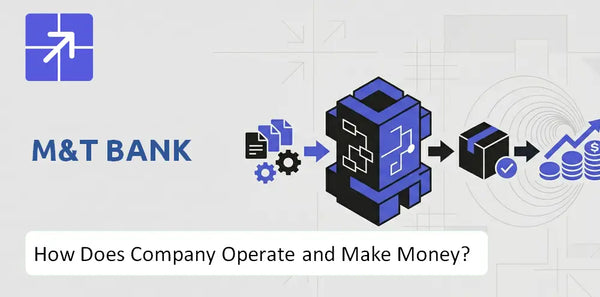
M&T leans on dense branch networks, commercial lending expertise, and transaction fees; prioritize credit quality and deposit stability to weather rate shifts. See product detail: M&T Bank BCG Matrix Analysis
What Does M&T Bank Actually Sell?
M&T Bank Corporation sells access to capital, financial security, and advisory expertise via deposit accounts, consumer and mortgage lending, commercial loans, and high-margin fiduciary and wealth services through Wilmington Trust; customers pay for credit, liquidity, risk management, and trusted custody and advice.
 Core Financial Products and Services
Retail: checking and savings, residential mortgages, auto and unsecured consumer loans. Commercial: commercial and industrial (C&I) loans, equipment finance, commercial real estate (CRE) lending. Institutional/high-net-worth: Wilmington Trust fiduciary services, wealth management, and corporate trust solutions. These drive M&T Bank business model revenue via net interest margin and fee income.
Who Buys These Products
Primary buyers: retail depositors and mortgage borrowers; small-to-medium enterprises and middle-market corporations for C&I and CRE lending; institutional clients and high-net-worth individuals for fiduciary, trust, and wealth services – see Target Customers and Market of M&T Bank Company for segmentation detail: Target Customers and Market of M&T Bank Company.
Value Delivered to Customers
Customers get liquidity and credit, deposit safety, tailored lending structures, and fiduciary stewardship. Wilmington Trust supplies trust accounting, custody, and high-margin advisory that increase fee-based revenue and diversify M&T Bank revenue streams away from pure interest income.
Why the Offering Stands Out
M&T Bank combines local-relationship banking with a national suite via Wilmington Trust, producing higher-fee fiduciary margins and stable deposit funding. In FY2025 M&T reported total assets of $142.3 billion and net interest income of $6.1 billion, with noninterest income of $2.8 billion, illustrating the mix of loan/deposit-driven margins and fee-based wealth/trust services that define How M&T Bank works and its business model.
M&T Bank SWOT Analysis
- Complete SWOT Breakdown
- Fully Customizable
- Editable in Excel & Word
- Professional Formatting
- Investor-Ready Format

How Does M&T Bank Run Its Business Day to Day?
M&T Bank Corporation runs daily through a decentralized branch network where local managers make credit decisions, a large deposit-gathering operation, and centralized digital and wealth platforms that deploy deposits into loans and investments. Key systems include core banking, digital transaction processing, and advisory systems that service retail, commercial, and wealth clients.

Decentralized operating model and local credit authority
M&T Bank business model centers on roughly 1,000 branches across the Northeast and Mid-Atlantic, where local managers exercise lending discretion to tailor credit to community conditions. Day-to-day operations mix branch underwriting, centralized risk oversight, and support from regional credit committees to balance growth and asset quality.
Product and service delivery: branch, digital, and advisory
Customers access M&T Bank services via branches, online/mobile apps, and relationship teams for commercial clients; digital banking handles millions of transactions daily. Retail deposits fund lending and fee businesses; wealth clients receive advisory sessions and portfolio services that drive AUM growth.
Loan origination, underwriting, and product development
Commercial and consumer loan products are sourced through branch origination, commercial bankers, and digital channels; credit underwriting uses a mix of local judgment and centralized policies. Product teams iterate on loan pricing, deposit rates, and fee services based on market data and regulatory guidance.
Sales channels and customer distribution
Main channels include the branch network, commercial relationship managers, digital banking, and intermediary referrals; cross-sell programs link deposits, loans, treasury, and wealth services. Branches drive local market share while digital reduces transaction costs.
Key assets, systems, and partnerships that scale the business
Core banking platforms, payment rails, CRM systems, and wealth-advisory platforms support operations. The bank manages a deposit base of approximately 165,000,000,000 dollars (early 2026) and a wealth management arm with over 170,000,000,000 dollars in assets under influence, requiring market data feeds, custody partners, and custodial integrations.
Operational levers that make the model work in practice
The model works through local credit insight, sticky core deposits, diversified loan deployment, and fee income from wealth and transaction services. Efficiency improves via digital transaction automation; risk is managed with centralized controls plus local knowledge – so underwriting stays responsive and losses remain contained.
See related corporate culture and strategic context in this article: Mission, Vision, and Values of M&T Bank Company
M&T Bank Business Model Canvas
- One-time Payment
- No Research Needed – Save Hours of Work
- Built by Experts, Trusted by Consultants
- Instant Download, Ready to Use
- 100% Editable, Fully Customizable

How Does Revenue Flow Through M&T Bank?
Revenue at M&T Bank flows mainly from interest earned on loans and from fee income; loan demand converts to interest revenue via spreads, while account activity and fiduciary services generate steady fees that diversify income.
Net Interest Income: Core Revenue Engine
Net interest income (NII) is the primary revenue source, driven by a 135 billion dollar loan portfolio that produces a spread over deposit costs; as of Q1 2026 NII represents about 70 percent of total revenue with a net interest margin near 3.55 percent.
Fee and Non – Interest Income: Revenue Diversifier
Non – interest income supplies roughly 30 percent of revenues from service charges, mortgage banking fees, and Wilmington Trust fiduciary fees; these fees cushion earnings when loan demand or rates fall.
Pricing and Monetization Model
M&T Bank monetizes through interest rate spreads on loans versus deposits, account and transaction fees, mortgage origination margins, and trust/asset – management fees; pricing mixes fixed service charges and volume – linked commissions.
Primary Revenue Drivers
Revenue is driven most by loan growth and interest rate spreads, deposit cost management, mortgage activity, and fiduciary fee trends; digital deposit volumes and commercial lending cycles materially affect NII and fee income. Read the company background for context: History and Background of M&T Bank Company
M&T Bank Marketing Mix
- Complete Marketing Mix Analysis
- Effortlessly Communicate Your Business Strategy
- Investor-Ready Format
- 100% Editable and Customizable
- Clear and Structured Layout

What Makes M&T Bank's Model Sustainable or Fragile?
M&T Bank Corporation's model rests on a low-cost deposit base, conservative credit culture, and efficient operations, but it faces concentration risk in Northeast commercial real estate and office exposure that could stress asset quality if values decline materially.
Efficiency and capital position support the model
M&T Bank business model benefits from an industry-leading efficiency ratio of 53.5 percent in 2026 and a Common Equity Tier 1 ratio of 11.5 percent, which lower operating leverage and provide loss-absorbing capacity while preserving profitability across cycles.
Key assets, systems, and customer franchise
How M&T Bank works is anchored in a diversified mix of loans, deposits, and fee income, a large regional branch network, and strong commercial client relationships that sustain deposit growth and cross-sell of services and products.
Concentration and market dependencies
M&T Bank strategy and operations show dependency on the Northeast commercial real estate market – especially office buildings – creating concentration risk; sustained remote-work driven vacancy increases could weaken loan collateral and pressure credit metrics.
Durability outlook for 2025 – 2026
For 2025 and 2026 the professional judgment is that M&T Bank Corporation remains a premier regional performer with a resilient balance sheet and well-positioned to capture share from retrenching competitors, though a systemic regional CRE downturn would materially increase impairments and capital strain; see Competitive Landscape of M&T Bank Company for context: Competitive Landscape of M&T Bank Company
M&T Bank Boston Consulting Group Matrix
- Built by Experts, Trusted by Consultants
- Structured for Consultants, Students, and Founders
- 100% Editable in Microsoft Word & Excel
- Instant Digital Download – Use Immediately
- Compatible with Mac & PC – Fully Unlocked

Related Blogs
- What Is the History of M&T Bank Company and How Did It Evolve?
- What Is the Competitive Landscape of M&T Bank Company and How Does It Compete?
- What Is the Growth Outlook of M&T Bank Company and Where Is It Heading?
- How Does M&T Bank Company Reach Customers and Turn Demand into Sales?
- What Do the Mission, Vision, and Core Values of M&T Bank Company Reveal?
- Who Are the Core Customers in M&T Bank Company's Target Market?
- Who Owns M&T Bank Company Today and Who Holds Control?
Frequently Asked Questions
M&T Bank sells access to capital, financial security, and advisory expertise. Its offerings include deposit accounts, consumer and mortgage lending, commercial loans, and fiduciary and wealth services through Wilmington Trust. Customers are paying for credit, liquidity, risk management, custody, and advice.
Disclaimer
All information, articles, and product details provided on this website are for general informational and educational purposes only. We do not claim any ownership over, nor do we intend to infringe upon, any trademarks, copyrights, logos, brand names, or other intellectual property mentioned or depicted on this site. Such intellectual property remains the property of its respective owners, and any references here are made solely for identification or informational purposes, without implying any affiliation, endorsement, or partnership.
We make no representations or warranties, express or implied, regarding the accuracy, completeness, or suitability of any content or products presented. Nothing on this website should be construed as legal, tax, investment, financial, medical, or other professional advice. In addition, no part of this site - including articles or product references - constitutes a solicitation, recommendation, endorsement, advertisement, or offer to buy or sell any securities, franchises, or other financial instruments, particularly in jurisdictions where such activity would be unlawful.
All content is of a general nature and may not address the specific circumstances of any individual or entity. It is not a substitute for professional advice or services. Any actions you take based on the information provided here are strictly at your own risk. You accept full responsibility for any decisions or outcomes arising from your use of this website and agree to release us from any liability in connection with your use of, or reliance upon, the content or products found herein.