
How does Myer operate as a retail house of brands and drive revenue across stores, online, and private labels?
Myer shifted from a legacy department store into a vertically integrated house of brands after its 2025 merger with Premier Investments apparel division. This matters because private-label margins and a 2025 loyalty database monetization plan will be key to restoring profitability amid flat Aussie retail spend.
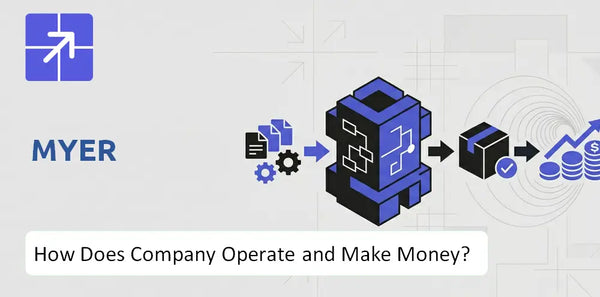
Focus on supply-chain integration and private-label growth to lift gross margins; digital loyalty offers a near-term revenue lever tied to targeted promotions and marketplace fees. See product analysis: Myer BCG Matrix Analysis
What Does Myer Actually Sell?
Myer sells curated third-party premium brands and higher-margin owned apparel across beauty, fashion, home, and electronics, plus services and digital access; customers pay for convenience, aspirational lifestyle curation, and loyalty – driven benefits.
 Core product mix and retail platforms
Myer offers fashion, beauty, homewares and electronics through physical stores and a unified e-commerce platform. After integrating Just Jeans and Portmans in 2025, the Myer private label strategy shifted product mix toward owned-brand apparel, increasing gross margin contribution versus the concession model.
Who buys from Myer
Core buyers are mid-to-upmarket consumers seeking curated premium brands and value from private labels, plus loyalty members. Brand partners and third – party suppliers also pay for shelf space and data-driven marketing via the MYER one ecosystem.
Value customers receive
Shoppers get curated assortments, personalized offers from MYER one and in – store services like personal shopping and beauty treatments that drive conversion during peak seasons. The loyalty base of 7.3 million active members supplies personalized promotions and faster repeat purchase cycles.
Why Myer's offering stands out
Myer combines a curated in-store experience with digital convenience and proprietary apparel that yields higher gross margins, improving Myer revenue streams and financial performance. The MYER one loyalty program creates data-rich insights for partners and supports targeted promotions, aiding Myer e-commerce growth and omnichannel customer experience.
Relevant reference: Mission, Vision, and Values of Myer Company
Myer SWOT Analysis
- Complete SWOT Breakdown
- Fully Customizable
- Editable in Excel & Word
- Professional Formatting
- Investor-Ready Format

How Does Myer Run Its Business Day to Day?
Myer runs daily via an integrated omnichannel fulfillment model that links its department store network with a high-volume e-commerce engine. Orders flow from stores and online into a central National Distribution Centre for rapid processing, while in-store teams and concession staff handle floor activity and customer service.

Omnichannel operating model
Myer business model blends physical department stores and a robust online platform; transactions are routed to the Ravenhall National Distribution Centre or local stores depending on speed and cost. Core systems include POS, OMS (order management), WMS (warehouse management), and a loyalty-driven analytics stack.
Product and service delivery flow
Customers buy via storefronts, the website, or mobile app; 20.5 percent of sales occurred online in 2025 and are often fulfilled from Ravenhall or ship-from-store. Click-and-collect, home delivery, and returns are integrated into daily logistics to shorten lead times.
Sourcing, merchandising, and development
Myer sources branded merchandise and develops private-label lines, aligning buys to seasonal demand and tag rate targets. Inventory buys focus on fast-turn categories; lean stock levels are maintained through automated replenishment and weekly assortment reviews.
Sales channels and distribution network
The main channels are 60+ department stores, brand concessions on the retail floor, and the online channel; omnichannel systems route orders to the optimal fulfillment node. Distribution is anchored by Ravenhall, which handles over 70 percent of online orders and store replenishment.
Key assets, systems, and partnerships
Critical assets include the Ravenhall National Distribution Centre with autonomous mobile robots, POS and OMS platforms, and a loyalty analytics engine tied to ~75 percent of transactions. Partnerships with brand concessionaires and logistics providers keep throughput high.
What keeps the model working day to day
Focus on inventory turnover and tag rate optimization drives margins; predictive analytics use the loyalty program to forecast demand and reduce markdowns. Operational KPIs tracked daily include order processing time, store replenishment rate, and online conversion versus in-store conversion.
See related customer and market context in Target Customers and Market of Myer Company
Myer Business Model Canvas
- One-time Payment
- No Research Needed – Save Hours of Work
- Built by Experts, Trusted by Consultants
- Instant Download, Ready to Use
- 100% Editable, Fully Customizable

How Does Revenue Flow Through Myer?
Revenue flows mainly from direct retail sales, with a growing share from private-label apparel and concession commissions; seasonal peaks convert demand into cash during the Christmas and January Stocktake periods. Monetization combines owned-inventory margins, concession commissions, and marketing services inside the MYER one ecosystem.
Main revenue: Direct retail and private-label margins
Direct sales of owned inventory are the largest contributor to revenue, with private-label apparel now representing 32 percent of clothing turnover, improving gross margins and cash conversion in the Myer business model.
Additional streams: Concessions and marketing services
Concession revenue – brands paying for space and typically giving Myer a 20 – 25 percent commission – plus paid marketing and promotional services within the MYER one ecosystem add predictable fee income and lower inventory risk.
Pricing and monetization model
Myer monetizes via retail mark-ups on owned stock, commission splits on concession sales, and fees for third-party marketing; post-acquisition of Premier Brands Myer now captures full retail margin on select specialty labels, boosting cash flow and gross profit.
What drives revenue most
Seasonality drives the timing and scale of sales – holiday trading and the January Stocktake deliver the bulk of underlying EBITDA – while private-label mix, concession penetration, and e-commerce growth determine margin expansion and revenue resilience. See Ownership and Control of Myer Company for related context: Ownership and Control of Myer Company
Myer Marketing Mix
- Complete Marketing Mix Analysis
- Effortlessly Communicate Your Business Strategy
- Investor-Ready Format
- 100% Editable and Customizable
- Clear and Structured Layout

What Makes Myer's Model Sustainable or Fragile?
The sustainability of Myer's model rests on vertical integration, loyalty data scale, and post-2025 balance-sheet strength, while fragility stems from sensitivity to Australian consumer sentiment, interest rates, and high fixed store costs that pressure margins and discretionary sales.
Defensive moat from vertical scale and loyalty data
Myer business model leverages a large loyalty database and in-house sourcing to defend against pure-play competitors; loyalty-driven repeat sales reduce customer acquisition costs and support cross-sell between private labels and national brands.
Key assets: omnichannel footprint and diversified revenues
After the 2025 merger Myer company overview shows a stronger balance sheet and diversified revenue streams including online, concessions, and owned brands; combined online vs in-store sales trends point to growing e-commerce while large-format stores keep brand presence and customer experience.
Dependencies and constraints: consumer sentiment and occupancy costs
Myer revenue streams remain concentrated in discretionary categories, so sales track Australian consumer sentiment and interest rate cycles; high fixed costs from store leases and store occupancy create leverage that amplifies downturns and limits margin flexibility.
Durability assessment for 2025/2026
Professional judgment is cautiously optimistic: the transition to a leaner, brand-heavy operator improved EBIT margins toward a target of 6 percent in 2025, but execution risk for multi-brand integration in 2026 and potential brand dilution if stores lose a premium feel leave the model exposed to rising occupancy and labor costs; see assessment in Competitive Landscape of Myer Company.
Myer Boston Consulting Group Matrix
- Built by Experts, Trusted by Consultants
- Structured for Consultants, Students, and Founders
- 100% Editable in Microsoft Word & Excel
- Instant Digital Download – Use Immediately
- Compatible with Mac & PC – Fully Unlocked

Related Blogs
- What Is the History of Myer Company and How Did It Evolve?
- What Is the Competitive Landscape of Myer Company and How Does It Compete?
- What Is the Growth Outlook of Myer Company and Where Is It Heading?
- How Does Myer Company Reach Customers and Turn Demand into Sales?
- What Do the Mission, Vision, and Core Values of Myer Company Reveal?
- Who Are the Core Customers in Myer Company's Target Market?
- Who Owns Myer Company Today and Who Holds Control?
Frequently Asked Questions
Myer sells curated third-party premium brands and higher-margin owned apparel across beauty, fashion, home, and electronics. It also offers services and digital access, with customers paying for convenience, aspirational curation, and loyalty-driven benefits.
Disclaimer
All information, articles, and product details provided on this website are for general informational and educational purposes only. We do not claim any ownership over, nor do we intend to infringe upon, any trademarks, copyrights, logos, brand names, or other intellectual property mentioned or depicted on this site. Such intellectual property remains the property of its respective owners, and any references here are made solely for identification or informational purposes, without implying any affiliation, endorsement, or partnership.
We make no representations or warranties, express or implied, regarding the accuracy, completeness, or suitability of any content or products presented. Nothing on this website should be construed as legal, tax, investment, financial, medical, or other professional advice. In addition, no part of this site - including articles or product references - constitutes a solicitation, recommendation, endorsement, advertisement, or offer to buy or sell any securities, franchises, or other financial instruments, particularly in jurisdictions where such activity would be unlawful.
All content is of a general nature and may not address the specific circumstances of any individual or entity. It is not a substitute for professional advice or services. Any actions you take based on the information provided here are strictly at your own risk. You accept full responsibility for any decisions or outcomes arising from your use of this website and agree to release us from any liability in connection with your use of, or reliance upon, the content or products found herein.