
How does Renewi convert waste into sellable materials and what drives Renewi as a business?
Renewi turns discarded materials into secondary raw materials through sorting, processing, and resale to manufacturers; its margins depend on commodity prices, processing yields, and logistics efficiency. This matters as Renewi's 2025 operational performance links to EU recycling targets and supply-chain decarbonization signals.
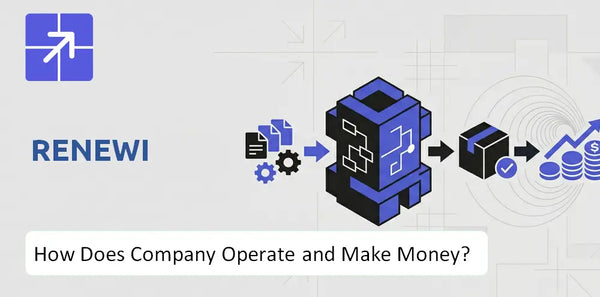
Watch processing yields and contracted commodity prices: a 1% yield change moves EBITDA materially; see Renewi BCG Matrix Analysis for product positioning.
What Does Renewi Actually Sell?
Renewi sells two linked offerings: legally compliant waste collection, sorting and treatment for businesses and municipalities, and high – quality secondary raw materials (recycled glass, paper, metals, plastics, organics). Customers pay for regulatory compliance, service logistics, and delivered recycled feedstock and circularity insights.
 Core services and products
Renewi provides inbound waste management services – collection, sorting, treatment and compliant disposal across commercial and municipal contracts – and outbound recycled commodities: glass cullet, recycled paper and cardboard, metal scrap, plastic pellets and organic compost. By 2025 it added circularity-as-a-service: closed-loop programs and carbon – avoidance reporting.
Main buyer groups
Buyers include over 150,000 commercial and municipal clients for inbound services; downstream customers include glass, paper and packaging manufacturers, metal recyclers, plastics compounders and agriculture/landscaping firms for recycled outputs. Municipal contracts and long – term corporate accounts anchor recurring revenue.
Customer value delivered
Clients receive regulatory compliance (EU landfill diversion and ESG reporting), reduced waste – handling risk, and lower – carbon feedstock; corporate clients gain measurable carbon – avoidance data and closed – loop supply for raw materials, improving sustainability KPIs and often lowering procurement costs.
Why Renewi's offering stands out
Renewi pairs large-scale collection networks with asset light commodity sales and service contracts, enabling steady service fees plus commodity revenue. Its 2025 push into circularity-as-a-service differentiates by bundling data – driven carbon avoidance and return – to – client feedstock, strengthening customer retention and expanding revenue streams; see Target Customers and Market of Renewi Company for customer segmentation.
Renewi SWOT Analysis
- Complete SWOT Breakdown
- Fully Customizable
- Editable in Excel & Word
- Professional Formatting
- Investor-Ready Format

How Does Renewi Run Its Business Day to Day?
Renewi runs daily as a reverse-manufacturing network: waste is collected across the Benelux and UK, routed to about 160 processing sites, and processed through optical sorting, mechanical separation and chemical treatment to recover saleable materials while minimizing residues.

Operating model: reverse-manufacturing logistics
Renewi business model centers on collecting heterogeneous waste streams, transporting them via thousands of specialist vehicles to local processing hubs, and converting inputs into secondary raw materials or energy products through centralized plants.
Product or service delivery: municipal and commercial waste services
Customers – municipalities and businesses – contract collection or drop-off services; recovered materials are sold to industrial buyers or used for energy-from-waste; billing mixes fixed contracts and commodity-linked prices.
Production, sourcing, development: material recovery at scale
Daily operations deploy AI-driven optical sorting, trommels, shredders, flotation and chemical treatments to increase purity yields; in 2025 AI systems raised throughput and cut manual picking hours, improving recovered commodity quality.
Sales channels and distribution: commodity and service contracts
Renewi sells recyclates and fuels to manufacturers and utilities, and secures long-term municipal contracts for collection services; spot sales adjust for commodity price swings, supporting revenue diversification.
Key assets, systems, partnerships: sites, fleets, tech
Core assets are ~160 processing sites, specialist collection fleet, AI sorting platforms and route-optimization software; strategic municipal contracts and industrial offtake agreements anchor cash flows.
What makes the model work: purity yields and logistics efficiency
Management tracks purity yields – the share converted to sellable product – plus route-optimization to reduce fuel and carbon; higher purity and optimized routing directly increase margins and lower landfill or incineration volumes.
Operational metrics in 2025 show Renewi integrating AI sorting across key sites, with fleet route-optimization reducing empty miles and contributing to targeted carbon-intensity cuts; see Growth Outlook of Renewi Company for broader context: Growth Outlook of Renewi Company
Renewi Business Model Canvas
- One-time Payment
- No Research Needed – Save Hours of Work
- Built by Experts, Trusted by Consultants
- Instant Download, Ready to Use
- 100% Editable, Fully Customizable

How Does Revenue Flow Through Renewi?
Renewi channels revenue via two linked streams: stable inbound fees from waste producers and outbound sales of recovered commodities. Demand converts to revenue through service contracts, dynamic gate fees tied to commodity prices, and commodity sales on global markets.
Inbound service fees: steady contract cash flow
Renewi business model centers on contract-based revenue from commercial and municipal customers for collection, bin rental, and gate fees; these predictable service fees cover most operating costs and underpin working capital. In 2025 Renewi reported a stable base of long-term contracts across the UK and Netherlands, supporting cash generation.
Outbound commodity sales: turning waste into products
Renewi recycling services convert sorted streams into sellable outputs – plastics, paper, metals, RDF – sold on global commodity markets. Outbound revenue is volatile but scales with processing volumes and recovery rates; in 2025 commodity sales accounted for a material share of revenue and enabled circular economy practices.
Dynamic pricing and monetization mechanics
Renewi monetizes demand via service fees, gate fees, bin rentals, and commodity sales, plus bespoke contracts with price-indexation features. In the 2025 fiscal cycle Renewi expanded dynamic pricing contracts that adjust gate fees based on recycled commodity indices to protect margins.
Primary revenue drivers: volumes, prices, contract mix
Revenue is driven most by waste volumes collected, commodity market prices, and the share of index-linked contracts; Renewi targets an EBITDA margin of 8% to 10% by using dynamic gate fees and improved recovery yields. Operational uptime and higher-value sorting (increasing yield of plastics and paper) directly lift outbound revenue.
Ownership and Control of Renewi Company
Renewi Marketing Mix
- Complete Marketing Mix Analysis
- Effortlessly Communicate Your Business Strategy
- Investor-Ready Format
- 100% Editable and Customizable
- Clear and Structured Layout

What Makes Renewi's Model Sustainable or Fragile?
Renewi's model is sustainable where regulation, scale, and feedstock contracts create a predictable demand floor for recycling and recovery, yet fragile because heavy energy use and ongoing capital intensity expose margins to electricity price spikes and investment cycles.
Regulation as a structural moat
Strict EU and national waste laws, higher carbon pricing on virgin materials, and landfill diversion targets secure baseline demand for Renewi business model services. This regulatory floor supports long-term contracts and pricing power in municipal and commercial recycling services.
Key assets that underpin operations
Renewi company profile shows dominant scale in Benelux handling nearly 14,000,000 tons annually, plus technical assets – sorting lines, washing, shredding and pelletizing plants – and long-term municipal and industrial contracts that lock-in feedstock volumes and revenue streams.
Operational dependencies and constraints
The business is a spread model: margins depend on the gap between logistics/sorting costs and commodity sale prices for recyclates and RDF. High electricity consumption for washing and pelletizing makes Renewi sensitive to energy price spikes; also, permit scarcity limits new entrants but raises political and execution risk for expansions.
How durable the model looks in 2025/2026
Professional judgment for 2025/2026: Robust with Upside. Renewi has digitized operations and shifted mix toward higher-margin recovery, improving EBITDA per tonne, yet sustained upside depends on managing capital expenditure for advanced sorting tech and hedging or controlling energy costs to protect spreads.
Key near-term facts: Renewi's 2025 operations benefit from tightened EU reuse and recycling targets and rising demand for secondary raw materials, while exposure remains to electricity price volatility and cyclic commodity values; see operational detail in Sales and Marketing Strategy of Renewi Company.
Renewi Boston Consulting Group Matrix
- Built by Experts, Trusted by Consultants
- Structured for Consultants, Students, and Founders
- 100% Editable in Microsoft Word & Excel
- Instant Digital Download – Use Immediately
- Compatible with Mac & PC – Fully Unlocked

Related Blogs
- What Is the History of Renewi Company and How Did It Evolve?
- What Is the Competitive Landscape of Renewi Company and How Does It Compete?
- What Is the Growth Outlook of Renewi Company and Where Is It Heading?
- How Does Renewi Company Reach Customers and Turn Demand into Sales?
- What Do the Mission, Vision, and Core Values of Renewi Company Reveal?
- Who Are the Core Customers in Renewi Company's Target Market?
- Who Owns Renewi Company Today and Who Holds Control?
Frequently Asked Questions
Renewi sells compliant waste collection, sorting, treatment, and secondary raw materials. Its offerings include recycled glass, paper, metals, plastics, and organics, plus circularity services such as closed-loop programs and carbon-avoidance reporting for businesses and municipalities.
Disclaimer
All information, articles, and product details provided on this website are for general informational and educational purposes only. We do not claim any ownership over, nor do we intend to infringe upon, any trademarks, copyrights, logos, brand names, or other intellectual property mentioned or depicted on this site. Such intellectual property remains the property of its respective owners, and any references here are made solely for identification or informational purposes, without implying any affiliation, endorsement, or partnership.
We make no representations or warranties, express or implied, regarding the accuracy, completeness, or suitability of any content or products presented. Nothing on this website should be construed as legal, tax, investment, financial, medical, or other professional advice. In addition, no part of this site - including articles or product references - constitutes a solicitation, recommendation, endorsement, advertisement, or offer to buy or sell any securities, franchises, or other financial instruments, particularly in jurisdictions where such activity would be unlawful.
All content is of a general nature and may not address the specific circumstances of any individual or entity. It is not a substitute for professional advice or services. Any actions you take based on the information provided here are strictly at your own risk. You accept full responsibility for any decisions or outcomes arising from your use of this website and agree to release us from any liability in connection with your use of, or reliance upon, the content or products found herein.