
How does Revolve leverage influencer-driven marketing and data to sell fashion online?
Revolve combines influencer-led promotion with fast, data-driven inventory turnover to target Millennials and Gen Z. This matters because Revolve reported strong 2025 traffic growth and higher repeat purchase rates, showing its model scales in a crowded market. Revolve BCG Matrix Analysis
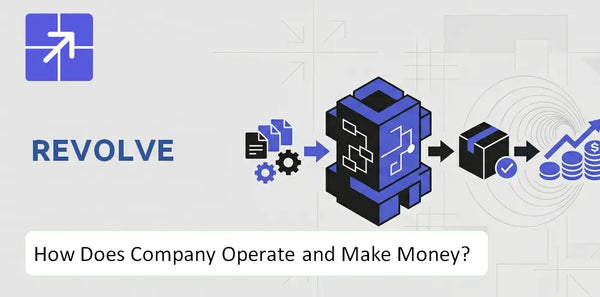
Track influencer ROI and shorten lead times: Revolve's edge is converting social engagement into sales faster than legacy retailers, reducing markdown risk and improving gross margins.
What Does Revolve Actually Sell?
Revolve sells curated fashion: apparel, footwear, accessories, beauty, plus about 20 owned brands and a catalog of over 1,000 third – party labels. Customers pay for trend-forward, camera-ready outfits and an aesthetic that signals social currency for events and digital content.
 Core assortment: fashion, beauty, owned brands
Revolve primarily retails apparel, footwear, accessories and beauty across its ecommerce platform and mobile app. Its merchandise mix pairs a curated set of >1,000 third – party brands with roughly 20 owned labels such as Lovers and Friends and GRLFRND, blending wholesale buys and direct – to – consumer brand sales.
Who buys it: social shoppers and occasion seekers
Primary customers are digitally native millennials and Gen Z shoppers seeking special – occasion, vacation and influencer – ready looks. High – engagement buyers value discovery, trends and social proof more than commodity basics.
Customer value: discovery, image and immediacy
Shoppers get curated, on – trend assortments, fast shipping and content – led discovery that shortens time from inspiration to purchase. Revolve sells not only garments but a lifestyle – helping customers create sharable looks for events and social media.
Differentiator: curated social commerce and owned labels
Revolve stands out by combining influencer marketing, event – centric merchandising and owned brands that boost margins. Its Revolve business model leans on discovery – driven merchandising and rapid assortment turnover to support premium pricing and repeat engagement.
See a deeper comparison in this article on the platform's competitive positioning: Competitive Landscape of Revolve Company
Revolve SWOT Analysis
- Complete SWOT Breakdown
- Fully Customizable
- Editable in Excel & Word
- Professional Formatting
- Investor-Ready Format

How Does Revolve Run Its Business Day to Day?
Revolve runs day-to-day on a technology-first retail engine: trend forecasting, test-and-read drops, automated inventory replenishment, and integrated marketing to convert social traffic into orders. Orders flow from site and apps through centralized fulfillment with real-time inventory, returns routing, and CRM-driven customer service.

Proprietary operating platform and test-and-read model
Revolve business model centers on a proprietary platform that ingests trend signals, sales data, and social metrics to run a daily test-and-read cycle: hundreds of new SKUs launched in small batches, real-time telemetry, then rapid scale-up for winners. This reduces markdowns and aligns assortment with demand.
Customer purchase and delivery flow
Customers buy via ecommerce site and mobile app with checkout, express shipping, and integrated returns. Fulfillment uses regional distribution centers for two-day and next-day delivery options; customer service is CRM-driven and tied to returns analytics.
Design, sourcing, and replenishment mechanics
Design teams push rapid micro – collections; sourcing mixes owned-label manufacturing and third-party brands. Automated replenishment triggers PO scale-ups when sell-through exceeds predefined thresholds, keeping inventory turns high and markdowns low.
Multi-channel sales and distribution
Main channels are direct-to-consumer ecommerce and curated wholesale partnerships; social commerce and influencer-driven drops drive immediate traffic. Logistics combine in-house DCs and third-party carriers for peak-season flexibility.
Key systems, partnerships, and assets
Critical assets include the analytics platform, fulfillment centers, and a network of over 30,000 influencers and ambassadors. Strategic brand partnerships and supplier relationships enable rapid production scaling and exclusive capsule launches.
Why the model works operationally
High-frequency testing plus automated replenishment raises inventory turns and lowers markdowns; marketing keeps acquisition costs efficient via influencer ROI tracking. One liners: fast drops reveal demand; data drives supply.
Relevant metrics: Revolve reported fiscal 2025 net revenue of $1.55 billion and maintained inventory turns near 6.0 (FY2025), reflecting the test-and-read replenishment efficiency; conversion lifts of 2 – 3x are credited to influencer campaigns. Read more on target customers here: Target Customers and Market of Revolve Company
Revolve Business Model Canvas
- One-time Payment
- No Research Needed – Save Hours of Work
- Built by Experts, Trusted by Consultants
- Instant Download, Ready to Use
- 100% Editable, Fully Customizable

How Does Revenue Flow Through Revolve?
Revenue flows primarily from direct online sales across two segments: the flagship Revolve site for contemporary fashion and FWRD for luxury. Demand converts to revenue via a high-intent base of active users, high average order values, and strong full-price sell-through driven by data-led inventory decisions.
Main revenue stream: Direct online retail sales
Revolve business model centers on e-commerce sales from Revolve and FWRD; these two sites account for the vast majority of merchandise revenue because customers buy full-price, high-AOV items. High-intent traffic of about 2.6 million active users (early 2026) funnels into checkout at an average order value near $320.
Additional revenue streams: owned brands and services
Owned brand sales expand margins since Revolve captures both wholesale and retail spreads; these internal labels deliver gross margins materially above third-party brands. Complementary revenue includes shipping, premium services, and promotional collaborations with designers and influencers.
Pricing and monetization model: retail pricing plus margin capture
Monetization is retail sale-driven: direct full-price transactions, branded merchandise margins, and limited promotional markdowns enabled by data-driven inventory (higher full-price sell-through). Revenue also benefits from limited wholesale to select partners and branded collaborations.
What drives revenue most: high-AOV buyers and inventory efficiency
Primary revenue drivers are high average order value ($320), strong full-price sell-through enabled by demand forecasting and assortment optimization, and owned-brand margin capture. Marketing and influencer strategy amplifies customer acquisition and repeat purchase rates, keeping unit economics favorable.
See a focused analysis of growth and financials in this piece: Growth Outlook of Revolve Company
Revolve Marketing Mix
- Complete Marketing Mix Analysis
- Effortlessly Communicate Your Business Strategy
- Investor-Ready Format
- 100% Editable and Customizable
- Clear and Structured Layout

What Makes Revolve's Model Sustainable or Fragile?
Revolve's model is sustainable due to high inventory turnover, elevated customer lifetime value, and a data moat that supports demand forecasting; fragility stems from dependence on social platforms and influencers and exposure to rising customer acquisition costs and discretionary spending shifts.
Superior unit economics and inventory efficiency
Revolve business model benefits from rapid inventory turnover and an average gross margin around 53 percent, which in 2025 translated into tighter working capital needs and higher cash conversion compared with many pure-play fashion rivals.
Data-driven demand forecasting and personalization
How Revolve works: proprietary customer data and predictive algorithms reduce markdown risk and optimize assortment, raising customer lifetime value (LTV) and enabling finer targeted promotions that improve marketing ROI.
Concentration on social commerce and influencer engine
Revolve marketing strategy relies heavily on Instagram and TikTok creators and the affiliate/ambassador ecosystem; changes in platform algorithms or rising CPMs push up customer acquisition cost (CAC) and stress unit economics.
Resilience outlook for 2025 – 2026
Professional judgment: Revolve remains a high-quality operator with a durable social commerce advantage, provided it scales the luxury FWRD segment and sustains owned brands versus competitors; risks include CAC inflation and consumer discretionary weakness that could compress margins and ROIC.
Key financial context: in 2025 Revolve sustained gross margin near 53 percent, LTV/CAC ratios remained favorable versus peers, and the firm reported faster inventory turns that limited markdowns; monitor CAC trends on TikTok/Instagram and FWRD revenue mix as indicators of model durability. Sales and Marketing Strategy of Revolve Company
Revolve Boston Consulting Group Matrix
- Built by Experts, Trusted by Consultants
- Structured for Consultants, Students, and Founders
- 100% Editable in Microsoft Word & Excel
- Instant Digital Download – Use Immediately
- Compatible with Mac & PC – Fully Unlocked

Related Blogs
- What Is the History of Revolve Company and How Did It Evolve?
- What Is the Competitive Landscape of Revolve Company and How Does It Compete?
- What Is the Growth Outlook of Revolve Company and Where Is It Heading?
- How Does Revolve Company Reach Customers and Turn Demand into Sales?
- What Do the Mission, Vision, and Core Values of Revolve Company Reveal?
- Who Are the Core Customers in Revolve Company's Target Market?
- Who Owns Revolve Company Today and Who Holds Control?
Frequently Asked Questions
Revolve sells curated fashion, including apparel, footwear, accessories, and beauty. It also combines a large third-party assortment with about 20 owned brands, so shoppers can find trend-forward looks and lifestyle pieces in one place.
Disclaimer
All information, articles, and product details provided on this website are for general informational and educational purposes only. We do not claim any ownership over, nor do we intend to infringe upon, any trademarks, copyrights, logos, brand names, or other intellectual property mentioned or depicted on this site. Such intellectual property remains the property of its respective owners, and any references here are made solely for identification or informational purposes, without implying any affiliation, endorsement, or partnership.
We make no representations or warranties, express or implied, regarding the accuracy, completeness, or suitability of any content or products presented. Nothing on this website should be construed as legal, tax, investment, financial, medical, or other professional advice. In addition, no part of this site - including articles or product references - constitutes a solicitation, recommendation, endorsement, advertisement, or offer to buy or sell any securities, franchises, or other financial instruments, particularly in jurisdictions where such activity would be unlawful.
All content is of a general nature and may not address the specific circumstances of any individual or entity. It is not a substitute for professional advice or services. Any actions you take based on the information provided here are strictly at your own risk. You accept full responsibility for any decisions or outcomes arising from your use of this website and agree to release us from any liability in connection with your use of, or reliance upon, the content or products found herein.