
How does Sandstorm Gold Ltd. generate returns by financing miners instead of operating mines?
Sandstorm Gold Ltd. buys precious-metal streams and royalties, converting future mine output into near-term cash flow and low fixed-cost exposure. This matters as streaming deals boosted its 2025 revenue mix amid stronger gold prices and expanded royalty portfolio.
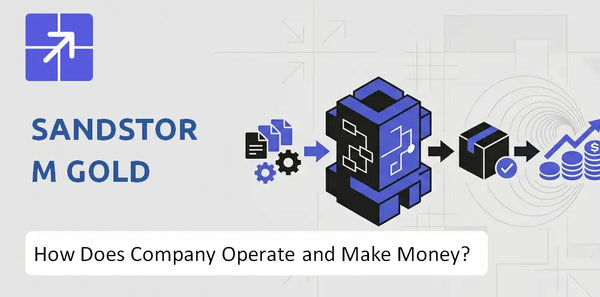
Stream and royalty payments scale with production but cap operating risk; use the Sandstorm Gold BCG Matrix Analysis to spot high-growth streams and prioritize financing targets.
What Does Sandstorm Gold Actually Sell?
Sandstorm Gold Ltd. sells specialized capital to mining companies in exchange for gold streams and royalties; customers pay upfront financing or cash for future metal offtake rights or revenue percentages, not physical mining services.
 Core offering: streams and royalties
Sandstorm Gold provides upfront, non-dilutive capital to miners in return for gold streaming agreements and precious metals royalties. A gold stream lets Sandstorm buy a set percentage of production at a fixed, heavily discounted price – typically around $400 to $500 per ounce – while a royalty pays a percentage of gross mine revenue.
Who buys the offering
Mining companies needing construction or expansion capital buy Sandstorm Gold's financing to avoid equity dilution and regular interest payments. Institutional and retail investors indirectly buy the resulting long-life cash flows by holding Sandstorm Gold stock.
Customer value: predictable, low-cost metal exposure
Miners gain flexible, non-dilutive funding and often faster project timelines; Sandstorm secures long-term, inflation-linked cash flow that scales with mine output and gold price – supporting dividend policy and growth. In 2025 Sandstorm's portfolio generated material recurring cash flow from a diversified set of streams and royalties.
Why this stands out
Sandstorm Gold's model avoids operating risk and capex cycles of miners while capturing upside from commodity prices; streaming agreements Sandstorm structures offer fixed purchase prices and revenue participation that are easier to underwrite than direct mine ownership. See the Competitive Landscape of Sandstorm Gold Company for context: Competitive Landscape of Sandstorm Gold Company
Sandstorm Gold SWOT Analysis
- Complete SWOT Breakdown
- Fully Customizable
- Editable in Excel & Word
- Professional Formatting
- Investor-Ready Format

How Does Sandstorm Gold Run Its Business Day to Day?
Sandstorm Gold runs like a compact investment firm: a ~25 – 30 person team handles deal sourcing, technical audits, and portfolio monitoring across >240 streams and royalties, focusing on capital deployment, cashflow tracking, and operator performance rather than mine-site operations.

Operating model: investment-first, not mining
Sandstorm Gold operates as a gold streaming company and precious metals royalty company: executives evaluate projects, structure streaming agreements Sandstorm uses, and fund operators in exchange for future metal deliveries or royalties. Daily work centers on due diligence, legal structuring, and cashflow forecasting tied to 240+ assets.
Product or service delivery: monetizing future production
Customers are internal stakeholders and shareholders; Sandstorm receives ounces or revenue from partner miners like Lundin Gold and Equinox Gold, converts those into cash via metal sales or hedging, and reports attributable production and revenue under its Sandstorm Gold revenue model.
Production, sourcing, and development: capital for miners
Sandstorm sources deals from junior and mid-tier miners, funding capex or development in return for a streaming agreement. Technical teams run geological reviews, reserve/ resource checks, and jurisdiction risk assessments to size streams and estimate long-term attributable production.
Sales channels and distribution: cashflow and metal management
Metal deliveries from operators feed treasury; sales are executed via spot market sales, concentrate sales, or structured contracts. Finance monitors metal price exposure and liquidity to support dividend policy and potential reinvestment into acquisitions.
Key assets, systems, and partnerships
Core assets are streaming agreements Sandstorm holds across >240 assets and partnerships with operators such as Lundin Gold and Equinox Gold. Systems include a technical audit function, portfolio monitoring dashboards, and legal/finance frameworks to manage cashflows, delivery credits, and compliance.
What makes the model work in practice
Lean staffing keeps G&A low while scale comes from a diversified portfolio: 240+ assets dilute project-level risks and smooth cashflow volatility driven by gold price movements. Rapid deal evaluation and repeatable streaming agreements let Sandstorm redeploy capital efficiently.
Daily tasks: pipeline screening, technical audits, operator performance reviews, cashflow reconciliation, and structuring new streams; investment decisions hinge on geology, jurisdiction risk, and operator track record, with finance modeling projected attributable ounces and revenue impacts for each potential deal – see further context in Target Customers and Market of Sandstorm Gold Company.
Sandstorm Gold Business Model Canvas
- One-time Payment
- No Research Needed – Save Hours of Work
- Built by Experts, Trusted by Consultants
- Instant Download, Ready to Use
- 100% Editable, Fully Customizable

How Does Revenue Flow Through Sandstorm Gold?
Revenue at Sandstorm Gold flows from contracted streams and royalties tied to partner mine production; when partners produce gold the company receives metal or cash, then sells at spot, converting demand into cash. The main streams produce predictable, low-cost ounces that turn elevated gold prices into outsized margins.
Main revenue: streamed gold sales
Under streaming agreements Sandstorm receives physical gold or cash and buys ounces at a contract price often below market. In 2025 the spot gold price stayed above $2,300 per ounce, creating a wide spread captured as gross margin.
Additional revenue: royalties and cash equivalents
Sandstorm Gold also earns revenue from royalties and occasional cash buyouts of metal; these streams add diversification and generate receipts when partner mines produce or sell concentrate.
Pricing and monetization: immediate sale at spot
Sandstorm monetizes by selling received ounces at prevailing market prices and booking the difference versus the contractual purchase price; since it does not pay operating mine costs, cash cost per ounce stays low and margins are stable.
Primary revenue drivers: production and gold price
Revenue scales with partner mine output and the gold price; higher production or a sustained price above $2,300 per ounce increases the spread and free cash flow conversion, historically exceeding 80% of revenue to free cash flow on streaming ounces.
Key mechanics: partner mines produce, Sandstorm receives ounces or cash, buys at contract price, immediately sells at spot, and records the spread; see portfolio effects and valuation in the article Growth Outlook of Sandstorm Gold Company
Sandstorm Gold Marketing Mix
- Complete Marketing Mix Analysis
- Effortlessly Communicate Your Business Strategy
- Investor-Ready Format
- 100% Editable and Customizable
- Clear and Structured Layout

What Makes Sandstorm Gold's Model Sustainable or Fragile?
Sandstorm Gold Ltd.'s model is sustainable via a fixed-cost streaming structure and broad asset diversification, but fragile because it depends entirely on third-party mine operators and emerging-market geopolitics. Structural strengths include high-margin cash flow and low operating leverage; key risks are operator disruptions, strikes, and expropriations.
Fixed-cost, high-margin advantage
Sandstorm Gold operates as a gold streaming company that pays upfront capital for future production, creating a fixed-cost revenue stream with minimal operating expenses; this yields high incremental margins as the gold price rises, benefiting cash flow and free cash flow conversion.
Massive portfolio diversification
With a portfolio of streams and royalties across dozens of mines, Sandstorm Gold's exposure is spread so no single mine failure materially impairs company-level production; attributable production for fiscal 2025 is forecast at ~80,000 – 100,000 gold equivalent ounces, entering a harvesting phase that enables debt paydown and potential dividend increases.
Reliance on third-party operators
Sandstorm Gold's revenue model depends on streaming agreements Sandstorm signs with mine operators; if an operator has a strike, wall failure, or political expropriation, Sandstorm has no operational control and must wait for remediation, creating concentrated counterparty and operational risk despite portfolio breadth.
Durability in 2025 – 2026: robust but exposed
My view for 2025/2026 is that the model is exceptionally robust: high-margin streaming economics and inflationary tailwinds protect real margins, and projected 80,000 – 100,000 GEOs support aggressive debt reduction and dividend optionality. Still, the model remains sensitive to geopolitical stability in emerging markets where several large growth assets are located; investors should weigh this when evaluating Sandstorm Gold stock 2026 outlook and cash flow and dividend policy.
See further context on ownership and governance in this related piece: Ownership and Control of Sandstorm Gold Company
Sandstorm Gold Boston Consulting Group Matrix
- Built by Experts, Trusted by Consultants
- Structured for Consultants, Students, and Founders
- 100% Editable in Microsoft Word & Excel
- Instant Digital Download – Use Immediately
- Compatible with Mac & PC – Fully Unlocked

Related Blogs
- What Is the History of Sandstorm Gold Company and How Did It Evolve?
- What Is the Competitive Landscape of Sandstorm Gold Company and How Does It Compete?
- What Is the Growth Outlook of Sandstorm Gold Company and Where Is It Heading?
- How Does Sandstorm Gold Company Reach Customers and Turn Demand into Sales?
- What Do the Mission, Vision, and Core Values of Sandstorm Gold Company Reveal?
- Who Are the Core Customers in Sandstorm Gold Company's Target Market?
- Who Owns Sandstorm Gold Company Today and Who Holds Control?
Frequently Asked Questions
Sandstorm Gold sells upfront capital to mining companies in exchange for gold streams and royalties. In practice, miners receive non-dilutive financing, and Sandstorm gets the right to buy a portion of future production at a fixed discounted price or receive a percentage of gross revenue.
Disclaimer
All information, articles, and product details provided on this website are for general informational and educational purposes only. We do not claim any ownership over, nor do we intend to infringe upon, any trademarks, copyrights, logos, brand names, or other intellectual property mentioned or depicted on this site. Such intellectual property remains the property of its respective owners, and any references here are made solely for identification or informational purposes, without implying any affiliation, endorsement, or partnership.
We make no representations or warranties, express or implied, regarding the accuracy, completeness, or suitability of any content or products presented. Nothing on this website should be construed as legal, tax, investment, financial, medical, or other professional advice. In addition, no part of this site - including articles or product references - constitutes a solicitation, recommendation, endorsement, advertisement, or offer to buy or sell any securities, franchises, or other financial instruments, particularly in jurisdictions where such activity would be unlawful.
All content is of a general nature and may not address the specific circumstances of any individual or entity. It is not a substitute for professional advice or services. Any actions you take based on the information provided here are strictly at your own risk. You accept full responsibility for any decisions or outcomes arising from your use of this website and agree to release us from any liability in connection with your use of, or reliance upon, the content or products found herein.