
How does Schlote Company make money by machining complex metal parts for automakers?
Schlote Company produces high-precision metal components for the global auto supply chain, selling to OEMs and tier-1 suppliers under long-term contracts. This matters because in 2025 the shift to EVs forces retooling; Schlote's margin hinges on winning specialized EV component work and maintaining capacity utilization.
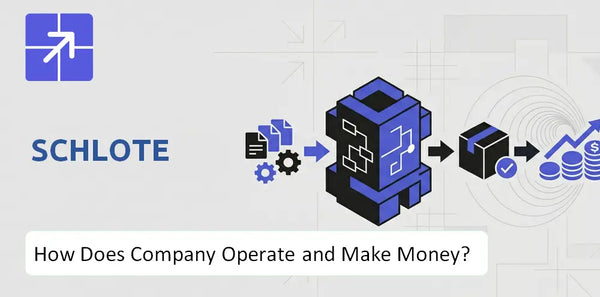
Focus on process automation, tight cost control, and contract tenure to preserve margins; see product positioning in the Schlote BCG Matrix Analysis.
What Does Schlote Actually Sell?
Schlote Company sells finished precision metal components and high-end machining services for engines, transmissions, chassis, and EV drivetrains; customers pay for zero-defect, micrometer-tolerance finishing and scalable volume conversion of raw castings into ready-to-assemble parts.
 Core product lines: precision powertrain and chassis components
Schlote Company manufactures cylinder heads, gearbox housings, axle supports, bearing shells and mounting brackets, plus lightweight aluminum motor frames and battery-housing components for EVs; revenue mix shifted in 2025 with ~18% of sales from EV-related aluminum parts.
Main customers: Tier 1s and OEMs
Primary buyers are Tier 1 suppliers and original equipment manufacturers in passenger cars, commercial vehicles, and electric-vehicle programs; contracts are long-term, with batch sizes from prototype runs to annual volumes exceeding 500,000 units for select parts.
Customer value: zero-defect, scale, and engineering support
Buyers pay for defect-free scalability, micrometer-level tolerances, tight traceability, and in-house metrology; this reduces OEM rework, line stoppages, and warranty exposure – Schlote reports typical first-pass yield above 99.2% on key lines in 2025.
Differentiators: process control and lightweighting capability
Schlote GmbH combines advanced CNC machining, automated quality inspection, and materials know-how to deliver consistent tolerances and rapid ramp-up; its pivot to alu – EV components and integrated finishing shortens supplier chains and supports OEM weight-reduction targets.
For context on market positioning and partnerships, see Competitive Landscape of Schlote Company.
Schlote SWOT Analysis
- Complete SWOT Breakdown
- Fully Customizable
- Editable in Excel & Word
- Professional Formatting
- Investor-Ready Format

How Does Schlote Run Its Business Day to Day?
Schlote Company runs day-to-day on automated, 24/7 production lines in Germany, the Czech Republic, and China, using just-in-time delivery tied to automaker assembly schedules. Core systems include CNC machining, industrial robotics, and integrated ERP/MES for order, inventory, and delivery synchronization.

Operating model: synchronous, supplier-integrated production
Schlote GmbH operates as a tiered automotive supplier with lines synchronized to client assembly slots. Daily workflows prioritize takt-time adherence, cycle-time monitoring, and cross-site capacity balancing to meet just-in-time commitments.
Product delivery: JIT flow into OEM assembly
Customers receive parts via scheduled shipments aligned with assembly sequences; logistics teams manage sequenced containers and milk-run routes. This makes Schlote automotive supplier deliveries reliably timed and low-inventory for automakers.
Production & development: prototype-to-mass pull
Daily operations mix CNC machining centers and robotic cells; R&D and production engineering collaborate on prototypes to tune tooling and cycle times. Once validated, lines run continuous production – minimizing changeover and boosting yield.
Sales & distribution: OEM contracts and sequenced logistics
Schlote products ship primarily under OEM contracts with scheduled call-offs; aftermarket and service parts follow distributor routes. Sales teams manage long-term supplier relationships and contract KPIs like delivery performance (% on-time) and defect rates (PPM).
Key assets & partnerships: automation, sites, and OEM ties
Key assets are high-precision CNC lines, industrial robots, ERP/MES integration, and three principal production sites in Germany, the Czech Republic, and China. Strong OEM contracts and co-development partnerships make Schlote supplier relationships with automakers strategically sticky.
What makes it work: technical integration and scale
Technical integration during prototyping, calibrated production lines, and continuous monitoring create high switching costs for clients. Operational KPIs – uptime, takt time, and PPM quality – are tracked daily to keep lines profitable and reliable; this is why Schlote company becomes hard to replace.
Read more on market positioning and customer segments here: Target Customers and Market of Schlote Company
Schlote Business Model Canvas
- One-time Payment
- No Research Needed – Save Hours of Work
- Built by Experts, Trusted by Consultants
- Instant Download, Ready to Use
- 100% Editable, Fully Customizable

How Does Revenue Flow Through Schlote?
Revenue at Schlote Company flows mainly from multi-year supply agreements with automakers; sales scale with unit volumes as vehicle production runs progress, and indexed pricing helps protect margins against raw material and energy cost swings.
Main revenue from long-term OEM contracts
Schlote GmbH earns most revenue via long-term, model-specific supply agreements where unit volume drives cash inflows; series production spreads initial machinery capex across millions of units, lowering per-unit costs.
Additional revenue: EV components and services
About 38 percent of new contract wins in the current cycle are for electric vehicle platforms and non-combustion components, while aftermarket parts, engineering services, and tooling rental add secondary income.
Pricing and monetization: indexed, volume-driven pricing
Schlote company increasingly uses indexed pricing tied to steel, copper, and energy indices for 2025/2026 contracts; monetization hinges on high-volume series production and amortizing upfront capital over large unit counts.
Primary revenue drivers: unit volume and contract mix
Revenue is driven most by OEM production volumes and contract mix (ICE vs EV). Higher volumes and EV-related wins lift revenue growth; indexed pricing and diversified product mix protect margins and reduce commodity exposure.
For deeper context on ownership and strategic control affecting contract wins and investment decisions, see Ownership and Control of Schlote Company
Schlote Marketing Mix
- Complete Marketing Mix Analysis
- Effortlessly Communicate Your Business Strategy
- Investor-Ready Format
- 100% Editable and Customizable
- Clear and Structured Layout

What Makes Schlote's Model Sustainable or Fragile?
Schlote company's model is sustainable where its pivot to e-mobility and technical precision create high-margin niches, yet fragile because of capital intensity and exposure to cyclical auto production. Structural strengths include proprietary manufacturing processes and global footprint; risks center on debt-funded EV-capex and demand volatility in Europe.
Core Strength: E-mobility pivot and technical moat
Schlote GmbH has shifted capacity toward electric vehicle components, winning lightweighting contracts that command higher margins; precision stamping and bearing shells capabilities are hard for mid-tier rivals to replicate. This niche protects pricing power and supports exporter volumes across European and non-European OEMs.
Key Assets or Capabilities: Scale, know-how, and sites
Schlote company leverages long-tenured engineering teams, certified quality systems, and multiple production sites in Europe and Asia to supply engine bearings and plain bearings as well as EV drivetrain parts. Strong OEM relationships and tooling assets create a technical and contractual moat that sustains revenue during supplier consolidation.
Dependencies or Constraints: Capital intensity and cyclical demand
The Schlote automotive supplier model depends on high capacity utilization and large, lumpy capex for EV tooling; management must service debt raised in 2025 – 2026 to upgrade facilities. Concentration in European OEM demand and supplier pricing pressure amplify downside when global auto production softens.
Durability Assessment in 2025/2026: Cautiously optimistic survival
Professional judgment for 2025/2026 is cautiously optimistic: Schlote Company will likely survive consolidation if it keeps capacity utilization above 82 percent and continues to win high-margin lightweighting contracts. As of March 2026, balance-sheet pressure from capex-linked debt and fluctuating European auto volumes make the model exposed if utilization slips below breakeven thresholds.
Mission, Vision, and Values of Schlote Company
Schlote Boston Consulting Group Matrix
- Built by Experts, Trusted by Consultants
- Structured for Consultants, Students, and Founders
- 100% Editable in Microsoft Word & Excel
- Instant Digital Download – Use Immediately
- Compatible with Mac & PC – Fully Unlocked

Related Blogs
- What Is the History of Schlote Company and How Did It Evolve?
- What Is the Competitive Landscape of Schlote Company and How Does It Compete?
- What Is the Growth Outlook of Schlote Company and Where Is It Heading?
- How Does Schlote Company Reach Customers and Turn Demand into Sales?
- What Do the Mission, Vision, and Core Values of Schlote Company Reveal?
- Who Are the Core Customers in Schlote Company's Target Market?
- Who Owns Schlote Company Today and Who Holds Control?
Frequently Asked Questions
Schlote sells finished precision metal components and high-end machining services for engines, transmissions, chassis, and EV drivetrains. The company turns raw castings into ready-to-assemble parts, with customers paying for zero-defect finishing, micrometer tolerances, and scalable production support.
Disclaimer
All information, articles, and product details provided on this website are for general informational and educational purposes only. We do not claim any ownership over, nor do we intend to infringe upon, any trademarks, copyrights, logos, brand names, or other intellectual property mentioned or depicted on this site. Such intellectual property remains the property of its respective owners, and any references here are made solely for identification or informational purposes, without implying any affiliation, endorsement, or partnership.
We make no representations or warranties, express or implied, regarding the accuracy, completeness, or suitability of any content or products presented. Nothing on this website should be construed as legal, tax, investment, financial, medical, or other professional advice. In addition, no part of this site - including articles or product references - constitutes a solicitation, recommendation, endorsement, advertisement, or offer to buy or sell any securities, franchises, or other financial instruments, particularly in jurisdictions where such activity would be unlawful.
All content is of a general nature and may not address the specific circumstances of any individual or entity. It is not a substitute for professional advice or services. Any actions you take based on the information provided here are strictly at your own risk. You accept full responsibility for any decisions or outcomes arising from your use of this website and agree to release us from any liability in connection with your use of, or reliance upon, the content or products found herein.