
How does Semtech Corporation connect sensors to cloud services and monetize its analog-to-digital solutions?
Semtech Corporation supplies long-range, low-power connectivity and protection ICs that let sensors and infrastructure send data efficiently. This matters because IoT device shipments and LoRaWAN network growth drove Semtech revenue signals in 2025, tying its fortunes to cloud and AI edge buildout. Semtech BCG Matrix Analysis
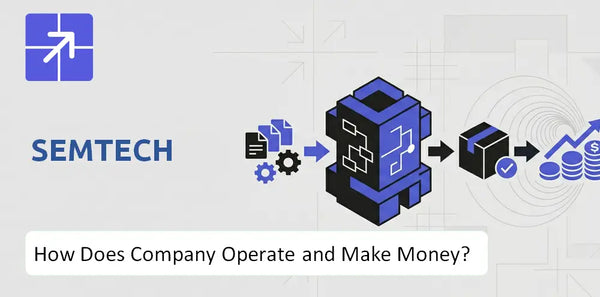
Semtech earns through IC sales, licensing, and ecosystem partnerships; watch component ASPs and LoRa alliance deployments as near-term demand indicators.
What Does Semtech Actually Sell?
Semtech Corporation sells analog and mixed-signal semiconductors, LoRa-based long-range IoT systems, optical data-link components for data centers, circuit protection devices, and cellular routers/modules plus a Device-to-Cloud management platform via Sierra Wireless. Customers pay for low-power long-range connectivity, high-speed optical interconnects, surge protection, and turnkey cellular IoT connectivity and management.
 Core product lines and platforms
Semtech Corporation sells LoRa transceivers and gateways, LoRaWAN network server licensing and royalties, optical components (laser drivers, transimpedance amplifiers) for 800G/1.6T links, TVS and surge protection diodes, plus Sierra Wireless cellular routers, modules, and a cloud Device-to-Cloud platform.
Primary buyers and channels
Buyers include smart-city and utilities integrators, industrial IoT customers, telecom and hyperscale data-center OEMs, smartphone/automotive electronics manufacturers, and enterprise M2M customers procuring cellular connectivity and cloud management. Semtech sells direct, through distributors, and via licensing partners.
Customer value and measurable benefits
Customers get multi-mile, battery-friendly connectivity from Semtech LoRa technology, lower total cost of ownership for IoT deployments, 800G/1.6T-ready optical PHY components for high-throughput links, and protection that reduces warranty costs. Sierra Wireless integration offers end-to-end cellular connectivity and remote device management, accelerating time-to-deploy.
Why Semtech's offering stands out
Semtech Corporation differentiates via proprietary Semtech LoRa technology and a royalty/licensing model that generated recurring revenue; in fiscal 2025 LoRa-related royalties and licensing remained a key margin driver. Their optical and analog products target high-growth 800G/1.6T markets, while Sierra Wireless expands subscription-style connectivity services – combining silicon sales, royalties, and device/cloud services.
For buyer segmentation and market context see Target Customers and Market of Semtech Company
Semtech SWOT Analysis
- Complete SWOT Breakdown
- Fully Customizable
- Editable in Excel & Word
- Professional Formatting
- Investor-Ready Format

How Does Semtech Run Its Business Day to Day?
Semtech Corporation runs daily as a fabless semiconductor designer that focuses on chip design, engineering, and global sales while outsourcing wafer fabrication; operations center on design-wins, supply-chain management for IoT modules, and scaling the LoRaWAN ecosystem through partnerships and standards work.

Operating model: design-led, fabless execution
Semtech Corporation uses a design-win model where engineering teams embed analog, mixed-signal, and RF chips early in OEM product roadmaps; once integrated, chips typically remain through the product lifecycle, creating predictable multiyear revenue streams tied to customer production volumes.
Product delivery: chips, modules, and licensed IP
Customers access Semtech semiconductor products via direct OEM engagements, authorized distributors, and module partners; Semtech also licenses LoRa IP and gains royalty income as device makers ship LoRaWAN-enabled products.
Production and sourcing: outsourced wafer fabrication
Semtech outsources wafer manufacturing to third-party foundries and concentrates internal resources on design, verification, and packaging; procurement teams manage global sourcing for IoT modules and components to mitigate raw-material and lead-time risk.
Sales channels: OEMs, distributors, and ecosystem partners
Revenue flows through direct OEM contracts, electronic component distributors, module vendors, and royalties from licensed LoRa technology; field sales and applications engineers drive design-wins that convert to multi-year supply agreements.
Key assets and partnerships: LoRa Alliance and foundry network
Semtech's core assets are its analog and mixed-signal IP, LoRa physical-layer technology, and relationships with >500-member LoRa Alliance partners; strategic foundry and packaging agreements reduce capital intensity while enabling scale.
Operational levers that make it work
The model scales because design-wins lock in long tail product revenue, outsourcing cuts fixed capital, and ecosystem-driven standards adoption (LoRaWAN) expands addressable market; Semtech reported in fiscal 2025 that IoT & infrastructure continued to drive recurring revenue and royalty streams, supporting margin stability.
For practical sales and marketing mechanics tied to these day-to-day operations, see Sales and Marketing Strategy of Semtech Company
Semtech Business Model Canvas
- One-time Payment
- No Research Needed – Save Hours of Work
- Built by Experts, Trusted by Consultants
- Instant Download, Ready to Use
- 100% Editable, Fully Customizable

How Does Revenue Flow Through Semtech?
Revenue flows into Semtech Corporation mainly from semiconductor and IoT hardware sales, plus growing subscription and service fees; product orders convert to revenue via distribution and direct channels while cloud and connectivity subscriptions add recurring income.
Signal Integrity and Protection Product Sales
About 75% of 2025 revenue comes from product sales across Signal Integrity, Protection, and IoT segments; Signal Integrity components – sold into hyperscale data centers – are the highest-margin, fastest-growing line driving per-unit revenue increases.
IoT System Solutions and Connectivity Services
Semtech IoT solutions sell cellular gateways, modules, and LoRa-based devices; hardware sales are complemented by cloud-based connectivity subscriptions that generate high-margin, per-device recurring fees reported as an expanding slice of revenue in 2025.
Hybrid Pricing and Monetization Model
Monetization mixes high-volume distribution for standardized protection chips and direct sales for specialized AI optical and IoT infrastructure; recurring monetization includes per-device subscriptions and licensing fees for wireless protocols like LoRaWAN.
Primary Revenue Drivers and Dynamics
Revenue is driven most by hyperscale data center demand for Signal Integrity parts, volume sales of protection semiconductors, and accelerating subscription revenue from IoT connectivity; supply-chain execution and partnerships expand market reach and pricing power. See Competitive Landscape of Semtech Company for ecosystem context: Competitive Landscape of Semtech Company
Semtech Marketing Mix
- Complete Marketing Mix Analysis
- Effortlessly Communicate Your Business Strategy
- Investor-Ready Format
- 100% Editable and Customizable
- Clear and Structured Layout

What Makes Semtech's Model Sustainable or Fragile?
Semtech Corporation's model leans on dominant LoRa intellectual property and a key role in AI optical interconnects, giving high switching costs and first – mover advantages; but heavy Sierra Wireless acquisition debt created fragility until aggressive deleveraging in 2024 – 2025. Structural strengths include royalty and licensing income plus 800G optics demand; risks are semiconductor cyclicality and low – cost cellular IoT competition.
IP dominance in long – range, low – power connectivity
Semtech LoRa technology gives the company a protected moat: patents and the LoRaWAN ecosystem drive recurring royalty income and high switching costs for device makers and network operators.
Strategic position in AI optical networking
Semtech semiconductor products sit in the AI data – center interconnect cycle; demand for 800G optical modules pushed revenue in 2025, supporting higher ASPs and OEM design wins.
Debt and integration constraints
The Sierra Wireless acquisition raised leverage materially; Semtech reduced net debt aggressively through 2024 – 2025, but lingering covenant and cash – flow sensitivity constrain capital allocation and M&A flexibility.
Resilience outlook for 2025 – 2026
Professional judgment: the business looks more resilient in 2025 due to recovering industrial IoT spend and booming AI interconnect demand; still exposed to semiconductor cycles and lower – cost cellular IoT competitors that can pressure margins and market share.
Key metrics: Semtech reported improving gross margins in 2025 driven by optics and licensing growth; management disclosed substantial deleveraging with net debt reduced relative to 2023 levels and interest expense trending down. Monitor royalty run – rate from LoRaWAN, 800G design – win cadence, and incremental free cash flow conversion to judge sustainability. See further corporate context in Mission, Vision, and Values of Semtech Company
Semtech Boston Consulting Group Matrix
- Built by Experts, Trusted by Consultants
- Structured for Consultants, Students, and Founders
- 100% Editable in Microsoft Word & Excel
- Instant Digital Download – Use Immediately
- Compatible with Mac & PC – Fully Unlocked

Related Blogs
- What Is the History of Semtech Company and How Did It Evolve?
- What Is the Competitive Landscape of Semtech Company and How Does It Compete?
- What Is the Growth Outlook of Semtech Company and Where Is It Heading?
- How Does Semtech Company Reach Customers and Turn Demand into Sales?
- What Do the Mission, Vision, and Core Values of Semtech Company Reveal?
- Who Are the Core Customers in Semtech Company's Target Market?
- Who Owns Semtech Company Today and Who Holds Control?
Frequently Asked Questions
Semtech sells analog and mixed-signal semiconductors, LoRa-based IoT systems, optical data-link components, circuit protection devices, and Sierra Wireless cellular routers, modules, and cloud management tools. The company's offering is built around low-power connectivity, high-speed interconnects, protection, and turnkey cellular IoT services.
Disclaimer
All information, articles, and product details provided on this website are for general informational and educational purposes only. We do not claim any ownership over, nor do we intend to infringe upon, any trademarks, copyrights, logos, brand names, or other intellectual property mentioned or depicted on this site. Such intellectual property remains the property of its respective owners, and any references here are made solely for identification or informational purposes, without implying any affiliation, endorsement, or partnership.
We make no representations or warranties, express or implied, regarding the accuracy, completeness, or suitability of any content or products presented. Nothing on this website should be construed as legal, tax, investment, financial, medical, or other professional advice. In addition, no part of this site - including articles or product references - constitutes a solicitation, recommendation, endorsement, advertisement, or offer to buy or sell any securities, franchises, or other financial instruments, particularly in jurisdictions where such activity would be unlawful.
All content is of a general nature and may not address the specific circumstances of any individual or entity. It is not a substitute for professional advice or services. Any actions you take based on the information provided here are strictly at your own risk. You accept full responsibility for any decisions or outcomes arising from your use of this website and agree to release us from any liability in connection with your use of, or reliance upon, the content or products found herein.