
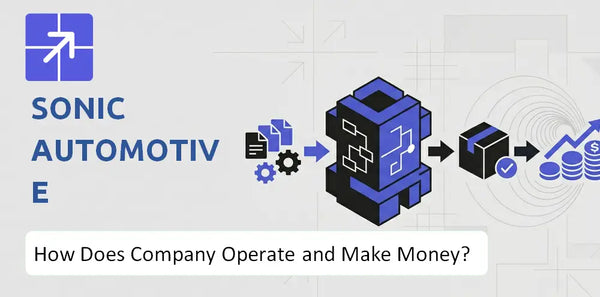
How does Sonic Automotive operate across franchised dealerships and EchoPark to generate revenue?
Sonic Automotive sells and services new and used cars through franchised dealerships and EchoPark, plus financing and parts services. This mix matters because EchoPark reduced used-inventory days in 2025, signaling better margin recovery amid higher rates. Sonic Automotive BCG Matrix Analysis
Sonic's service and parts profit share cushions retail cyclicality; in 2025 fixed-ops margins improved, showing resilience. Focus on accelerating digital lead conversion to cut hold times and boost used-vehicle margins.
What Does Sonic Automotive Actually Sell?
Sonic Automotive sells vehicles, vehicle care, and financial protections: new and used cars and light trucks, maintenance and collision services, and finance & insurance products that bundle lending, warranties, and protection plans. Customers pay for acquisition, convenience, and lifetime upkeep via a franchised dealership network and omnichannel platforms.
 Vehicle sales: new and used inventory
Sonic Automotive sells new cars from brands including BMW, Mercedes-Benz, Honda, and Toyota alongside a large used-vehicle portfolio. Revenue drivers include retail vehicle margins and wholesale disposition; in fiscal 2025 Sonic Automotive reported that vehicle sales remained the largest share of total revenue.
Fixed operations: service, parts, collision
Fixed operations deliver routine maintenance, OEM parts, and collision repair across dealership service bays and independent collision centers. In 2025 fixed operations produced recurring revenue with higher margins than retail vehicle sales and contributed materially to Sonic Automotive operations profitability.
Finance & Insurance (F&I) products
Sonic Automotive sells third-party financing, extended warranties, GAP and protection plans through dealer finance and insurance services. F&I is a high-margin revenue stream that improves per-vehicle profitability and customer retention.
Who buys it
Buyers include retail consumers seeking new or used cars, fleet and commercial customers, and owners needing service or collision repairs. Repeat service customers and finance product buyers drive Sonic Automotive business model stickiness; see Target Customers and Market of Sonic Automotive Company for customer segmentation detail.
What value customers get
Customers get a one-stop-shop for buying, financing, and maintaining vehicles, with guaranteed OEM parts, certified pre-owned options, and bundled protection plans that reduce ownership risk. This convenience supports higher lifetime value and loyalty.
Why the offering stands out
Sonic Automotive differentiates through a diversified brand mix, scale in fixed operations, and integrated F&I offerings across its franchised dealership group. Its omnichannel sales approach and reconditioning capabilities optimize used car margins and speed inventory turnover, which is central to how Sonic Automotive makes money and its revenue breakdown by segment in 2025.
Sonic Automotive SWOT Analysis
- Complete SWOT Breakdown
- Fully Customizable
- Editable in Excel & Word
- Professional Formatting
- Investor-Ready Format

How Does Sonic Automotive Run Its Business Day to Day?
Sonic Automotive runs daily through two operating pillars: franchised dealerships for new cars and service, and EchoPark for high-volume, nearly new used cars. Inventory turns fast using data-driven pricing, omnichannel lead flow, and centralized F&I and service operations to convert online interest into showroom delivery.

Operating model split: franchised retail and EchoPark
Daily operations balance a franchised dealership network that sources new-vehicle allocations and captures high-margin warranty work with EchoPark's low-unit-margin, high-volume pre-owned model. Managers use local market feeds and centralized analytics to set prices and allocate inventory across stores.
Customer delivery flow and omnichannel sales
Most customer journeys start online via the company's digital platform, move to appointmented showroom inspections, and finish with finance and insurance (F&I) processing and vehicle delivery. Dealers complete paperwork and service scheduling in-store; EchoPark emphasizes rapid pickup after reconditioning.
Vehicle sourcing, reconditioning, and inventory velocity
Franchised stores receive new-vehicle allocations from automakers and source used cars from trades and wholesalers; EchoPark focuses on trade-ins and off-lease nearly new units. Daily reconditioning throughput and turn-time targets drive throughput – EchoPark aims for rapid reconditioning to keep days-to-turn low.
Sales channels and distribution systems
Primary channels are franchised showroom sales, EchoPark retail lots, online fixed-price listings, and wholesale auctions. Dealer finance and insurance services (F&I) plus fixed-ops service bays provide recurring revenue beyond vehicle margins.
Key assets, systems, and partnerships
Core assets include franchise rights, EchoPark retail footprint, service facilities, and a centralized CRM and pricing engine that ingests market data. Manufacturer relationships secure allocations; wholesale partners and auctions feed used-inventory supply.
What makes the model work in practice
High-velocity inventory turnover, tight integration of online leads into physical sales, and diversified automotive retail revenue streams (new vehicles, used retail, wholesale, F&I, and fixed operations) drive margins. In fiscal 2025 Sonic Automotive reported $14.2 billion in total revenue with EchoPark and franchised operations contributing to a mixed-margin profile, and management targeting days-to-turn reductions to lift gross profit per unit.
Read more on company history: History and Background of Sonic Automotive Company
Sonic Automotive Business Model Canvas
- One-time Payment
- No Research Needed – Save Hours of Work
- Built by Experts, Trusted by Consultants
- Instant Download, Ready to Use
- 100% Editable, Fully Customizable

How Does Revenue Flow Through Sonic Automotive?
Sonic Automotive channels revenue mainly through vehicle sales, fixed operations (parts and service), and finance & insurance (F&I) commissions; demand converts to cash via retail/wholesale transactions, repeat service visits, and per-vehicle F&I income.
Vehicle Sales: Volume Drives Top Line
New and used vehicle retail sales generate roughly 80 percent of Sonic Automotive total revenue in 2025, sourcing inventory through manufacturer allocations, trade-ins, auctions, and wholesale lanes; price competition compresses gross margins to low single-digit levels, so scale matters.
Fixed Operations and Parts: Margin Engine
Parts and Service account for about 12 – 15 percent of revenue but represent nearly 50 percent of Sonic Automotive gross profit due to higher margins, recurring service demand, and captive customer lifetime value from franchised dealership group service bays and certified technicians.
F&I and Aftermarket: High-Margin Per-Vehicle Income
Dealer finance and insurance services produce near-pure margin; in fiscal 2025 Sonic Automotive targets F&I income of approximately 2,400 to 2,600 dollars per vehicle, creating steady cash flow even when unit volumes swing.
What Most Strongly Drives Revenue
Revenue is driven by unit sales volume and per-unit F&I take rates, plus fixed operations utilization; margins hinge on service penetration rates, parts gross margins, and finance commission capture across Sonic Automotive operations.
For strategic context on corporate priorities and culture that support these revenue streams, see Mission, Vision, and Values of Sonic Automotive Company
Sonic Automotive Marketing Mix
- Complete Marketing Mix Analysis
- Effortlessly Communicate Your Business Strategy
- Investor-Ready Format
- 100% Editable and Customizable
- Clear and Structured Layout

What Makes Sonic Automotive's Model Sustainable or Fragile?
Sonic Automotive's model is sustained by steady Fixed Operations revenue and a diversified franchised dealership mix, but it is fragile to interest rate swings, F&I concentration, and used-car price volatility. Structural strengths include service margins and scale; risks center on floorplan costs, consumer credit, and EchoPark's used-car spread.
Fixed Operations as a Cushion
Service, parts, and maintenance (fixed operations) delivered about 35 – 38% of Sonic Automotive's gross profit mix in recent years, providing recurring cash even when new-vehicle sales slow. This revenue stream is less cyclical and supports margins during downturns.
Scale, Franchises, and Omnichannel Reach
Sonic Automotive leverages a nationwide network of franchised dealerships and an expanding omnichannel sales approach, increasing inventory velocity and reducing per-unit overhead. Brand relationships and centralized reconditioning lower used-car turn times and costs.
Interest-Rate and Floorplan Exposure
Higher interest rates raise floorplan interest expense and depress consumer financing demand; Sonic Automotive reported floorplan interest that materially affected EBIT in prior rate cycles. Dependence on dealer finance and insurance services (F&I) concentrates earnings and raises regulatory risk.
Durability Assessment for 2025/2026
As of early 2026, Sonic Automotive appears resilient: diversified franchise mix, EchoPark scale, and improved digital efficiency support cautious optimism. Still, heavy reliance on F&I profit and sensitivity to used-car spreads mean the model is exposed if credit tightens or EchoPark acquisition costs widen.
EchoPark's margin swing is pivotal: keep acquisition-to-retail spreads positive and disciplined inventory management limits markdowns; otherwise floorplan costs and tighter consumer credit can erode earnings quickly. See Growth Outlook of Sonic Automotive Company for context: Growth Outlook of Sonic Automotive Company
Sonic Automotive Boston Consulting Group Matrix
- Built by Experts, Trusted by Consultants
- Structured for Consultants, Students, and Founders
- 100% Editable in Microsoft Word & Excel
- Instant Digital Download – Use Immediately
- Compatible with Mac & PC – Fully Unlocked

Related Blogs
- What Is the History of Sonic Automotive Company and How Did It Evolve?
- What Is the Competitive Landscape of Sonic Automotive Company and How Does It Compete?
- What Is the Growth Outlook of Sonic Automotive Company and Where Is It Heading?
- How Does Sonic Automotive Company Reach Customers and Turn Demand into Sales?
- What Do the Mission, Vision, and Core Values of Sonic Automotive Company Reveal?
- Who Are the Core Customers in Sonic Automotive Company's Target Market?
- Who Owns Sonic Automotive Company Today and Who Holds Control?
Frequently Asked Questions
Sonic Automotive sells new and used vehicles, service and collision repair, and finance and insurance products. The company combines vehicle sales with fixed operations and F&I offerings to create revenue from both the initial purchase and the long-term ownership experience.
Disclaimer
All information, articles, and product details provided on this website are for general informational and educational purposes only. We do not claim any ownership over, nor do we intend to infringe upon, any trademarks, copyrights, logos, brand names, or other intellectual property mentioned or depicted on this site. Such intellectual property remains the property of its respective owners, and any references here are made solely for identification or informational purposes, without implying any affiliation, endorsement, or partnership.
We make no representations or warranties, express or implied, regarding the accuracy, completeness, or suitability of any content or products presented. Nothing on this website should be construed as legal, tax, investment, financial, medical, or other professional advice. In addition, no part of this site - including articles or product references - constitutes a solicitation, recommendation, endorsement, advertisement, or offer to buy or sell any securities, franchises, or other financial instruments, particularly in jurisdictions where such activity would be unlawful.
All content is of a general nature and may not address the specific circumstances of any individual or entity. It is not a substitute for professional advice or services. Any actions you take based on the information provided here are strictly at your own risk. You accept full responsibility for any decisions or outcomes arising from your use of this website and agree to release us from any liability in connection with your use of, or reliance upon, the content or products found herein.