
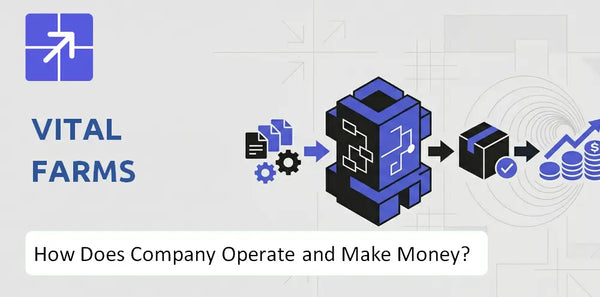
How does Vital Farms work as a capital-light orchestrator between ethical farmers and retailers?
Vital Farms licenses brand, manages supply chain, and markets pasture-raised eggs and butter while farmers handle production. This model matters because it supported over 20% annual growth into 2025 and preserved pricing power amid retail inflation. See operational signals from 2025 volume and margin trends.
Focus on margin expansion: prioritize retailer shelf placement, branded SKUs, and tight quality controls to defend premiums and drive repeat purchases. Also review Vital Farms BCG Matrix Analysis.
What Does Vital Farms Actually Sell?
Vital Farms sells primarily pasture-raised shell eggs and a growing set of dairy products; customers pay a verified animal-welfare and sustainability premium tied to traceability and the 108 square feet per hen standard.
 Core Product Line: Pasture-Raised Eggs and More
The core product line consists of pasture-raised shell eggs, which account for approximately 89 percent of total net revenue in fiscal 2025; the remainder includes pasture-raised butter, liquid eggs, and expanding dairy offerings. Revenue mix drives the Vital Farms business model and explains why the pasture-raised egg company remains the primary focus of product development and marketing.
Who Buys It: Retail, Foodservice, and Ethical Shoppers
Retail chains and specialty grocers purchase shelf-ready cartons for nationwide distribution across over 28,000 retail stores by early 2026, while foodservice and direct-to-consumer channels take smaller shares. End consumers are premium-focused shoppers who choose a sustainable food brand Vital Farms for verified animal welfare and traceability.
Customer Value: Verified Welfare and Traceability
Customers pay a price premium – often 2x to 3x conventional eggs – for assurance of pastured systems, the 108 square feet per hen commitment, third-party audits, and visible farm sourcing. That trust-based premium supports higher margins and underpins Vital Farms pricing strategy and premium pricing.
Differentiators: Brand Halo, Standards, and Scale
The offering stands out via a clear animal welfare standard (108 sq ft per hen), supplier partnerships with family farms, and a supply chain and traceability system that supports retail scale. These assets helped the company capture a leading share of the ethical food segment; see the Growth Outlook of Vital Farms Company for deeper analysis.
Vital Farms SWOT Analysis
- Complete SWOT Breakdown
- Fully Customizable
- Editable in Excel & Word
- Professional Formatting
- Investor-Ready Format

How Does Vital Farms Run Its Business Day to Day?
Vital Farms runs daily as a decentralized hub-and-spoke network: over 375 independent family farms supply eggs under long-term exclusive contracts, logistics teams collect and truck eggs to Egg Central for processing, and sales/distribution teams move packaged product to retailers and foodservice.

Decentralized hub-and-spoke operating model
Operations center on coordinating 375+ pasture-raised farms through exclusive, multi-year contracts. Vital Farms business model relies on farmer compliance with pasture standards while corporate teams manage logistics, quality control, and demand forecasting from centralized offices and Egg Central processing.
Product delivery to retailers and consumers
Retailers and foodservice buy packaged eggs distributed from Egg Central; customers access products through supermarket chains, e-commerce grocers, and select foodservice partners. The company supports retailer replenishment with daily-to-weekly shipments tied to POS and inventory signals.
Sourcing and on-farm standards
How Vital Farms sources eggs from farms: farmers retain hens and land, then follow strict pasture-raised protocols, animal welfare metrics, and traceability reporting. Onboarding includes audits, training, and data feeds for egg volumes and flock health.
Sales channels and distribution network
Main channels include national grocery chains, regional retailers, and foodservice; distribution uses contract carriers and co-packed shipments from Egg Central. Pricing strategy targets premium shelves with margins reflecting sustainable food brand Vital Farms positioning.
Key assets, systems, and partnerships
Critical assets: Egg Central processing facilities in Springfield, Missouri; farm partnership agreements; cold-chain logistics; quality-control labs; and farm management IT for traceability. Partnerships with independent family farms reduce capital spend and enable scaling supply without buying land.
Practical mechanics that make the model work
The model runs on standardized contracts, daily logistics coordination, and centralized processing capacity – expanded in 2025 to support over $1 billion in annual retail sales – so adding new farm partners increases supply efficiently while preserving quality and traceability. See Ownership and Control of Vital Farms Company for contract detail: Ownership and Control of Vital Farms Company
Vital Farms Business Model Canvas
- One-time Payment
- No Research Needed – Save Hours of Work
- Built by Experts, Trusted by Consultants
- Instant Download, Ready to Use
- 100% Editable, Fully Customizable

How Does Revenue Flow Through Vital Farms?
Revenue flows mainly from retail and foodservice sales of pasture-raised eggs and related products; high shelf velocity plus premium pricing converts consumer demand into cash quickly. Wholesale deals with major grocers and a growing foodservice division drive most receipts, while capital spending targets processing to protect margins.
Main revenue stream: Retail wholesale of pasture-raised eggs
Vital Farms business model centers on wholesale distribution to national retailers such as Whole Foods, Kroger, Target, and Costco; retail sales of eggs account for the bulk of net revenue because grocery shelf velocity and household penetration scale quickly.
Additional revenue streams: Foodservice and product extensions
A growing foodservice division supplies restaurants and institutional buyers, while product portfolio expansion (butter, liquid eggs, specialty SKUs) and seasonal promotions add secondary monetization and higher-margin SKUs.
Pricing and monetization model: Premium-tier gross margins
Monetization uses premium pricing against conventional eggs; for fiscal 2025 Vital Farms reported net revenue exceeding $730,000,000 and sustains gross margins between 34% and 37%, capturing trade-up demand driven by health and ethical concerns.
What drives revenue most: Household penetration and shelf velocity
Revenue growth depends on increasing household penetration, retailer listings, and high turnover on grocery shelves; supply-side focus on processing tech over farm capex preserves cash and supports faster fulfillment and margin stability. See Competitive Landscape of Vital Farms Company for context: Competitive Landscape of Vital Farms Company
Vital Farms Marketing Mix
- Complete Marketing Mix Analysis
- Effortlessly Communicate Your Business Strategy
- Investor-Ready Format
- 100% Editable and Customizable
- Clear and Structured Layout

What Makes Vital Farms's Model Sustainable or Fragile?
Vital Farms business model rests on a hard-to-replicate, supply-side moat built from a network of >375 compliant pasture-raised farms and strong brand trust, yet it is fragile to biosecurity shocks like HPAI and to consumer income-driven demand swings caused by the product's premium pricing.
Supply-side moat from a vetted farm network
How Vital Farms works centers on a multi-year onboarding process to certify pasture-raised farms; building the current network of 375+ farms creates a barrier to entry competitors struggle to match, protecting margins and shelf presence in retail channels.
Proven brand and traceability that command premium pricing
Vital Farms company overview shows a consumer-facing sustainable food brand Vital Farms that leverages clear animal welfare standards and supply chain traceability to justify a premium price, supporting higher gross margins versus conventional egg brands.
Concentration risk: eggs dominate revenue
As of fiscal 2025, the business remains highly dependent on shell eggs for roughly 90 percent of revenue; this revenue concentration magnifies exposure to category-specific shocks and limits resilience if demand softens.
Biosecurity and pricing sensitivity
Pasture-raised hens face increased contact with wild birds, leaving the model fragile to Highly Pathogenic Avian Influenza (HPAI), which remained a persistent threat in 2025 – 2026; also, premium pricing makes sales elastic to declines in consumer disposable income.
Opportunities to diversify product mix
Expanding beyond eggs into butter, ghee, and other pasture-based dairy offers a path to lower single-category risk; success here would reduce the current 90 percent shell-egg revenue dependency and stabilize cash flows.
Durability assessment for 2025/2026
My professional judgment: Vital Farms remains a top-tier growth story in the staples sector in 2025/2026 due to brand strength and supply-side moat, but its long-term stability is exposed until product diversification reduces egg concentration and biosecurity controls cut HPAI risk.
See company context and farm partnership history: History and Background of Vital Farms Company
Vital Farms Boston Consulting Group Matrix
- Built by Experts, Trusted by Consultants
- Structured for Consultants, Students, and Founders
- 100% Editable in Microsoft Word & Excel
- Instant Digital Download – Use Immediately
- Compatible with Mac & PC – Fully Unlocked

Related Blogs
- What Is the History of Vital Farms Company and How Did It Evolve?
- What Is the Competitive Landscape of Vital Farms Company and How Does It Compete?
- What Is the Growth Outlook of Vital Farms Company and Where Is It Heading?
- How Does Vital Farms Company Reach Customers and Turn Demand into Sales?
- What Do the Mission, Vision, and Core Values of Vital Farms Company Reveal?
- Who Are the Core Customers in Vital Farms Company's Target Market?
- Who Owns Vital Farms Company Today and Who Holds Control?
Frequently Asked Questions
Vital Farms primarily sells pasture-raised shell eggs, and it is also expanding into dairy products like butter and liquid eggs. The blog says shell eggs make up about 89 percent of total net revenue in fiscal 2025, which is why eggs remain the main focus of the business model.
Disclaimer
All information, articles, and product details provided on this website are for general informational and educational purposes only. We do not claim any ownership over, nor do we intend to infringe upon, any trademarks, copyrights, logos, brand names, or other intellectual property mentioned or depicted on this site. Such intellectual property remains the property of its respective owners, and any references here are made solely for identification or informational purposes, without implying any affiliation, endorsement, or partnership.
We make no representations or warranties, express or implied, regarding the accuracy, completeness, or suitability of any content or products presented. Nothing on this website should be construed as legal, tax, investment, financial, medical, or other professional advice. In addition, no part of this site - including articles or product references - constitutes a solicitation, recommendation, endorsement, advertisement, or offer to buy or sell any securities, franchises, or other financial instruments, particularly in jurisdictions where such activity would be unlawful.
All content is of a general nature and may not address the specific circumstances of any individual or entity. It is not a substitute for professional advice or services. Any actions you take based on the information provided here are strictly at your own risk. You accept full responsibility for any decisions or outcomes arising from your use of this website and agree to release us from any liability in connection with your use of, or reliance upon, the content or products found herein.