
How does Zscaler deliver cloud-native Zero Trust security and monetize it as a recurring SaaS business?
Zscaler sells cloud-native Zero Trust security that shifts protection from on-prem hardware to a global proxy platform. This matters because enterprises moved 2025 traffic to cloud apps, driving Zscaler's subscription growth and gross margins. See product analysis: Zscaler BCG Matrix Analysis
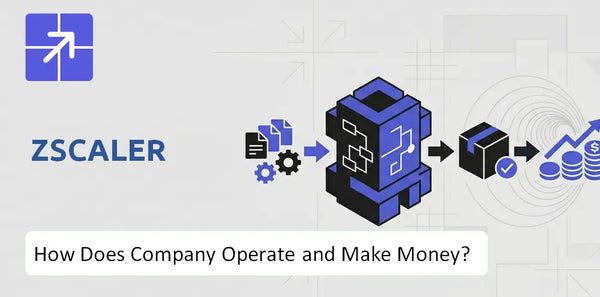
Zscaler earns predictable revenue via per-user, per-month subscriptions and platform add-ons; scale and low capex boost unit economics, so churn and upsell rates are critical operational signals in 2025.
What Does Zscaler Actually Sell?
Zscaler sells the Zero Trust Exchange, a multi-tenant cloud security platform sold by subscription that replaces VPNs and edge appliances. Customers pay for secure internet access, private app access, and digital experience monitoring delivered from the cloud.
 Core Products: Zero Trust Exchange and Subscriptions
Zscaler Internet Access (ZIA) secures web and SaaS traffic; Zscaler Private Access (ZPA) provides zero trust remote access to internal apps; Zscaler Digital Experience (ZDX) measures user performance. Customers buy these as recurring SaaS subscriptions that scale per user, per app, or per GB of inspected traffic.
Who Buys It: Enterprise Security and IT Teams
Large enterprises, regulated industries (finance, healthcare), cloud-first companies, and MSPs purchase Zscaler services. Typical buyers are CISOs, network and cloud architects, and MSP channel partners implementing Zscaler cloud security at scale.
Customer Value: Security, Performance, and Simplified Ops
Zscaler removes the corporate network perimeter, delivering a clean pipe that reduces ransomware/data breach risk and improves cloud app latency – customers report faster Microsoft 365 and AWS access. As of fiscal 2025, Zscaler protects over 8,500 organizations and the SaaS model drives recurring revenue growth and predictable cash flow.
Why It Stands Out: Cloud-Native Zero Trust and Multi-Tenant Scale
Zscaler company differentiates with a cloud-native multi-tenant architecture that replaces appliances, reducing hardware costs and deployment time. The platform integrates threat protection, data loss prevention, and performance telemetry, and is easy to buy via per-user or per-service SaaS pricing – see Growth Outlook of Zscaler Company for strategy and financial context.
Zscaler SWOT Analysis
- Complete SWOT Breakdown
- Fully Customizable
- Editable in Excel & Word
- Professional Formatting
- Investor-Ready Format

How Does Zscaler Run Its Business Day to Day?
Zscaler runs a globally distributed, software-defined security cloud that inspects user traffic at the edge, processes vast telemetry, and pushes policy and threat updates in real time. Daily ops center on a high-touch direct sales model, partner-led distribution, and an engineering-run fabric of >150 data centers that keeps uptime near 99.999% while blocking billions of threats.

Operational Fabric and Control Plane
Zscaler operates a central control plane that configures and monitors a global data plane spanning more than 150 data centers; engineers maintain global policy, telemetry ingestion, and real-time ML-driven signature updates across the fabric.
Product and Service Delivery Flow
Customers subscribe to Zscaler services via SaaS contracts and route traffic to the nearest Zscaler node for inspection; no hardware ships – customers use cloud connectors, agents, or DNS/routing changes to enforce Zscaler zero trust policies.
Development, Data and Threat Intelligence
Product teams continuously develop features, ML models, and threat signatures using telemetry from roughly 450 billion daily transactions; security research and SRE teams iterate on detections and push global updates in real time.
Sales, Partners, and Distribution
Sales rely on a direct enterprise sales force for large deals and a partner ecosystem – global system integrators and telcos (for example Deloitte and AT&T) – to extend reach and integration services for deployments and managed offerings.
Key Assets and Reliability Targets
Core assets include the distributed data centers, ML-enabled threat intelligence, and the multi-tenant software platform; operational SLAs target 99.999% uptime while blocking over 9 billion threats every 24 hours across the Zscaler cloud security fabric.
Why the Model Scales in Practice
The software-defined, edge-first delivery removes hardware constraints, centralizes policy and ML updates for fast global propagation, and monetizes via predictable SaaS subscriptions – this drives efficient scale and recurring revenue for Zscaler business model.
For context on corporate purpose and culture that supports this operating model see Mission, Vision, and Values of Zscaler Company
Zscaler Business Model Canvas
- One-time Payment
- No Research Needed – Save Hours of Work
- Built by Experts, Trusted by Consultants
- Instant Download, Ready to Use
- 100% Editable, Fully Customizable

How Does Revenue Flow Through Zscaler?
Zscaler converts demand into recurring subscription revenue, mainly via per-user and per-workload SaaS contracts. Multi-year deals with upfront collections create large deferred revenue and RPO balances that fund growth.
Main revenue stream: Per-user and per-workload subscriptions
Zscaler earns most revenue through cloud security subscriptions sold per user or per workload, across web security, private access, and data protection modules. This subscription-first model drove the company toward $3.4 billion in annual revenue by early 2026, making cloud security the core monetization engine for the Zscaler company.
Additional revenue streams: Services, add-ons, and channel
Zscaler services – professional services, training, and premium support – plus add-on modules (AI-driven data protection, advanced analytics) and partner channel margins provide secondary revenue. Upsells and partner-led deals increase average contract value as enterprises consolidate onto the Zscaler cloud security platform.
Pricing and monetization model: SaaS subscriptions with upfront billing
Zscaler uses a SaaS subscription model with tiered per-user or per-workload pricing and typical contract terms of one to three years. A significant portion of billings are collected upfront, producing a large deferred revenue pool and Remaining Performance Obligations (RPO) that recently exceeded $5.8 billion.
What drives revenue most: Land-and-expand and net retention
Revenue growth is driven by a land-and-expand strategy: customers start with web security and then add private access or AI data protection, boosting ARPA (average revenue per account). Strong customer economics – net retention around 116% – and multi-year upfront billings sustain predictable growth; see Competitive Landscape of Zscaler Company for context: Competitive Landscape of Zscaler Company
Zscaler Marketing Mix
- Complete Marketing Mix Analysis
- Effortlessly Communicate Your Business Strategy
- Investor-Ready Format
- 100% Editable and Customizable
- Clear and Structured Layout

What Makes Zscaler's Model Sustainable or Fragile?
Zscaler's model is sustainable through entrenched technical switching costs and AI-driven threat intelligence, yet fragile from aggressive SASE moves by legacy vendors and reliance on large IT budgets sensitive to macro cycles. Structural strengths include data scale and global routing; risks include competition, price pressure, and hyperscaler commoditization.
High switching costs create a durable moat
Data scale and AI-driven security advantage
Zscaler processes roughly ~0.5 trillion daily transactions (industry-cited scale), feeding machine-learning models that improve threat detection and reduce false positives, a capability hardware-based rivals and many newcomers struggle to match.
Concentration on large enterprise IT budgets
Zscaler revenue streams depend heavily on large-enterprise SaaS subscription contracts and renewal cycles; macro downturns or IT budget cuts can materially slow sales and elongate sales cycles for Zscaler services and pricing and plans.
Competitive pressure from legacy and hyperscale providers
Palo Alto Networks and Fortinet have pivoted into SASE bundles and aggressive pricing, while hyperscalers can embed basic cloud security into IaaS – both trends threaten margin compression and potential commoditization of Zscaler cloud security offerings.
Partner ecosystem and technical integration
Zscaler's partner ecosystem, channel strategy, and integrations with identity providers and SIEMs accelerate deployments, raising adoption velocity for Zscaler zero trust architectures and making the platform stickier across enterprise stacks.
Durability outlook for 2025/2026
Professional judgment for 2025/2026 rates Zscaler as a premier growth asset with an adjusted operating margin near 22%; resilience hinges on continuous AI-driven innovation in threat hunting to sustain premium valuation and fend off commoditization by hyperscale cloud providers. See Ownership and Control of Zscaler Company for governance context: Ownership and Control of Zscaler Company
Zscaler Boston Consulting Group Matrix
- Built by Experts, Trusted by Consultants
- Structured for Consultants, Students, and Founders
- 100% Editable in Microsoft Word & Excel
- Instant Digital Download – Use Immediately
- Compatible with Mac & PC – Fully Unlocked

Related Blogs
- What Is the History of Zscaler Company and How Did It Evolve?
- What Is the Competitive Landscape of Zscaler Company and How Does It Compete?
- What Is the Growth Outlook of Zscaler Company and Where Is It Heading?
- How Does Zscaler Company Reach Customers and Turn Demand into Sales?
- What Do the Mission, Vision, and Core Values of Zscaler Company Reveal?
- Who Are the Core Customers in Zscaler Company's Target Market?
- Who Owns Zscaler Company Today and Who Holds Control?
Frequently Asked Questions
Zscaler sells the Zero Trust Exchange, a cloud security platform delivered by subscription. Its core offerings include Zscaler Internet Access for web and SaaS traffic, Zscaler Private Access for internal apps, and Zscaler Digital Experience for performance monitoring. Customers buy these as recurring SaaS services that scale by use.
Disclaimer
All information, articles, and product details provided on this website are for general informational and educational purposes only. We do not claim any ownership over, nor do we intend to infringe upon, any trademarks, copyrights, logos, brand names, or other intellectual property mentioned or depicted on this site. Such intellectual property remains the property of its respective owners, and any references here are made solely for identification or informational purposes, without implying any affiliation, endorsement, or partnership.
We make no representations or warranties, express or implied, regarding the accuracy, completeness, or suitability of any content or products presented. Nothing on this website should be construed as legal, tax, investment, financial, medical, or other professional advice. In addition, no part of this site - including articles or product references - constitutes a solicitation, recommendation, endorsement, advertisement, or offer to buy or sell any securities, franchises, or other financial instruments, particularly in jurisdictions where such activity would be unlawful.
All content is of a general nature and may not address the specific circumstances of any individual or entity. It is not a substitute for professional advice or services. Any actions you take based on the information provided here are strictly at your own risk. You accept full responsibility for any decisions or outcomes arising from your use of this website and agree to release us from any liability in connection with your use of, or reliance upon, the content or products found herein.